1839-O 50C GR-1, RPM MS(PCGS#531106)
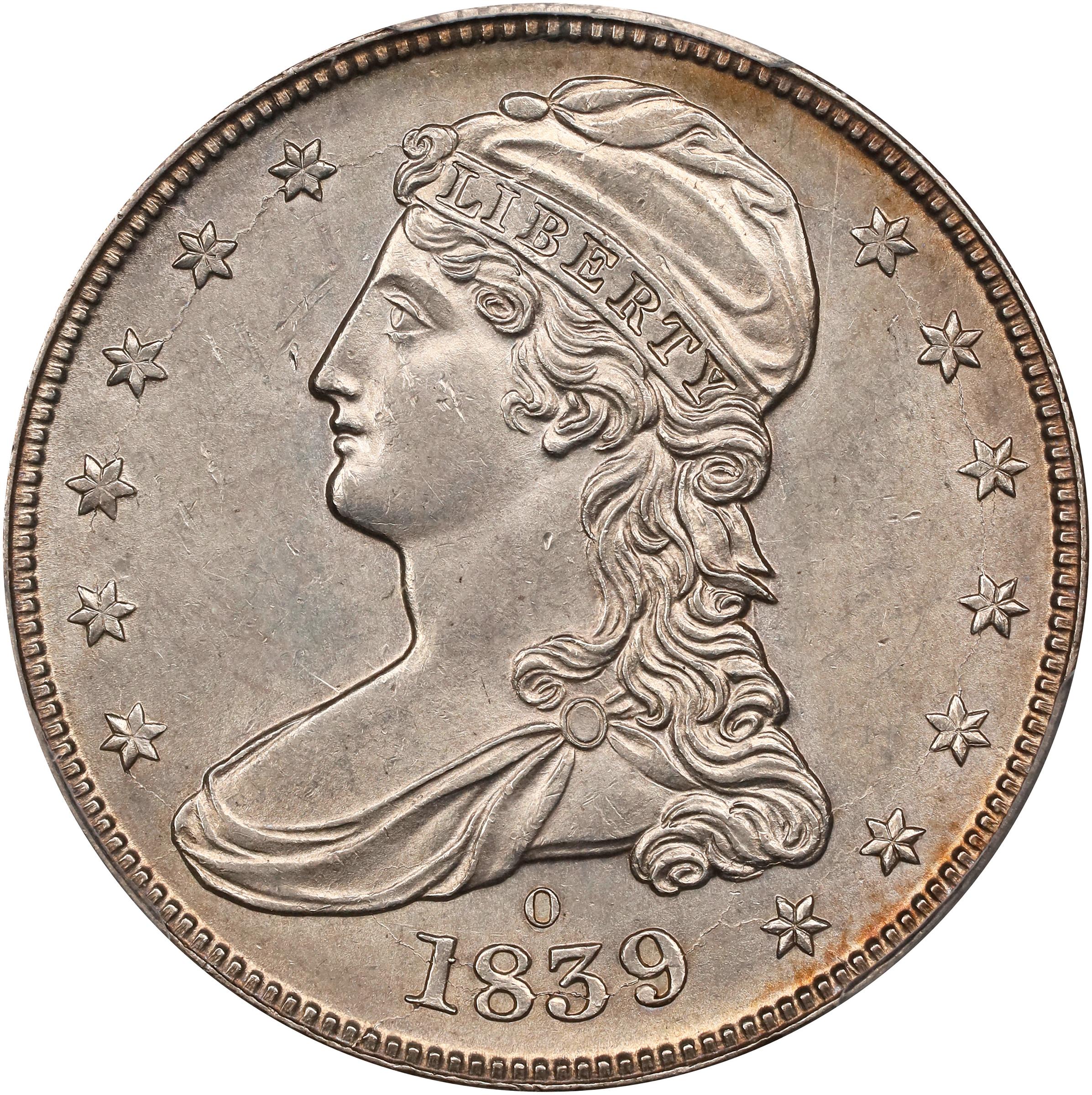
1839-O 50C GR-1, RPM MS (PCGS#531106)
Summer 2025 Global Showcase Auction U.S. Coins
- Auctioneer
- Stack's Bowers
- Lot Number
- 3072
- Grade
- MS61
- Price
- 11,400
- Lot Description
- This is an issue that we seldom offer in certified Mint State preservation. The present example is minimally toned in champagne-pink iridescence, the color a tad more pronounced on the obverse, but both sides presenting as brilliant at most angles. Soft satin luster is appreciable under a light, providing additional visual appeal. Faint hairlines are noted for accuracy, but there are few sizable marks. The strike detail is universally sharp to full throughout the design.<p>This issue is the second on which the New Orleans mintmark appeared on the obverse of the half dollar, the first of course the extremely rare 1838-O half dollar. The 1839-O is the only realistically obtainable mintmarked half dollar of the Capped Bust design type as far as most collectors are concerned, although we stress that most survivors are heavily worn, impaired, or both. This is a condition rarity Mint State survivor that will appeal to advanced collectors.<p>The 1839-O half dollar was first described in print six years after its production, in a work on counterfeit detection by Dr. John L. Riddell, the melter and refiner of the New Orleans Mint. Appointed to a position at the Mint at the end of 1839, Riddell wrote and illustrated <em>A Monograph of the Silver Dollar, Good and Bad</em> from the deposits that arrived daily at the New Orleans Mint. An inventor, a chemistry professor, and an adventurer, Riddell's creativity and skill were put to use in his production of "metal types adapted for printing, indirectly from the coins themselves." By casting the coins he found into printing blocks made of type metal, the illustrations in Riddell's work are still detailed enough to be useful to numismatists 180 years later. While Riddell illustrated no genuine New Orleans Mint half dollars of this type, neither this date nor its rare predecessor, by 1845 he had already encountered three different varieties of counterfeit 1839-O half dollars. Two of the counterfeits were crudely struck from handmade dies, while the other was cast from a genuine coin in "an alloy like type metal with copper," similar to what is called German silver today.