1796 50C O-102 MS(PCGS#39262)
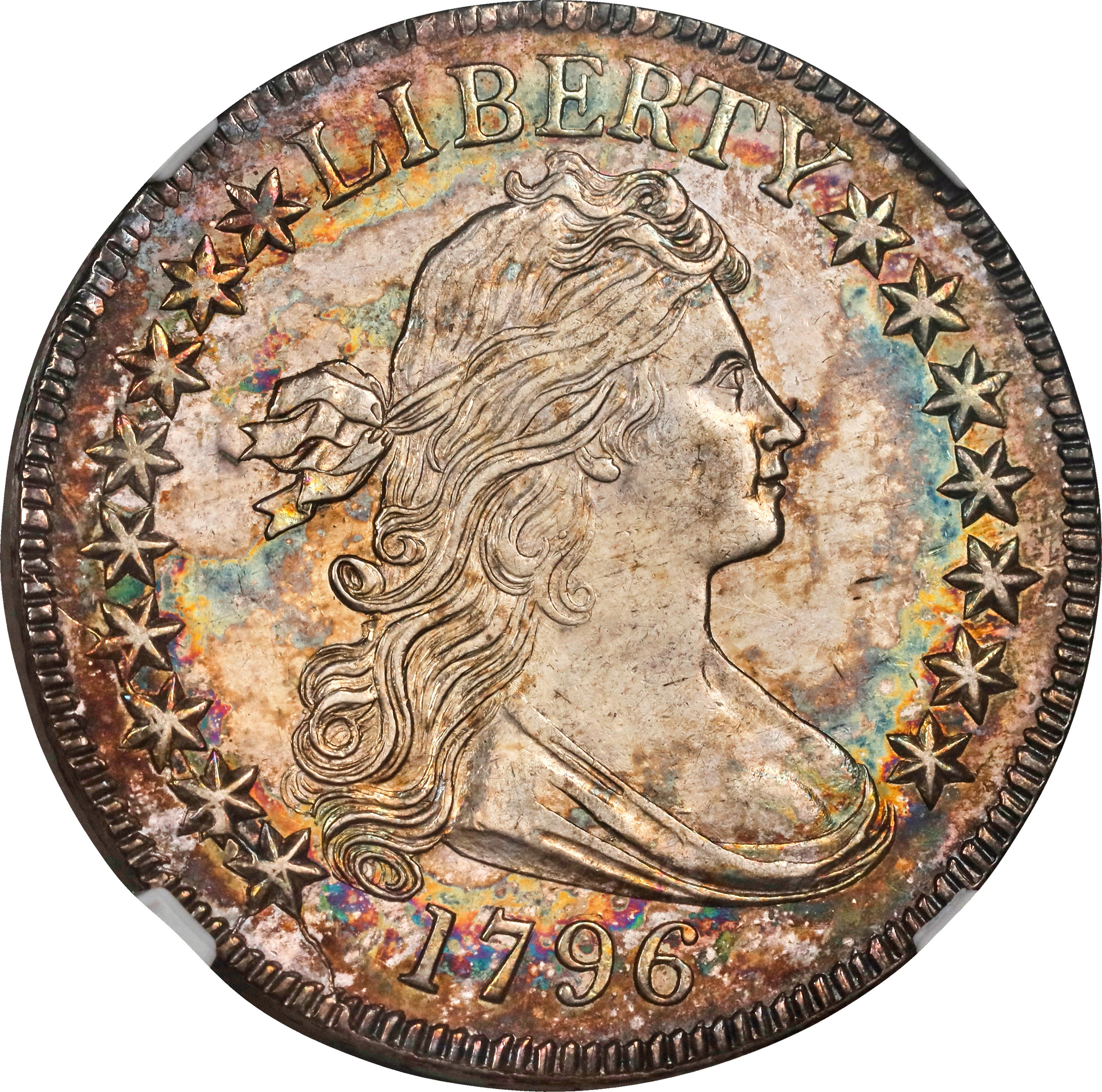
1796 50C O-102 MS (PCGS#39262)
Summer 2026 Global Showcase Auction U.S. Coins
- Auktionator
- Stack's Bowers
- Losnummer
- 2086
- Erhaltungsgrad
- MS63
- Preis
- 671.000
- Losbeschreibung
- Amato-Unlisted. Tompkins Die Stage 5/3. Here is a splendid 1796 half dollar, a premium Select Mint State example of one of the rarest and most desirable silver design types in the entire American series. Similar in appearance to the "Col." Green-Newman 1796 O-101 half dollar offered above, this album-toned beauty was obviously stored in the same way for many decades. Both sides are splashed with mottled reddish-russet, olive-copper, cobalt blue and champagne-pink iridescence with the boldest colors confined to the peripheries. The strike is ideally centered and boldly to sharply executed throughout, a touch of softness to the high points of the eagle at central reverse characteristic of this challenging type. A shallow planchet void on Liberty's cheek is as made - a particularly useful identifier for provenance purposes - and while light handling marks after present to help define the MS-63 grade, none are singularly distracting during in-hand appreciation. Luster is full with a strong frosty to semi-reflective finish that shines forth powerfully as the coin rotates under lighting.<p>A monument of American expansion, the 1796 16 Star half dollar represents a key moment in our history, when the United States finally had too many states to continue to symbolize each of them with an obverse star. Tennessee joined the Union as the 16th state on June 1, 1796. There would be no 17 Stars half dollar, nor any other denomination, upon the admission of whatever state that would be (Ohio, as it turned out, in 1803). A new procedure was not settled upon immediately: half dimes of 1797 would be struck with 16 stars, 15 stars, and 13 stars; the latter became the new standard. Dimes and half eagles of 1797 likewise showed this transition, with dimes made in both 16-star and 13-star varieties, while half eagles were coined with obverses that showed either 15 or 16 stars. Half dollars depicted 15 stars in 1797 before adopting the new 13-star standard when the next half dollars were struck in 1801. That new standard caught on last with the dollar denomination, which used both 15-star and 13-star alignments as late as 1798, before adopting a standard 13-star obverse for all issues thereafter.<p>The 1796 O-102 variety is the scarcest in the Draped Bust, Small Eagle half dollar series with Very Fine representing the median grade among survivors. The remarkable "Col." Green-Newman specimen offered here is a legendary condition rarity in NGC/CAC MS-63. Although it is not listed in the extensive census published by Jon P. Amato in his 2012 reference <em>The Draped Bust Half Dollars of 1796-1797</em>, it has since become one of the most celebrated examples of both the type and die pairing. It is an important coin that would do equally well in an advanced type collection or specialized early half dollar variety set.