1878 $5 J-1570, CAM PR(PCGS#861933)
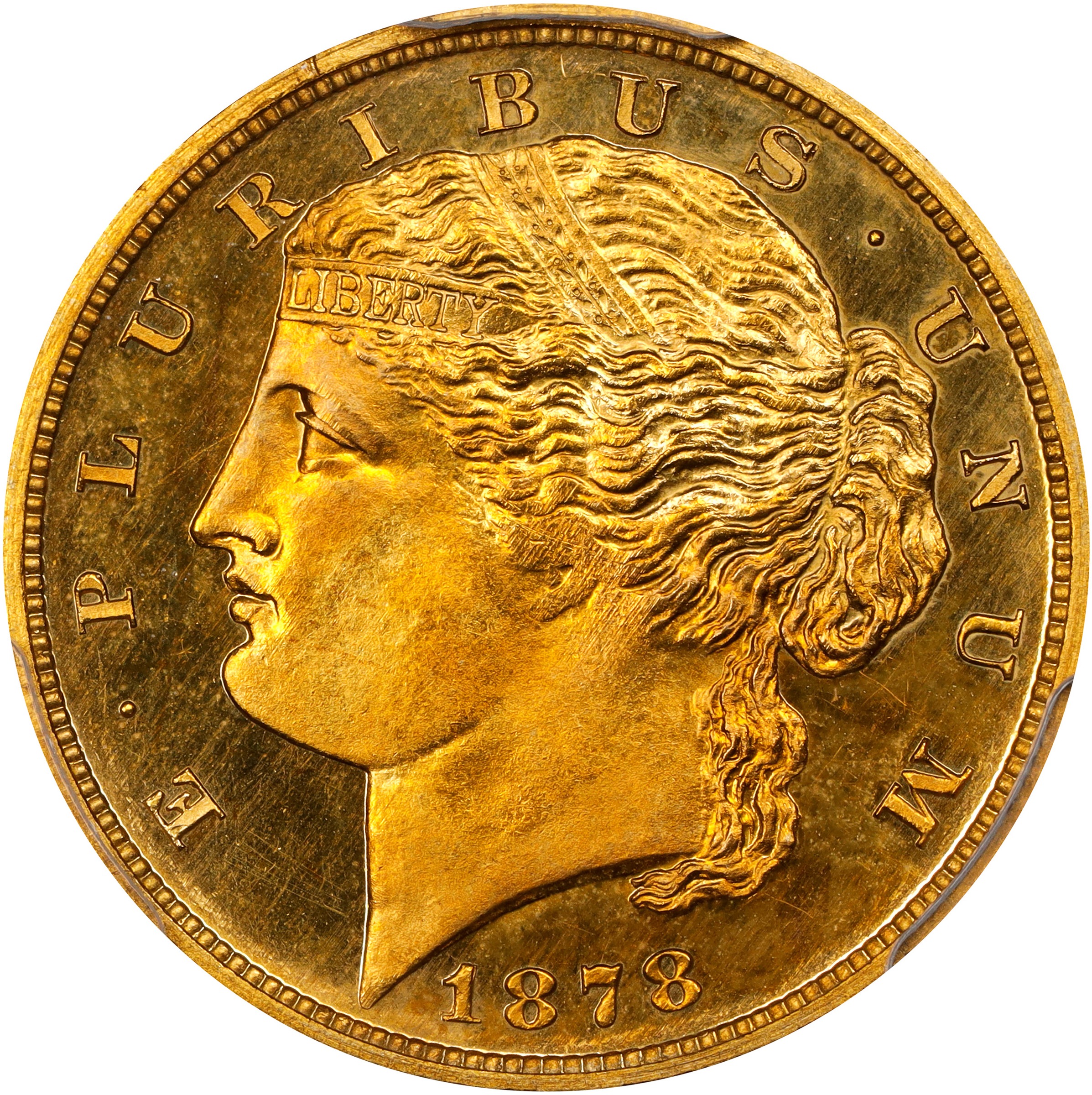
1878 $5 J-1570, CAM PR (PCGS#861933)
Summer 2026 Global Showcase Auction U.S. Coins
- Auktionator
- Stack's Bowers
- Losnummer
- 2596
- Erhaltungsgrad
- PR65+CAM
- Preis
- 512.400
- Losbeschreibung
- <strong>Obv:</strong> A head of Liberty faces left with the motto E PLURIBUS UNUM around the border and the date 1878 below. Liberty's hair is tied in a bun, and a band extending back from the forehead is inscribed LIBERTY. The point of the truncation just misses touching the border before the date, and there are pellets punctuating the motto. <strong>Rev:</strong> An eagle with spread wings clutches an olive branch in its right talon and three arrows in its left. The motto IN GOD WE TRUST is in the field immediately above the eagle, the legend UNITED STATES OF AMERICA lines the upper border, and the denomination expressed as FIVE DOL. is at the lower border. The diameter is larger than that of the contemporary regular issue half eagle (25.5 mm vs. 21.6 mm), but it is correspondingly thinner. A marvelous Gem with a gentle mottling of pale silver iridescence to otherwise warm, vivid, olive-orange color. Direct lighting calls forth brighter sunset-orange and golden-wheat undertones - very attractive. The finish is nicely cameoed and contrasts frosty motifs with reflective fields. Boldly struck, expertly preserved, and of the utmost significance.<p>This pattern type is attributed to George T. Morgan, and it was produced in accordance with the ideas on anti-counterfeiting introduced by Dr. J.T. Barclay on the 1860 Judd-271 pattern half eagle. Barclay believed that the most dangerous and difficult to detect method of counterfeiting U.S. gold coins was to hollow out the inner gold core and replace the extracted metal with an equal amount of platinum, a less valuable metal than gold at the time, but one which weighed about the same. It was thought that coins struck on thinner planchets would be more difficult to hollow out, thus making this method of counterfeiting less attractive. The Mint abandoned the idea in 1860, after only a few experimental pieces were struck. The attempt in 1878 met with the same fate, likely because the thinner coins proved difficult to produce in the same manner as the regular issue Type II gold dollars of 1854 to 1856.<p>The Judd-1570 gold striking is a legendary rarity. It is the only specimen in this metallic composition that combines Morgan's second obverse design of this type, with pellets punctuating the Latin motto, with the IN GOD WE TRUST/FIVE DOL. reverse. It is identifiable by a thin, faint, staccato-like hairline in the lower left reverse field, slanting up from the border toward the eagle's right wing. This type is usually represented by copper strikings, Judd-1571, although that attribution is rare in its own right with only about half a dozen known. To simulate the unique gold specimen, some of the copper pieces have been gilt. There is no substitute for the real thing, however, and Judd-1570 is it - the unique gold striking from these dies and a rare artifact of a failed Mint initiative to combat counterfeiting in the 19th century.