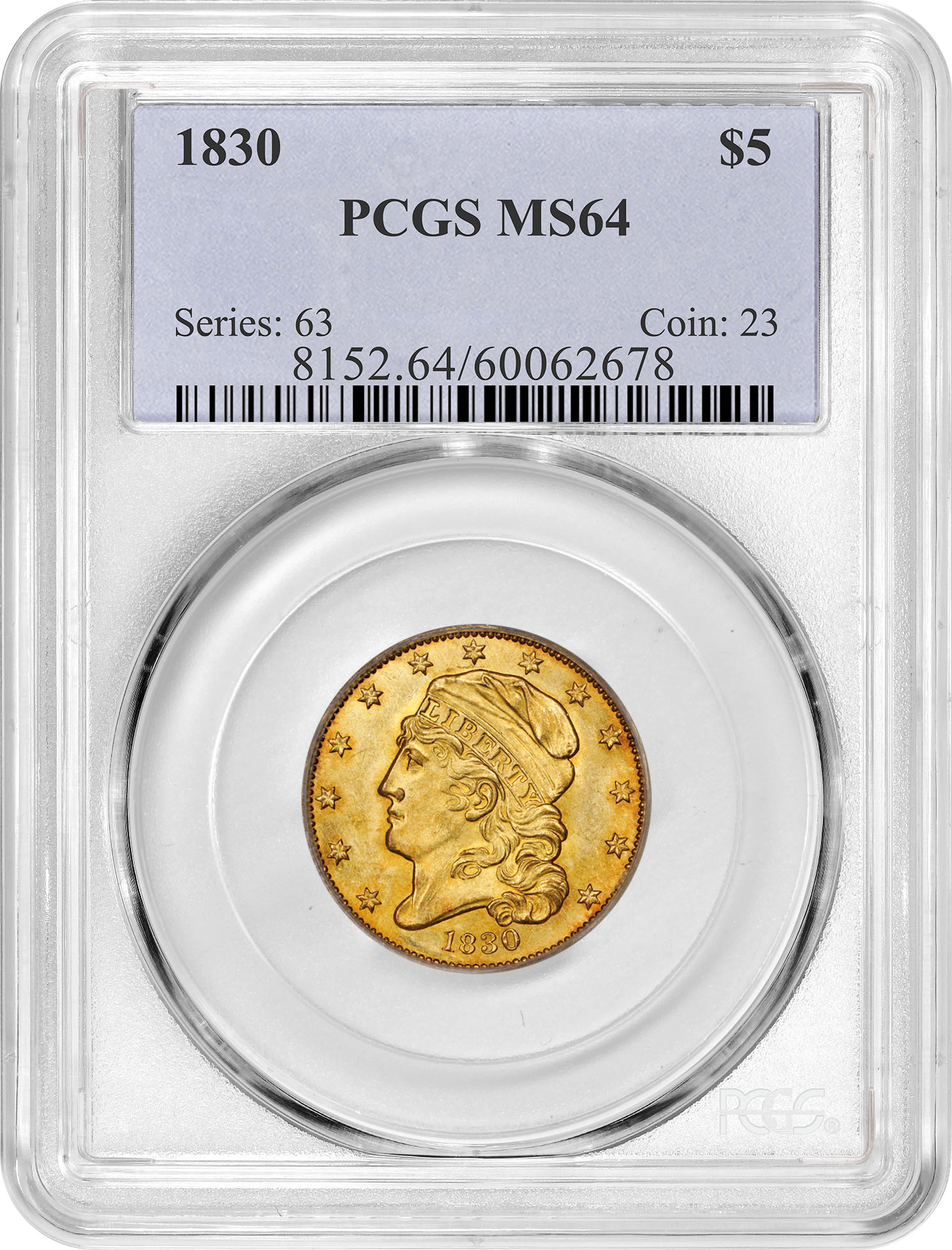
Early United States gold coins are an area of American numismatics that appeal to so many but are obtainable only by but a few. When the United States Mint began striking gold coins in 1795, gold supplies were scant, and the nation had yet to see any domestic “gold rushes,” with the first at the dawn of the 19th century in the southern foothills of the Appalachians.
In the late 1830s, the United States Mint situated some of its first branch facilities near these gold deposits, constructing mints in Charlotte, North Carolina, and Dahlonega, Georgia – as well as farther southwest in New Orleans, where gold coins were also struck. Leading up to the boom of U.S. gold coinage during the latter 1830s and into the 1840s, specie containing the yellowish precious metal was produced in only relatively small quantities. Making matters all the harder for the collector of today? Most of these early U.S. gold coins were lost to the hands of time – smelted for their bullion content, worn to oblivion by the demands of circulation, permanently damaged by stints in jewelry mountings, or buried and forgotten by souls now forever gone.
Early U.S. gold coins that remain undamaged and problem free are rare numismatic gems, regardless of grade or pedigree. Find any U.S. gold coin struck before the waning years of the 1830s, and you’ve found a real treasure, a traveler from yore that somehow managed to escape the unforgiving hands of time’s passage. Yet, that alone isn’t what makes this 1830 Capped Bust Half Eagle special. To understand its true rarity, one must peel back the layers of a coin whose mintage was officially reported as 126,351 but, in today’s reality, is known to be far rarer.
There are two types of 1830 Capped Bust Half Eagles: The Small 5D and Large 5D. The “D” in this case refers to the “D” of “DOLLARS,” which is inscribed next to the number “5” on the reverse to indicate the coin’s denomination. Both the Small 5D and Large 5D varieties are rare, but the Large 5D is the rarer of the two. PCGS estimates only 30 to 35 specimens exist, mostly in the XF to AU range. Mint State specimens are exceedingly rare, with PCGS having graded just three at that level, including this MS64 specimen.
This impeccable example is part of the renowned Chicago Collection, assembled by well-known collector Howard Sharfman. His cabinet of early U.S. quarter eagles, half eagles, and eagles has been carefully curated by numismatic stewardship that sought only coins of the finest eye appeal and surface quality.
According to Brian Kendrella, president of Stack’s Bowers Galleries, “This collection comprises 53 coins of the highest caliber that individually would be considered highlights in most collections. We are excited to present The Chicago Collection as part of our Summer 2025 Global Showcase Auction in August where we are An Event Auctioneer Partner of the ANA World’s Fair of Money. We invite your participation as a bidder or a consignor.”