Concerns over the big costs of making small-denomination coins like one cent coins is nothing new. As early as 1837, the rising cost of making pennies led an enterprising physician and metallurgist named Lewis Feuchtwanger to strike a run of small tokens made from German silver (60% copper, 20% nickel, and 20% zinc – no actual silver) denominated at one cent. The so-called Feuchtwanger Cents of 1837 were never official legal tender, but they filled a void during a shortage of small change.
Feuchtwanger pitched his small cents to Congress as a lower-cost solution for making pennies, but lawmakers declined to move forward with them. In 1849, the large cent became a candidate for the chopping block as copper prices rose due to demands from the growing railroad industry.
By 1850, with copper prices soaring and large cents unpopular with much of the public, New York Senator Daniel S. Dickinson proposed a bill requiring cents to be made from a copper-silver alloy known as billon. These coins would be made with a hole in the middle, reducing the weight of the coin. Experimental versions of the coin were difficult for the mint to produce and weren’t well liked by those who saw them. Dickinson’s legislation didn’t go very far.
Still, copper prices persisted upward as the decade wore on. Small, base-metal patterns approximately the width of a dime came along in 1853. Among the compositions were nickel and an alloy known as “French bronze,” containing 95% copper and 5% tin and zinc – a composition the U.S. Mint would eventually use for nearly 120 years in the one-cent coin. United States Mint Director James Ross Snowden threw his hat in support of small-size small cents. Patterns emerged in 1854 and 1855 carrying Liberty Seated and Flying Eagle motifs by Christian Gobrecht.
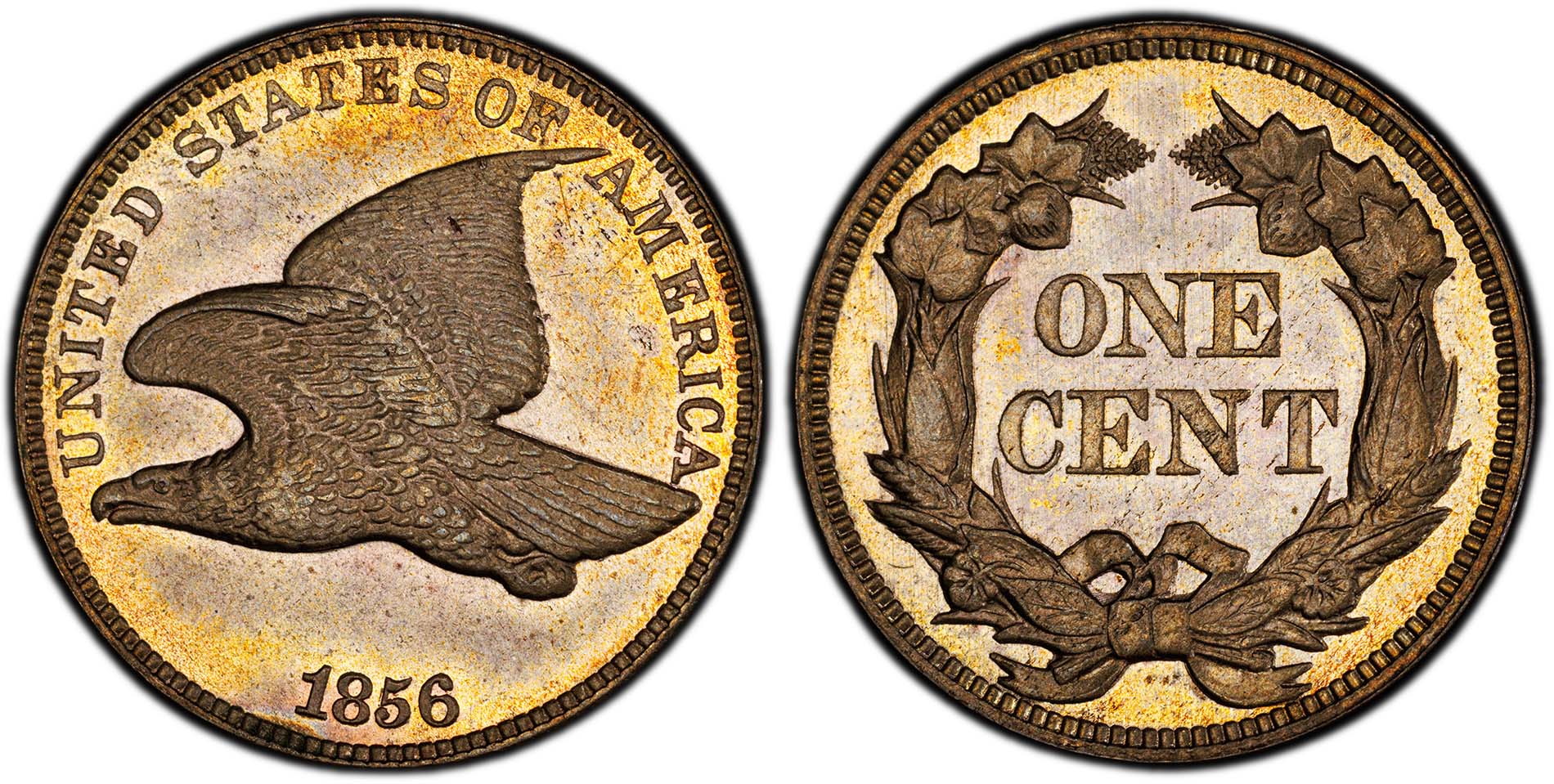
As legislation was hammered out to authorize the new small cents, Mint Director Ross Snowden and Mint Melter and Refiner James Curtis Booth perfected the coin’s eventual composition – an alloy of 88% copper and 12% nickel. Meanwhile, Chief Engraver of the United States Mint James Longacre was tasked with designing the patterns. He employed a flying eagle design in 1856, and several hundred examples of his new penny were struck. President Franklin Pierce and members of Congress were among the recipients of the new coins, which were well liked by many who saw them.
On May 25, 1857, the United States Mint officially released the Flying Eagle Cent into circulation. Though the Flying Eagle Cent lasted only two years (three if counting the 1856 pattern), the series yielded some intriguing options for collectors. The 1856 pattern ranks chief among these, with examples even in G4 taking $8,000. The 1857 and 1858 dates are far more common, but the 1858 issue saw a handful of important varieties that include iterations with either large or small letters as well as a so-called 1858/7 overdate, which shows the last “8” in the date stamped over remnants of a “7.” Generic examples of the 1857 and 1858 Flying Eagle Cents in moderately worn grades sell for between $50 and $100.