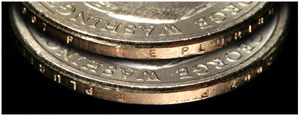
If you have ever spent much time researching Presidential Dollars, Native American Dollars, or American Innovation Dollars, you may have noticed that some are cataloged as “Position A” while others are known by the nomenclature “Position B.” What do Position A and Position B mean on these “Golden” Dollar coins anyway? It all comes down to the orientation of the lettered edges on these coins.
This is how PCGS defines Position A versus Position B on dollar coins:
- POSITION A - Edge lettering reads upside-down when the president's portrait faces up.
- POSITION B - Edge lettering reads normally when the president's portrait faces up.
PCGS initially announced this information back in 2007, when it applied only to the then-newly released Presidential Dollars. Similar edge lettering has been used on the Native American Dollars and American Innovation Dollars that have come along since. Thus, PCGS has parlayed these edge-lettering definitions to these more recent additions to the U.S. Mint lineup.
In general, neither Position A nor Position B is the rarer, as the edge lettering is usually applied to the coins in a separate process after they have been struck by the obverse and reverse dies. The application of edge lettering is random, with about one half of a given production run receiving edge lettering in the Position A orientation and the other half seeing Position B.
The reason PCGS chose to use the Position A and Position B terms is multifold. The variance in edge-lettering orientation is a bona fide variety worthy of recognition and attribution; recognition ensures the collector that either orientation is mint-made and correct, and other coins with edge lettering have been cataloged in a similar fashion. PCGS attributes Position A and Position B status on a coin for no extra charge beyond the usual submission and grading fees.