1787 NJ 1/2P Camel Head, Maris 56-n, BN MS(PCGS#767837)
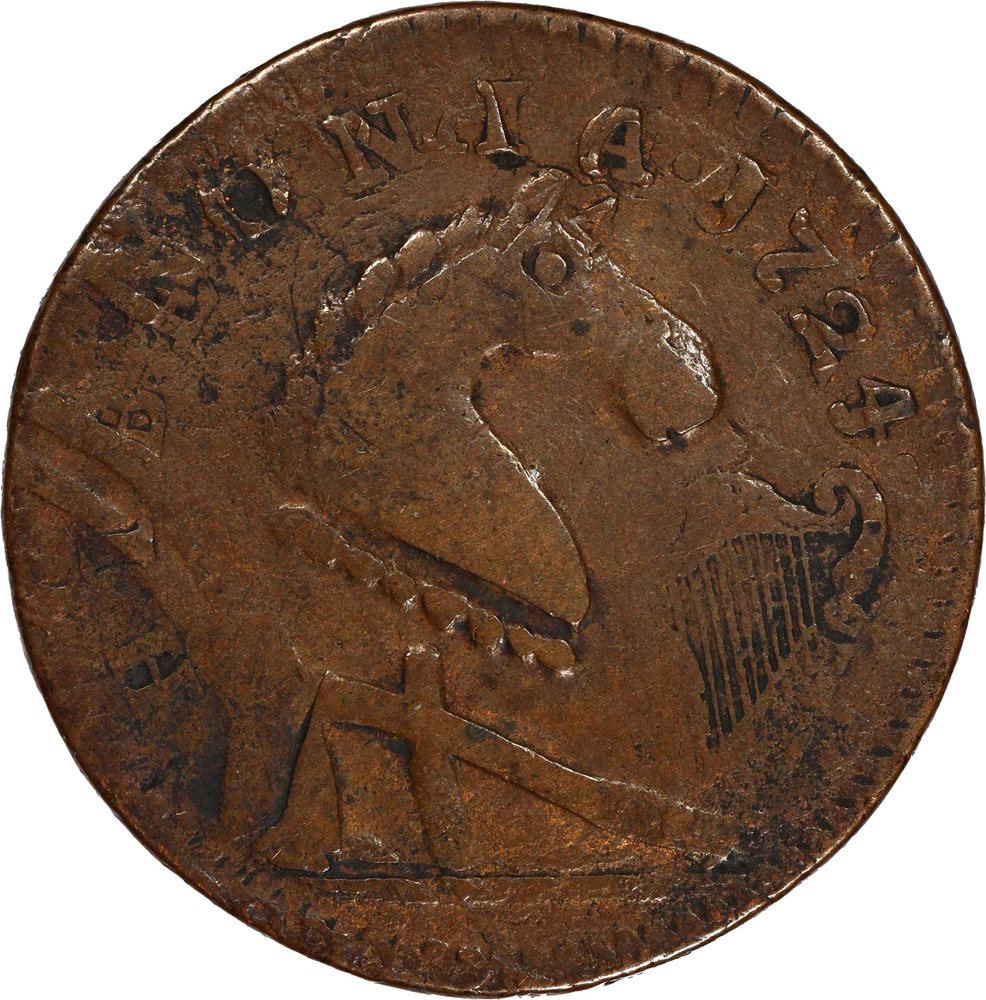
1787 NJ 1/2P Camel Head, Maris 56-n, BN MS (PCGS#767837)
The Summer 2022 Global Showcase Auction U.S. Coins
- Auctioneer
- Stack's Bowers
- Lot Number
- 8112
- Grade
- VF25BN
- Price
- 16,800
- Lot Description
- The Ultimate Syd Martin Maris 56-n Overstrike Struck on a 1724 Wood's Hibernia Halfpenny Unique 1787 New Jersey Copper. Maris 56-n, W-5310. Rarity-1. Camel Head--Overstruck on a 1724 Wood’s Hibernia Halfpenny, Martin 4.67-K.3--VF-25 (PCGS). 101.7 grains. 26.3 mm. Perhaps the most important and evocative Camel Head overstrike there is, certainly the one that meant the most to Syd. It was cataloged at the time he acquired it as "1787 NJERSY -- New Jersey Copper, Camel Head Overstruck on HIB 1/2P -- VF30 NGC. NGC Census: (2/12). PCGS Population: (11/41)." Fortunately Syd recognized its rarity, its importance, and its provenance - in fact, he had been looking for this exact coin for years! Nearly five years before this coin turned up at auction, Syd published a short piece in the Fall 2013 issue of the C4 Newsletterentitled "Wood's Hibernia as Undertype for NJ Copper." It read, in full: "A WOOD'S HIBERNIA AS AN UNDERTYPE FOR A NEW JERSEY COPPER "As you know, I am quite interested in the coinage of William Wood. While perusing old catalogues, I came across an interesting lot. The auction I was reviewing is: Mason & Co.; The Fewsmith Cabinet of Foreign and American Silver and Copper Coins, Medals, Etc. Etc.; Leavitt, Strebeight & Co. Auctioneers; 4 October 1870; Lot 2156. The description is: Lot 2156. 1724; New Jersey Cent; double strike; struck over a Wood half penny; date very distinct; horse head in left of field; harp in right; rev., "E. Plurib - Dei Gratia Rex" good; very rare. "My annotated copy of this auction indicates that the lot was purchased by "Ashborn" for $.30. I'd love to know the location of this coin today!" Sometimes, when you're the expert, the coin finds you. After nearly a century and a half of anonymity, this coin turned up, looking as magnificent as we could have ever expected. The 1724 date of the undertype is complete, positioned just right of 12:00 along the obverse periphery. The harp is intact and bold in the right obverse field, in front of the horsehead, and HIBERNIA is barely interrupted by the NOVA that appears between HIB and the end of the word. The New Jersey obverse's alignment towards 6:00 allows for a bold arc of denticles from the undertype to frame the upper periphery of that side. On the reverse, as cataloged in the 1870 Fewsmith sale, the legend essentially reads E PLURIB DEI GRATIA REX, and the profile of George I is outlined completely within the shield of the New Jersey, making for an incredible and satisfying visual display. The surfaces are light brown and attractive, with no significant problems but for a bit of granularity from pre-existing texture on the undertype. Aside from being so eye-catching, aside from its unique stature, and aside from its ancient provenance and providential reappearance, this piece provides insight into the circulation of Wood's Hibernias that no other evidence - in metal or on paper - does. We know of the circulation of Wood's coinage in America from diverse sources: documentary, archaeological, etc. Those sources are well-covered in Syd's The Hibernia Coinage of William Wood (1722-1724). Chapter 5 in the book is entirely devoted to the question of American circulation of Wood's coinage. Syd's well-researched presentation was written prior to his discovery of this coin, either from its 1870 auction appearance or its modern rediscovery, so it is necessarily silent on overstrike evidence - without this coin, there simply is none. But this coin proves not only that Wood's coinage was circulating in the New Jersey and New York region (a fact that we already knew from archeological and metal detector evidence), but that these coins were still encountered in typical pocket change as late as the era leading up to the Copper Panic of 1789. It's a fascinating and important data point, one that numismatists simply wouldn't have if this coin had remained anonymous and unappreciated. Provenance: From the Sydney F. Martin Collection. Earlier from Ebenezer Locke Mason's sale of the William Fewsmith Collection, October 1870, lot 2156; Heritage's January 2018 FUN Signature Auction, lot 7030. PCGS# 767837. Click here for certification details from PCGS. Image with the PCGS TrueView logo is obtained from and is subject to a license agreement with Collectors Universe, Inc. and its divisions PCGS and PSA.