1870-S G$1 MS(PCGS#7570)
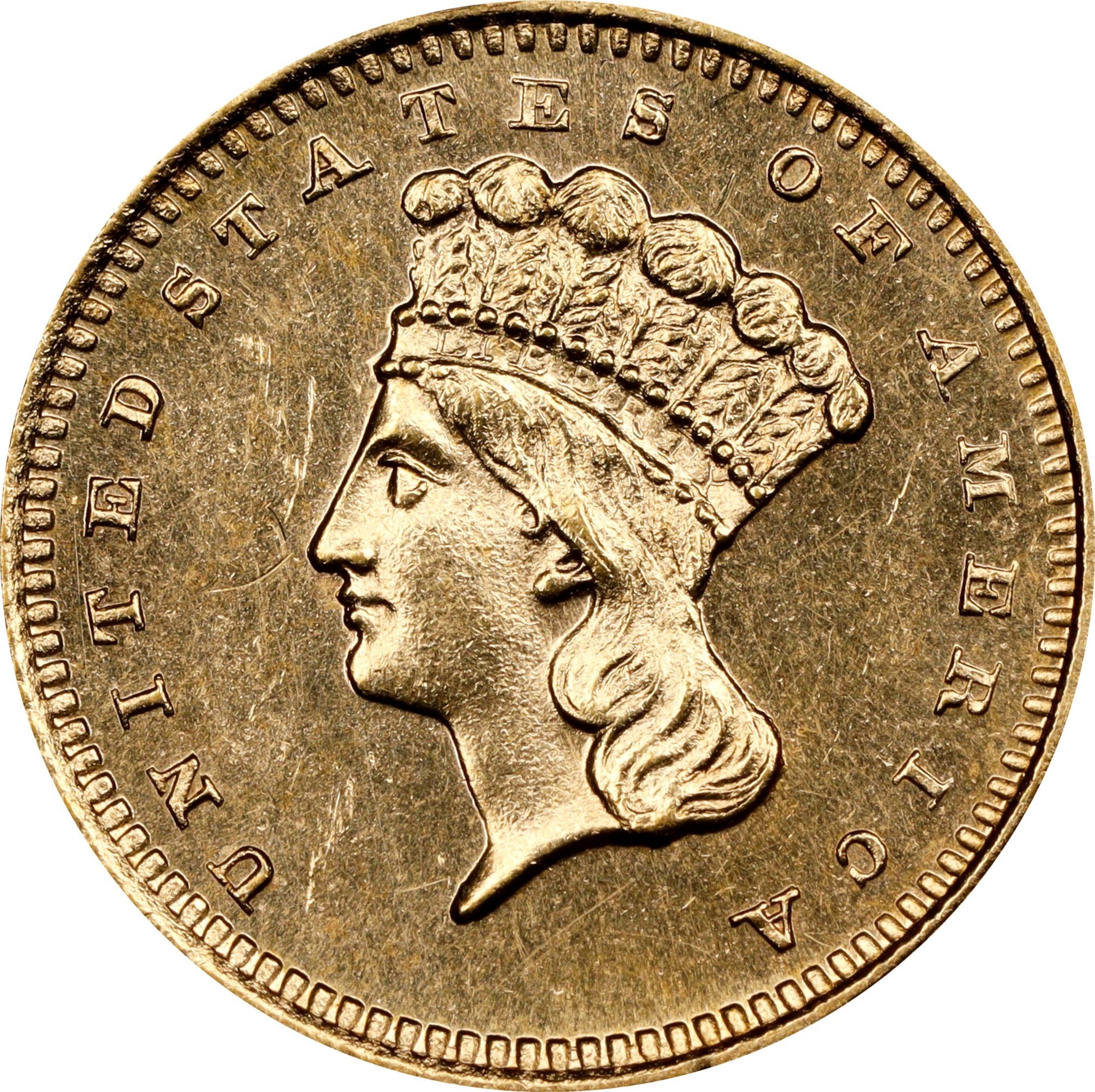
1870-S G$1 MS (PCGS#7570)
February 2026 Showcase Auction - The James A. Stack, Sr. Collection Part II
- Auctioneer
- Stack's Bowers
- Lot Number
- 23003
- Grade
- MS62
- Price
- 4,920
- Lot Description
- The beautiful surfaces of this Mint State gold dollar glow with strong luster in a frosty to semi-reflective finish. Both sides are enhanced by vivid honey-gold color that brightens to a more wheat-gold appearance in direct lighting. Fully struck and crisp with only faint, singularly inconspicuous handling marks precluding a higher grade.<p>The various 1870-S issues across all denominations have long been popular with both numismatists and non-collectors, for this was the year the cornerstone of the new San Francisco Mint (affectionately known as "The Granite Lady") was laid at Fifth and Mint streets, between Market and Mission. This event, which took place on May 25, is widely regarded as the catalyst for creation of several celebrated rarities in the U.S. Mint series, namely the 1870-S half dime, 1870-S quarter dollar, 1870-S silver dollar, and 1870-S three-dollar gold piece, none of which are mentioned in the Mint Director's annual report for 1870.<p>Although the 3,000-coin mintage for the 1870-S gold dollar is included in the Mint Director's report, establishing it as a regular issue, one example of this denomination was produced for placement in a time capsule with other items in a cavity in the foundation below the cornerstone of the new mint building. An exhaustive search of official San Francisco Mint records at San Bruno, California, and the National Archives in College Park, Maryland by Nancy Y. Oliver and Richard G. Kelly turned up a purchase warrant for $49.60, dated June 1, 1870, signed by Clerk W.F. Tracy, and verified by San Francisco Mint Chief Coiner Joseph B. Harmstead. The warrant included a 12.5% premium for exchanging precious metal coinage with currency, as well as an itemized list of coins purchased: one example of each of the gold and silver denominations struck by the San Francisco Mint in 1870, including the gold dollar, as well as the four denominations not listed in the Mint Director's report. These coins are still presumed to be ensconced in the foundation of "The Granite Lady."<p>Most other 1870-S gold dollars, of course, followed the usual paths into circulation for which they were intended. For while the denomination had lost much of its general function in commerce in the East and Midwest, it continued to see use out West. As it turned out, however, the 1870-S was the last circulating gold dollar issue of the San Francisco. (Dies were prepared for an 1871-S issue in December of 1870, but went entirely unused.) The facility had produced only four others of the Type III design - 1857-S, 1858-S, 1859-S, 1860-S - which were preceded by the 1854-S Type I and the 1856-S Type II. While Californians and others in the American West had been petitioning the San Francisco Mint to provide more smaller denomination coinage since its opening, the gold dollar clearly benefited little from these calls, and what use it did see out West beginning in the 1850s was clearly limited.<p>In fact, by 1870 the gold dollar was probably more popular for use in jewelry than as circulating specie, and even in the West, where the privately produced small denomination gold "coins" (at this point better classed as tokens) were also increasingly looked upon for the former purpose. The laying of the cornerstone for the second mint building further increased demand for 1870-S gold dollars as souvenirs, as Q. David Bowers explains in the 2011 edition of his <em>Guide Book of Gold Dollars</em>:<p><em>The 1870-S dollars were a popular curiosity in circulation in San Francisco in the 1870s and 1880s, and jewelers and others kept an eye out for them, resulting in many being saved. Quite a few were employed in the making of pins, brooches, etc.</em><p>Even most examples that were not used in jewelry had already acquired wear from limited commercial use when they were set aside as keepsakes. Today, the typical 1870-S grades EF or AU, at which levels the issue is scarce; Bowers accounts for only 90 to 120 survivors in all circulated grades. True Mint State examples with problem free surfaces are rare with fewer than 100 believed extant. At the assigned grade level, the James A. Stack, Sr. specimen is an exceptionally attractive example of this historically significant and widely popular San Francisco Mint issue.<p>Since "The Granite Lady" did not open for coinage until late in 1874, the mintage of 1870-S gold dollars was achieved at the San Francisco Mint's first location at 608-610 Commercial Street, previously the offices of highly regarded private coiners Moffat & Company. The fascinating history of the first San Francisco Mint is told by Nancy Y. Oliver and Richard G. Kelly in their 2014 book <em>The Inconspicuous Gold Rush Mint: San Francisco 1854-1874</em>, which is highly recommended both as a numismatic reference and an entertaining read.