1851 "887" $50 RE Augustus Humbert MS(PCGS#10214)
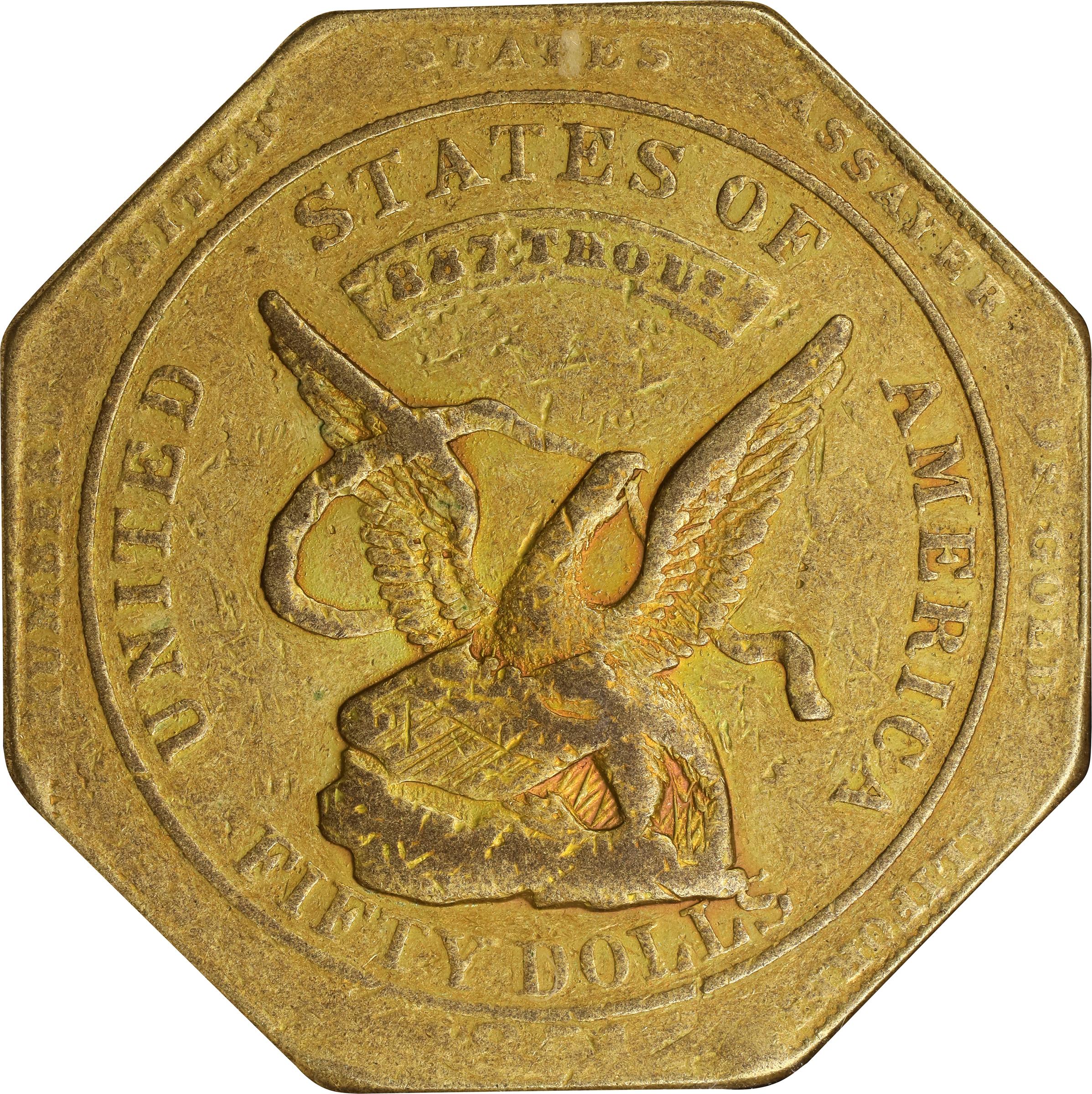
1851 "887" $50 RE Augustus Humbert MS (PCGS#10214)
December 2025 Showcase Auction - The James A. Stack, Sr. Collection Part I
- Auctioneer
- Stack's Bowers
- Lot Number
- 22246
- Grade
- XF40
- Price
- 36,000
- Lot Description
- An attractive example of this classic $50 gold type from the California Gold Rush. Rich honey-rose color blankets both sides, the surfaces of which also reveal hints of frosty luster as the coin rotates under a light. Peripheral strike detail is typical of the type and comes up short most significantly on the obverse, where portions of the legend and much of the date are difficult to discern. High point softness to the eagle is also typical for both the issue and the assigned grade, as are scattered handling marks. The surfaces have a curious, somewhat matte-like texture that we mention for accuracy, but are visually appealing in a circulated survivor of this large and impressive type. This coin will certainly have no difficulty finding its way into an advanced collection, be it a Territorial gold type set or one focused on California Gold Rush issues.<p>The large octagonal $50 "slugs" of Augustus Humbert are among the first to come to mind when many collectors think about the numismatic heritage of the California Gold Rush. Issued for only a few years starting in 1851, the huge coins have become symbols of the exploration of vast riches that lay within the rocks of Northern California. The earliest $50 pieces came from the United States Assayer of Gold, Augustus Humbert, who in 1851 joined up with Moffat & Co. to produce large denomination ingots using obverse dies prepared by Charles Cushing Wright. The earlier issues in two purity levels, 0.880 fine and 0.887 fine, all bore an intricate geometric design on the reverse, reminiscent of a target. The denomination, while large for the time, proved to be popular and saw extensive use in commerce. While initially accepted at the Customs House, a law passed in August 1852 forbade the use of gold of purity lower than the statutory 0.900 fine to pay customs dues. Many of the lower fineness slugs ended up being recoined into 0.900 fine $50 pieces. Ultimately, when the United States Mint at San Francisco opened in 1854, even the high purity coins ended up in the melting pots, leaving few survivors for collectors to enjoy today. This is certainly a desirable EF example of an important type that is often found at the top of many collectors' want lists.