1860-D G$1 MS(PCGS#7556)
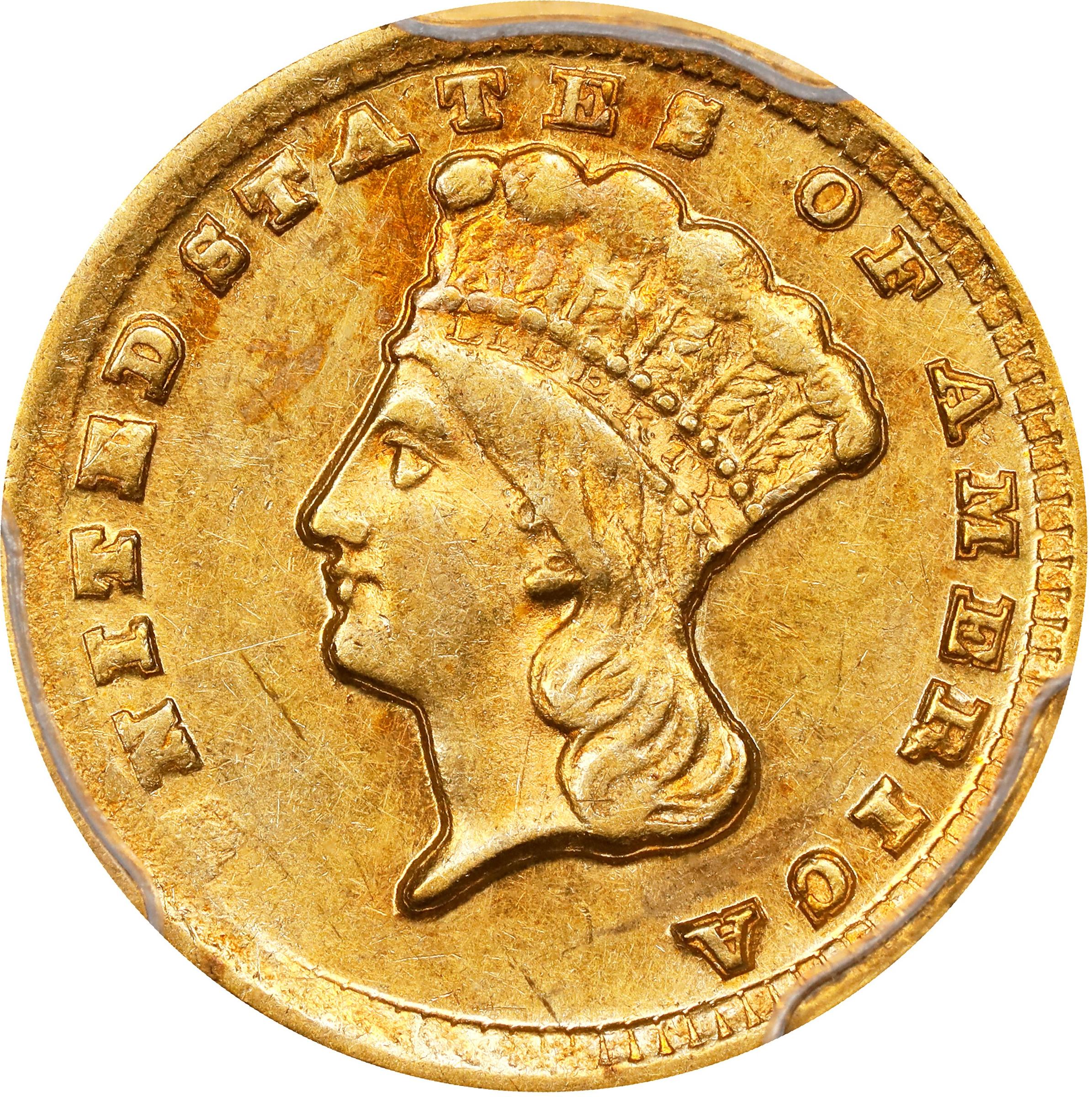
1860-D G$1 MS (PCGS#7556)
February 2026 Showcase Auction - The James A. Stack, Sr. Collection Part II
- Auctioneer
- Stack's Bowers
- Lot Number
- 23001
- Grade
- AU55
- Price
- 21,600
- Lot Description
- Offered is an exceptionally well preserved and attractive example of a notoriously difficult Dahlonega Mint issue to find "nice." The Philadelphia Mint shipped two pairs of dies to Dahlonega for coinage of gold dollars in 1860, although only one of these pairs was employed to strike 1,566 coins for this issue. The facility had largely outlived its purpose after the discovery of gold in California in 1848, and was facing increasing calls for its closure since the start of San Francisco Mint operations in 1854. By 1860 the coiners at Dahlonega had little incentive and even less support to turn out a quality product. Whether defective dies rejected by the Philadelphia Mint and/or worn-out machinery also played a role is unknown, but the 1860-D is clearly the most poorly produced gold dollar from the Dahlonega Mint. The typical example is softly struck both in the centers and at the peripheries, and in a manner that is highly distinctive to this issue. These qualities are seen on the James A. Stack, Sr. specimen and include lack of border denticulation along the left obverse and upper left reverse, softness to the high points of Liberty's portrait and throughout much of the wreath, and a letter U in UNITED that is barely perceptible under magnification (and essentially invisible during in-hand viewing). On the other hand, the central reverse on this coin offers above average detail with the word DOLLAR bold and the date likewise fully legible, even if the letter O and digit 6 are a bit soft and lacking in finer definition. In sum, the Stack specimen is about as sharp as one could realistically hope to obtain in an 1860-D gold dollar.<p>The coiners at Dahlonega also did a poor job with planchet preparation for this issue, the quality of which Doug Winter describes as "among the poorest for any Dahlonega issue" in the 2025 edition of his standard reference <em>Gold Coins of the Dahlonega Mint: 1838-1861</em>. The result is the somewhat granular, almost "fuzzy" appearance to the texture on both sides of this coin. Poorly prepared and/or employed dies combined with crude planchets also resulted in inferior luster, and even high grade pieces are apt to be subdued, if not outright dull in appearance. When the high degree of numismatic mishandling affecting the survivors is added to the mix, it is easy to see why so few 1860-D gold dollars have even one of the three key ingredients to eye appeal: strike, luster, and color. If the strike on the Stack 1860-D is somewhat above average, where this coin really shines are in the areas of luster and color. Both qualities are highly dependent on originality, which this coin has in spades. Both sides display handsome, rich honey-orange color with wisps of reddish-rose and powder blue iridescence. Good lighting calls forth an abundance of luster, maybe not in an absolute sense, but certainly relative to the typical 1860-D gold dollar. The texture is generally frosty, but with faint traces of semi-reflectivity in the fields, especially on the obverse. Minimally worn with only wispy handling marks, it is easy to understand why this is one of the finest About Uncirculated 1860-D gold dollars certified by PCGS and endorsed by CAC.<p>From a mintage of 1,566 pieces, Southern gold expert Doug Winter accounts for only 90 to 115 survivors in all grades. Interestingly, the typical 1860-D gold dollar encountered in today's market will grade in the range of AU-50 to AU-58. Because of economic uncertainty in the midst of talk of secession, many 1860-D gold dollars were pulled from circulation soon after their release, which helped make the survival rate and overall preservation somewhat higher than for earlier Dahlonega Mint gold dollars. In an absolute sense, of course, an issue with no more than 115 or so coins extant is a significant rarity in U.S. numismatics. With poorly produced and carelessly handled examples abounding even at AU levels, the 1860-D is an even more formidable condition rarity with the superior quality, originality and eye appeal that define the James A. Stack, Sr. specimen. It is a coin worthy of the strongest bids, and one that is perfectly suited for one of the finest collections of Southern gold.