1836 $1 J-60 Original, Alignment I PR(PCGS#11225)
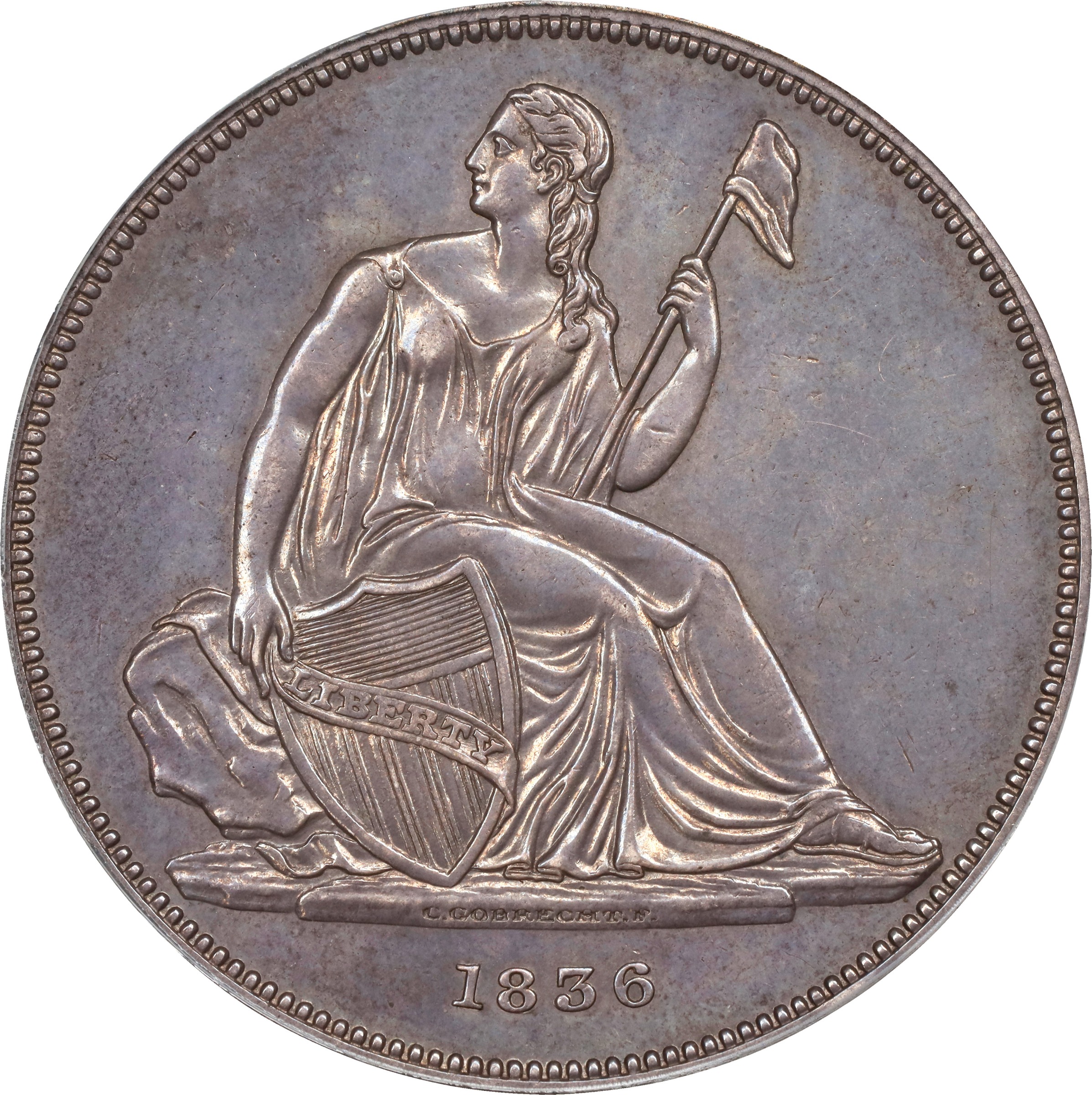
1836 $1 J-60 Original, Alignment I PR (PCGS#11225)
June 2026 Showcase Auction U.S. Coins
- Auctioneer
- Stack's Bowers
- Lot Number
- 2161
- Grade
- PR60
- Price
- 29,280
- Lot Description
- Korein-78. DTS Die State F. Liberty's head is opposite the letters DO in DOLLAR. This warmly toned example exhibits moderately deep mauve-gray patina with more vivid undertones of antique gold and powder blue iridescence. This is secondary, albeit natural toning, the surfaces a bit muted and also somewhat glossy in texture to betray an old cleaning. This is consistent with the assigned grade, especially for a Gobrecht dollar, and with no sizeable or otherwise singularly distracting marks the in-hand appearance is rather smooth at the Proof-60 level. The strike is sharply executed, as expected for the issue, and we note just a trace of cabinet friction that also helps to explain the certified grade.<p>The historic 1836 Name on Base Gobrecht dollar is the first issue of this denomination produced for circulation since those struck in 1804 from 1803-dated dies. Silver dollar production was suspended in the early 19th century after the value of the silver exceeded the coin's face value. While proposals to resurrect this denomination started as early as 1831, it was not until 1835 that any serious attempt was made. Christian Gobrecht was directed to prepare a set of pattern dies based on designs by Titian Peale and Thomas Sully. The result is a coin widely considered one of the classics of American numismatics with its beautiful representation of Liberty seated on the obverse and majestic soaring eagle on the reverse.<p>The Mint used only a single pair of dies to strike 1,000 examples of the new dollar in December 1836, the coins delivered in two batches: 400 pieces for distribution to the public and 600 for distribution into commerce through local Philadelphia banks. Mint personnel experienced considerable difficulty in production of this issue. Either the feed fingers for the planchets were improperly designed, or the coiners used feed fingers intended for half dollars. In either case, the feed fingers kept slamming into the reverse die during coinage, forcing Mint personnel to deliberately rotate the dies and adjust the feed mechanism in an effort to solve the problem. This tinkering explains the three different die alignments for originals of this variety (I, II and IV), as well as the tiny nicks seen around the reverse rim through the various die states.<p>For generations, the precise timeline of production based on die alignment has been in dispute, but recent scholarship by John Dannreuther, Craig Sholley, and Saul Teichman has indicated that the correct sequence of all the Judd-60 dollars is I-IV-II-IV-I-IV, with all of the Die Alignment III pieces being later restrikes.<p>As the most frequently encountered Gobrecht dollar, the 1836 Name on Base is very popular for type purposes. Examples are certified as Proofs, as above, but most show (considerable) wear and marks (if not also impairments) from time in commerce. A perennial favorite for generations, Gobrecht silver dollars remain as popular now as ever and are in constant demand. This handsome specimen - well preserved for the type and visually appealing - represents a significant find for advanced type collectors, silver dollar enthusiasts, or those with an interest in this challenging series.