1856-D $2.50 MS(PCGS#7779)
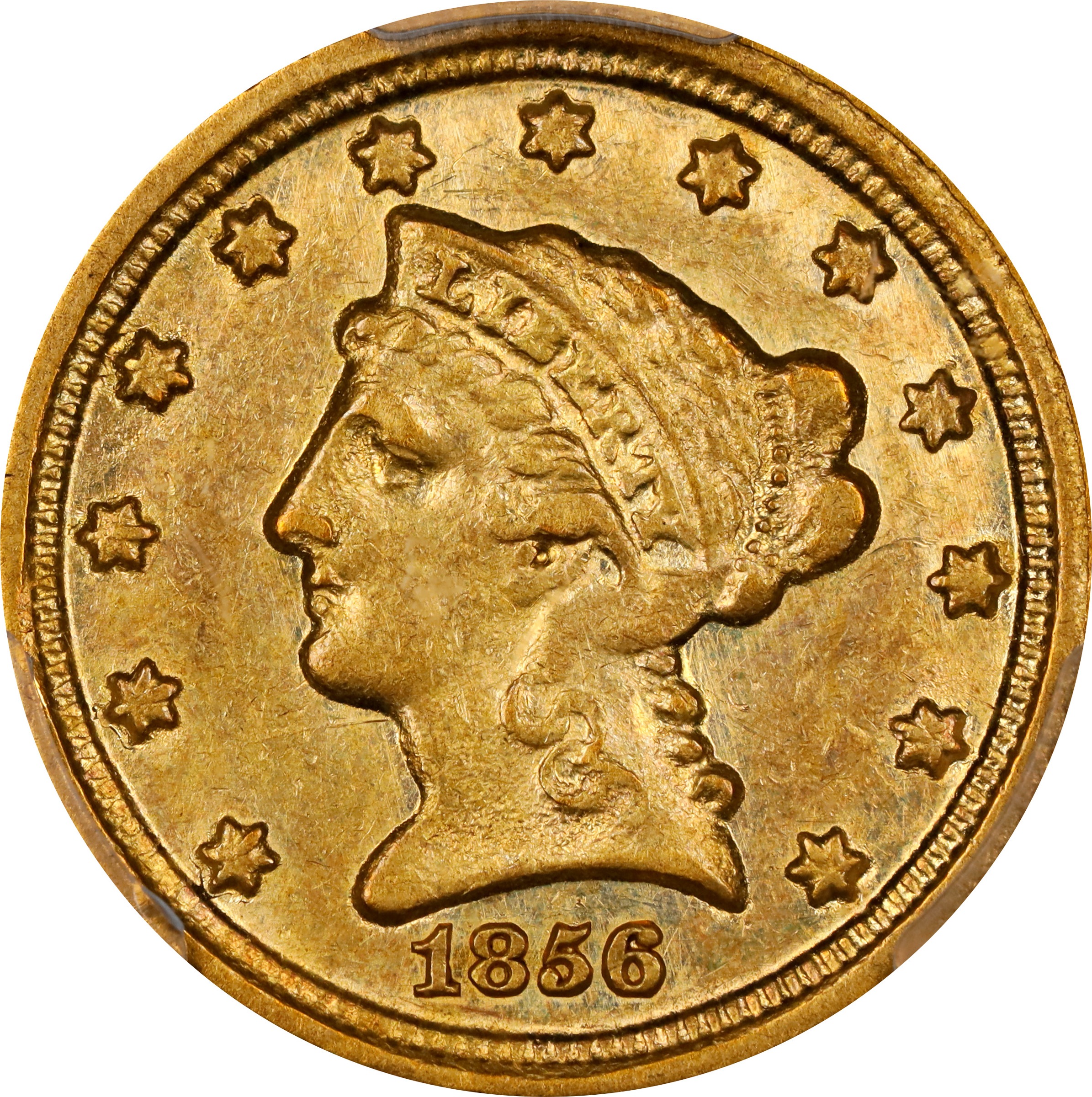
1856-D $2.50 MS (PCGS#7779)
February 2026 Showcase Auction - The James A. Stack, Sr. Collection Part II
- Auctioneer
- Stack's Bowers
- Lot Number
- 23009
- Grade
- AU55
- Price
- 84,000
- Lot Description
- Offered is a Condition Census survivor from this fabled low mintage year in the Dahlonega Mint quarter eagle series. A thoroughly PQ example, it is nicer in your cataloger's eyes than the PCGS/CAC AU-58 that brought $120,000 in our August 2024 Global Showcase Auction, and has legitimate claim to a lower Mint State grade. The 1856-D is the worst struck Dahlonega Mint quarter eagle, and the softness of detail seen in and around the centers on both sides of this coin, as well as along the lower left obverse and upper left reverse borders, should be expected. The stars are also fairly blunt with only partial centrils, again typical, but some minor detail is just beginning to emerge within the eagle's leg, neck and wing feathers close in to the shield. The best struck 1856-D quarter eagle that we have handled in recent memory is the John O. Sykes specimen, also in PCGS/CAC AU-58, that realized $144,000 in our Summer 2022 Global Showcase Auction. The present example does not rise to the same level, but its strike detail must still be regarded as a bit above average for the issue. The word LIBERTY on the headband is fully legible, if typically soft, and there is considerable sharpness within the feathers of the eagle's outstretched wings. All other major features are bold to sharp, including the date, D mintmark, denomination, and legend UNITED STATES OF AMERICA.<p>Surface texture for the typical 1856-D $2.50 is also poor, with areas of roughness and what Doug Winter (2025) describes as a "peculiar, 'pebbly' appearance that make[s] the coin appear as if it had been polished or had been used in jewelry." These features are seen here, most noticeably within Liberty's portrait, which is rough and granular (as made) throughout. There is also considerable roughness in and around the central reverse, affecting both the shield (especially the vertical stripes) and the surrounding feathers.<p>While its strike is somewhat above average for the issue, and the surface texture is par for the course, the James A. Stack, Sr. specimen really comes into its own in the area of preservation. Survivors of this issue rarely retain any trace of the original mint finish, but here we see about as much luster as one could realistically hope to find in an 1856-D quarter eagle. The finish is again typical of the issue, muted and understated, but with the characteristics of a softly frosted texture readily evident. There is little to report here in the way of even light high point rub, and scattered handling marks are both few in number and small enough to be overlooked in most viewing situations. The entire package is dressed in pleasing color, generally medium wheat-gold, but with tinges of pale olive and pinkish-rose discernible as the coin rotates under strong lighting. While we make no guarantees on this coin's chances of securing a Mint State grade in a later certification, we feel it is premium quality for both the issue and the assigned grade. It is also exceptionally well composed overall in an example of this rare and challenging issue, with superior eye appeal to match. In short, one would be hard pressed to find a significantly nicer and more appealing 1856-D quarter eagle irrespective of certified grade. We expect fierce competition for this prize among astute Southern gold collectors and offer our congratulations in advance to the winning bidder.<p>Contrary to popular belief, the California Gold Rush was not the United States' first gold rush. That honor belongs to the Carolina Gold Rush that had its origins in the discovery of a large gold nugget in North Carolina in 1799. Mining began in earnest in the region in the earliest years of the 19th century and continued for several decades.<p>This early event was overshadowed by the nation's second gold rush, the Georgia Gold Rush, sparked by discoveries in 1828 in a region that is now part of Lumpkin County. Additional finds were made in the mountains of North Georgia, and soon miners from North Carolina were drawn to the new area. The heyday of the Georgia Gold Rush ended in the early 1840s, by which time gold was becoming increasingly difficult to find in the region. The experiences of mining gold in North Carolina and Georgia during the early decades of the 19th century, and the skills acquired through those experiences, created a population of Americans who were eager and able to travel west and participate in what proved to be the more extensive - and consequently more famous - California Gold Rush of the late 1840s and 1850s.<p>Despite the dangerous and time-consuming process of transporting Georgia gold to the Philadelphia Mint for coinage, it was not until 10 years after the Gold Rush began that a branch of the United States Mint was opened in Dahlonega to service the region's mining operations. In fact, were it not for wider political considerations the Dahlonega Mint could have been nothing more than a story of what might have been.<p>The origins of the Dahlonega Mint can really be traced to 1792, not 1828. The Act of April 2, 1792, which established the Mint and the nation's coinage system, set the value of gold relative to silver at 15 to 1. This ratio undervalued gold and overvalued silver, preventing domestic circulation of gold and resulting in its widespread export during the early decades of U.S. Mint operations. By the 1820s, in fact, gold coins were entirely absent from domestic circulation with commerce conducted using an unstable combination of Spanish-American silver coins, bank notes and, to a lesser extent, U.S. copper and fractional silver coins. The first steps to remedy this problem were taken in 1830, although the process did not come to fruition until passage of the Act of June 28, 1834.<p>This significant Act was a victory for President Andrew Jackson's hard money policy that sought to undermine bank notes in circulation in favor of gold coinage. It finally addressed the problem of the relative value of gold to silver in the United States by fixing the ratio at 16 to 1. This represented a last-minute change from a proposed ratio of 15.625 to 1, the impetus for which is thought to have come from two powerful special interests: Eastern businesses, which wanted gold restored to active circulation to aid in foreign trade, and Southern mining interests, which believed that the return of gold to circulation would create a large market for Carolina and Georgia bullion. The Act succeeded in its primary aim of returning gold to active circulation and, as anticipated, Southern miners were now faced with a sudden and dramatic increase in demand for their precious metal.<p>The Philadelphia Mint had been the primary destination for Georgia gold since 1828, and from 1830 to 1837 it received more than $1.7 million in deposits from that region. Calls for assay offices and, later, branch mints in North Carolina and Georgia had first been mooted in 1830, but after passage of the Act of June 28, 1834, Southern politicians finally had the clout they needed to secure establishment of these facilities. This was achieved through the Act of March 3, 1835, which created branch mints in Charlotte, Dahlonega and New Orleans, the first two solely for the processing and coining of gold.<p>Located in what was then still a remote region of the United States and plagued by a shortage of good materials during construction, the Dahlonega Mint did not officially open for business until February 12, 1838, with the first coins - 80 half eagles - struck on April 21. The Mint would operate for 24 years, striking gold coins in dollar, quarter eagle, three-dollar and half eagle denominations. It is ironic that the first full decade of the Mint's activities coincided with a sharp decline in gold mining in Georgia. Consequently, yearly mintages at Dahlonega were small throughout the 1840s. The facility did receive a temporary boost from 1850 to 1855 due to an influx of California gold. This source largely dried up after the first gold coins were struck at the newly established San Francisco Mint in 1854, and production at Dahlonega fell off markedly and remained very limited, especially compared to those of the West Coast facility. The outbreak of civil war in 1861 spelled the end of coinage operations at the Georgia mint.<p>Outraged over Lincoln's victorious presidential campaign, the legislature of South Carolina voted to secede from the Union on December 20, 1860, initiating what would be a cascade of secessions over the following months. Georgia signed the Ordinance of Secession on January 19, 1861, becoming the fifth state to secede from the Union, although the Southern Confederacy did not officially assume control of the Dahlonega Mint until April 8, 1861. While some of the remaining bullion was coined into gold dollars and half eagles under Confederate authority, the Mint served as merely a depository for the Confederate Treasury for the remainder of the Civil War. After the cessation of hostilities, the United States Treasury provided estimates for reinstating the facility as an assay office or mint, but neither option was adopted. In 1871, the building was given to the North Georgia Agricultural College. The original Dahlonega Mint building burned down in 1878, and a replacement structure constructed on its foundation now serves as an administration building for the University of North Georgia.<p>Dahlonega Mint gold coinage as a group is scarce, and all issues are rare in the finer circulated and Mint State grades. Throughout its operational history the highest yearly mintage for an issue from this branch mint was achieved in 1843, when 98,452 half eagles were produced. Numerous Dahlonega issues have mintages of fewer than 10,000 coins, with several not even reaching 5,000. But mintages are only part of the story when it comes to understanding the scarcity of Dahlonega Mint gold. Almost without exception, these coins saw immediate and widespread commercial use that in most cases ended with destruction through melting.<p>The rarity of its coinage, combined with the appeal of the Antebellum South era, has made the Dahlonega Mint very popular with specialized gold collectors. Through its 1861-dated coinage the facility also has direct ties to the formation of the Southern Confederacy. Finally, the difficulty of locating well produced Dahlonega Mint coins at any grade level is a challenge that attracts advanced numismatists. Minting operations in the remote mining region of North Georgia during the late 1830s, 1840s and 1850s was difficult under the best of circumstances. External factors further complicated the process, such as the propensity of the engraving department in the Philadelphia Mint to send dies that were deemed unsuitable for use at the nation's main coinage facility to the branch mint in Dahlonega. The discovery of gold in California, the booming Gold Rush there during the 1850s, and the beginning of coinage operations at the San Francisco Mint in 1854 led to calls to close the Dahlonega facility. Mining in Georgia was already in decline by that time, and it suffered an even greater setback as people headed west to pursue more attractive prospects in California. As the Mint's usefulness was increasingly called into question, it is not surprising that the worst produced Dahlonega Mint issues are those dated from the mid-1850s through cessation of coinage operations in 1861.<p>More so than any other issue, the 1856-D quarter eagle represents the swan song of coinage operations at the Dahlonega Mint during the late 1850s. It is the most poorly produced Dahlonega Mint quarter eagle, as previously related, and it is also the only issue of any denomination from this mint with a confirmed mintage of fewer than 1,000 coins. A mere 874 pieces were produced, in fact, and with fewer than 60 coins believed extant, perhaps only 40 to 50, the 1856-D is the rarest Dahlonega Mint issue of any denomination. Even in VF and EF this issue is elusive, although those are the most likely grades to be found in today's market. Lower-end AU coins are very rare, while a handful of Choice AUs make up much of the Condition Census for the issue. Not surprisingly, the 1856-D is extremely rare in Mint State, which fact further confirms the awesome condition rarity and numismatic significance of this premium PCGS AU-55 from the James A. Stack, Sr. Collection.