1798 $5 BD-1, Small Eagle MS(PCGS#507321)
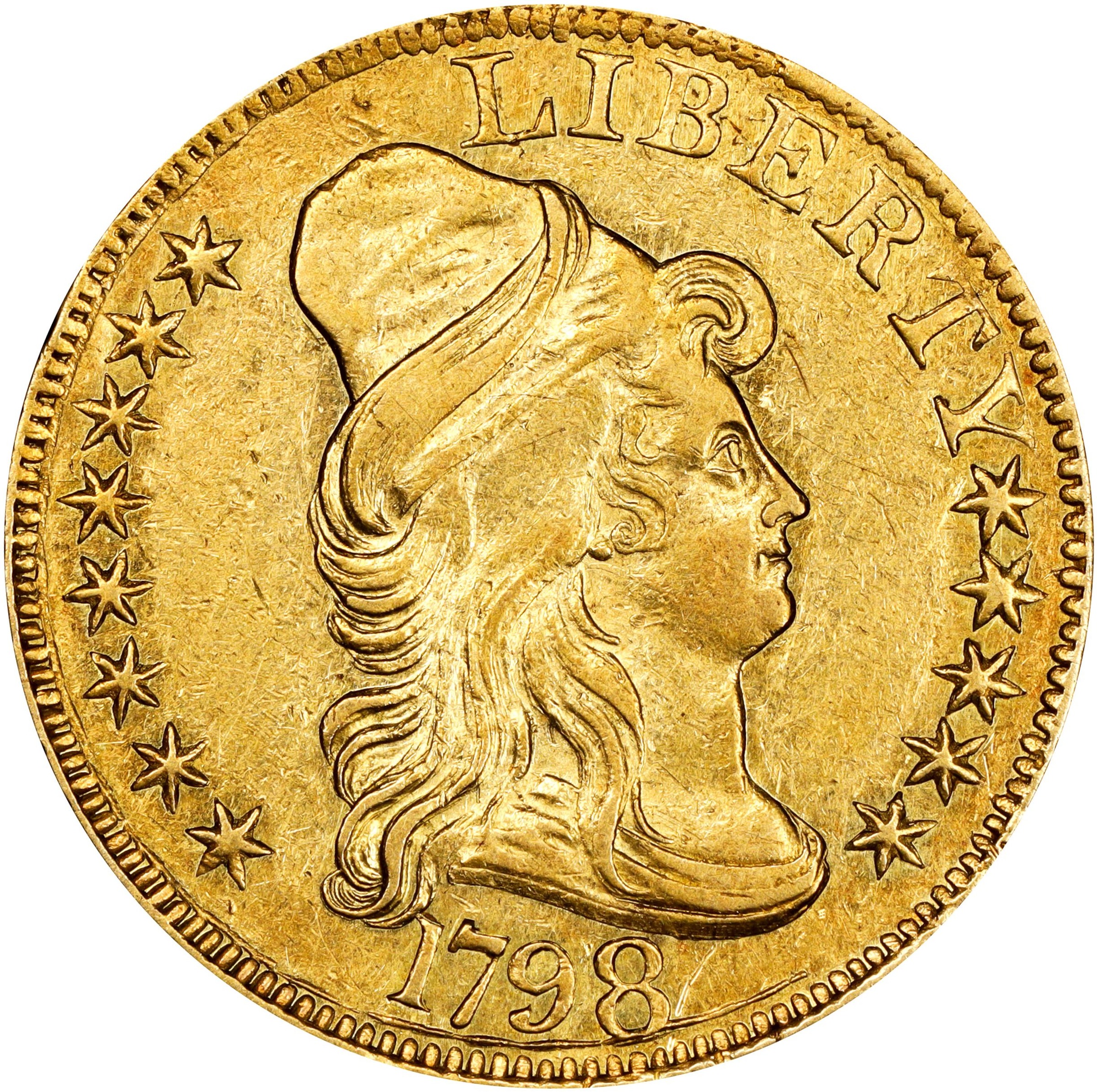
1798 $5 BD-1, Small Eagle MS (PCGS#507321)
February 2026 Showcase Auction - The James A. Stack, Sr. Collection Part II
- Auctioneer
- Stack's Bowers
- Lot Number
- 23012
- Grade
- AU53
- Price
- 2,820,000
- Lot Description
- With a total survivorship of just seven coins, the 1798 Small Eagle $5 is an iconic issue, one of the all-time classic gold rarities struck at the First Philadelphia Mint. This precise example was once the most valuable coin in the world, a fact that made it the focus of headlines nationwide in June 1912, after it sold for a then-shocking $3,000 in Henry Chapman's auction of the George H. Earle, Jr. collection.<p><p>Even and attractive light yellow gold with the warm glow of subtle orange-copper toning gathering in areas of the periphery and around design elements. A good deal of bright, lightly reflective luster persists in protected areas of the design, including within the letters of the peripheral legends. The rest of the surfaces show the impacts of a short time serving the function for which this coin was created: circulation as a piece of money worth five dollars. Scattered light marks are seen on both sides, mostly minor and not troublesome. We see a nearly vertical diagonal scratch right of the date, a thin hairline scratch across the lower right serif of E in LIBERTY toward the forecurl below, a thin diagonal hairline scratch in the space between STATES and OF, and another short one left of the first A in AMERICA. A very subtle and nearly obliterated batch of parallel vertical adjustment marks are seen at the base of the reverse, also manifesting on the leg and talon of the eagle adjacent to his tail. The reverse centering is aligned slightly left, as seen on other specimens. The visual appeal is superb for the assigned grade and superb among survivors of this legendary rarity.<p><p>A new example of this rarity turned up in 2000, offered as lot 1290 in the June 2000 Ira and Larry Goldberg sale. At the time, John Dannreuther identified it as the Atwater coin, a provenance we agreed with in writing when cataloging the Pogue specimen in 2015. Though the Atwater plate is not of great use, B. Max Mehl noted that Atwater purchased his coin from the 1912 Earle sale, where a superb photographic plate illustrates this coin perfectly. The June 2000 Goldberg coin and the Atwater coin share an aspect that, a decade ago, your cataloger used as confirmation that those two coins were the same, namely a struck-through atop the second T of STATES that left a nearly round depression. With this coin in front of us, it's plain that the Atwater coin went to James A. Stack, Sr. and has been in the collection since (still in the 1946 Atwater sale envelope!). Interestingly, that struck through characteristic is seen on both coins, meaning that the same piece of detritus was clinging to the reverse die when both coins were struck, suggesting that they were struck nearly (or exactly) one after each other.<p><p>Considering the abbreviated mintage of just a few hundred coins, it's perhaps not surprising that two of the survivors were struck in close sequence to each other. The Dannreuther-Bass book suggests a likely run of 300 to 600 coins, with the now obsolete Small Eagle reverse apparently pressed into emergency service. This is the very last use of a Small Eagle die, the only half eagle variety to use a Small Eagle reverse after 1797, and also (as pointed out by Dannreuther) the sole 13 star obverse / Small Eagle reverse variety in the entire half eagle series. Further, rather than requiring a book and a magnifying glass to attribute, this variety is as naked-eye as can be, making it a focal rarity for advanced gold enthusiasts.<p><p>We know of seven examples, two of which are impounded in the Smithsonian Institution.<p><p>1.The Farouk-Pogue coin. PCGS AU-55.<p>2.The Earle-Atwater-Stack coin. PCGS AU-53. CAC.<p>3.The Mickley-Garrett coin. PCGS AU-53.<p>4.The Eliasberg-Bass coin. PCGS AU-53. Formerly impounded in the Harry W. Bass, Jr. Core Collection.<p>5.The Dannreuther-Kardatzke coin. PCGS EF-40.<p>6.The Seavey-Parmelee coin. Acquired for the Mint Cabinet in 1890, moved to the Smithsonian Institution in 1923. VF.<p>7.The Ten Eyck-Newcomer-Lilly coin. Smithsonian Institution. EF, edge damage.<p><p>While graded the same as the Garrett and Bass coins, this is the only 1798 Small Eagle half eagle that has ever been approved by CAC.<p><p>From the <em>New York Tribune</em> to the <em>Honolulu Star-Advertiser</em>, and nearly everywhere in between, the headlines were the same in 1912: $3000 FOR A 1798 HALF EAGLE. The <em>New York Tribune</em> ran a special report on the front page of the June 29, 1912 issue: "Three thousand dollars, said to be the highest price ever paid for an American coin, was the successful bid of Henry C. Chapman, of this city [Philadelphia], this afternoon for an American half eagle, which is the gem of the collection gathered by George H. Earle, Jr., of this city, and now being sold at auction." That article and the ones derived from it also reported the $2,200 sale price of a silver 1776 Continental dollar, along other rarities. While the news appeared across the country in late June and early July, it did not make it to Honolulu until October 15.<p><p>Chapman sold the coin to Col. James W. Ellsworth, a Gilded Age coal baron whose wealth allowed him to control the numismatic market to such an extent that Henry Chapman's code name for him was Hercules. In 1907, after selling his coal mines to Bethlehem Steel, Ellsworth was free to pursue collecting full time, acquiring paintings by artists like Rembrandt and Winslow Homer, ancient Greek vases, and even Florence's renowned Villa Palmieri, where Ellsworth died in 1925. He engaged a New York art dealer to sell his collections in 1923, including his coins, about which they had no specialized knowledge. Wayte Raymond paid $100,000 for the coin collection, with half of that sum put up by John Work Garrett, who thereby got first choice of the rare U.S. colonial coins he still needed for his advanced cabinet. The rest of the coins went to Raymond to sell as he wished, including this 1798 Small Eagle $5, by then an issue already represented in the Garrett Collection. Raymond sold it to William Cutler Atwater, who announced as much in a letter to <em>The Numismatist</em> in February 1936: <p><p>As a member of the American Numismatic Association I am very much interested in your edition of April last, containing a letter from Raymond L. Caldwell regarding the 1798 half eagle with small eagle reverse. My interest arises from the fact that I happen to be the owner of the Earle specimen, which I purchased from the Ellsworth collection eleven years ago, and which is rated by Wayte Raymond as being in very fine condition. This will locate the Earle specimen and bring the record up to date.<p><p>You may be also interested to know that I am the owner of the Stickney 1804 dollar, which I purchased at the same time from the Ellsworth collection.<p><p><p>This coin remained with Atwater until his death in 1940. Six years later, B. Max Mehl auctioned it. When the coin arrived in our offices, it was still in the Atwater envelope.