1841 $2.50 MS(PCGS#87720)
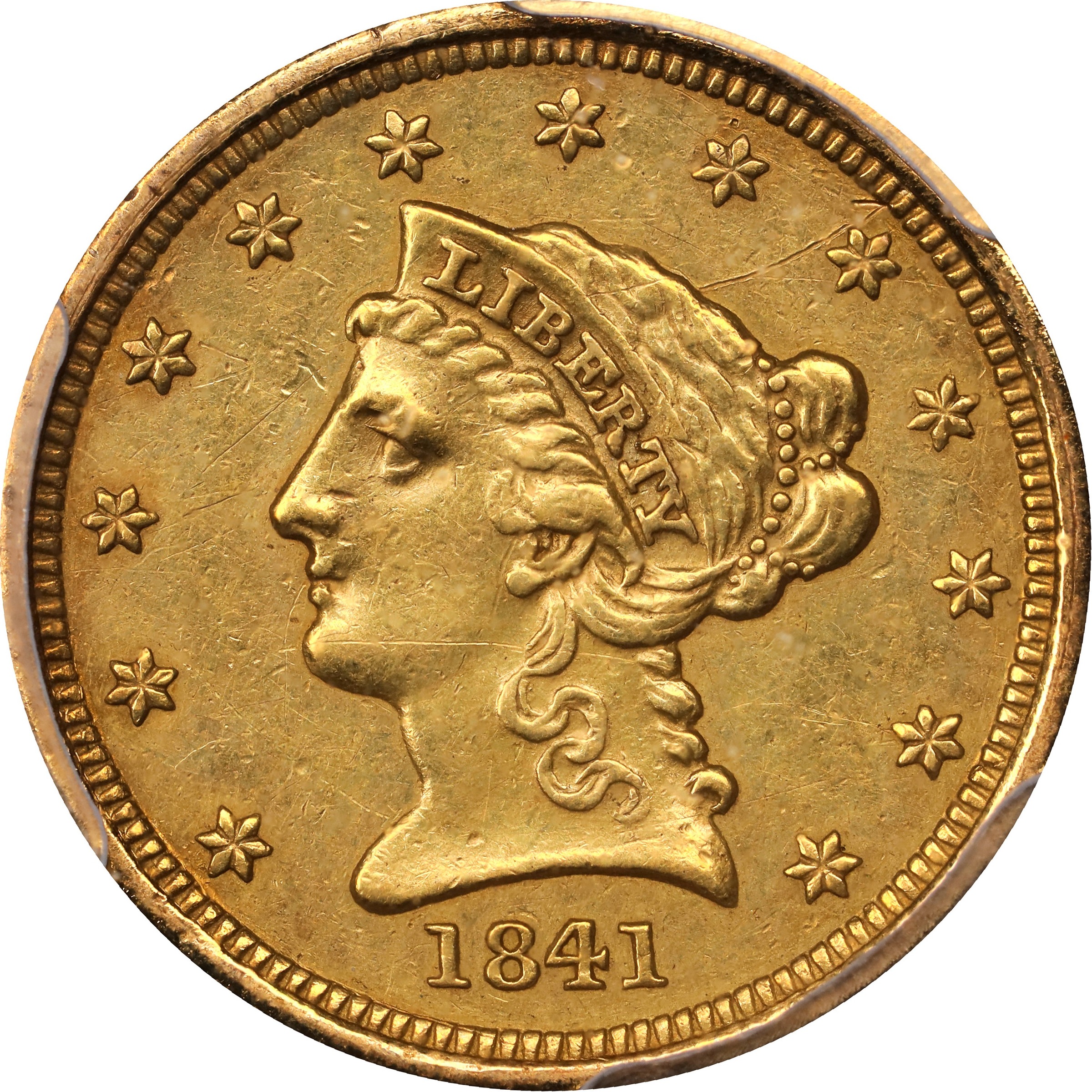
1841 $2.50 MS (PCGS#87720)
Spring 2026 Showcase Auction U.S. Coins
- Auctioneer
- Stack's Bowers
- Lot Number
- 3114
- Grade
- XF45
- Price
- 120,000
- Lot Description
- One of the most famous of all United States coins and ranked #95 in the fifth edition (2019) of the influential reference <em>100 Greatest U.S. Coins</em> by Jeff Garrett and Ron Guth. Dubbed the "Little Princess" by Abe Kosoff in his 1950 Adolphe Menjou sale and by Norman Stack in the Davis-Graves auction of 1954, this moniker may have first been applied to the 1841 quarter eagle by an unknown source in the 1930s. Regardless of its origin, the name has continued to this day and is instantly recognized among advanced collectors specializing in the rarest and most desirable United States coins.<p>The 1841 is also one of the most enigmatic and curious of all major numismatic rarities. Enigmatic because the format in which the known examples were struck continues to be debated by researchers. Curious because, despite being pictured in print as early as 1842, the issue largely escaped the attention of numismatists until early in the 20th century. Since the <em>Annual Report of the Director of the Mint</em> for that year does not mention any circulation strike quarter eagles from the Philadelphia Mint, traditional numismatic wisdom has regarded the 1841 as a Proof-only issue. The Mint Cabinet received a specimen in 1841, and the following year, in 1842, Jacob Eckfeldt and William Dubois mentioned the issue, along with providing an engraved image of an example, in their book <em>A Manual of Gold and Silver Coins of All Nations</em>. In his book published in 1860, describing the Mint Cabinet Collection, Director James Ross Snowden also specifically mentioned the 1841 quarter eagle, which he referred to as a "pattern". Outside of Mint circles, however, the issue remained largely unappreciated - if not unrecognized - throughout much of the 19th century, during which only a few auction appearances have been traced.<p>The 1841 quarter eagle achieved numismatic fame seemingly overnight when, in 1909, Edgar H. Adams published his <em>Official Premium List of United States Private and Territorial Gold Coins</em> and noted that only two examples were known. Since that time most numismatists have adopted the obvious explanation for the extreme rarity of this issue: since the issue is not listed in the Mint Director's <em>Report</em> for 1841, as related above, and further since the Mint did not start recording the number of Proof gold coins struck until 1859, the 1841 quarter eagle must be a Proof-only issue.<p>The Proof-only status of the "Little Princess" remained largely unchallenged until 2012 when, backed by recent research and opinions, PCGS certified the present example as the first 1841 quarter eagle that it recognized as a circulation strike. This coin, with an unknown prior provenance, realized $105,800 in our March 2012 Baltimore Auction. The most significant evidence used to support the belief that some circulation strikes were produced for this issue are the number of coins extant and the level of preservation of many of these survivors. With a <em>PCGS CoinFacts</em> estimate of 16 or 17 known, and 16 examples positively traced, the 1841 has an extant population that seems abundant when compared to those of other Proof 1840s quarter eagle issues, survivors for each of which can be counted on one hand. Additionally, more than half of all 1841 quarter eagles known are worn, including an example in Good-4.<p>Opinions still differ regarding the 1841 quarter eagle, however, and there are also compelling arguments on the side of those who advocate for continued acceptance of its Proof-only status. Chief among these are the fact that all known examples were struck from a single die pairing, that attributed as JD-1 in the 2018 reference <em>United States Proof Coins</em> by John W. Dannreuther. Even more significant is that the reverse die of the 1841 is the same that the Mint used to strike all other Proof quarter eagles dated 1840 to 1848. As Dannreuther observes:<p><em>For the circulation strike argument to be correct, the 1841 quarter eagle would have to be the only circulation coins struck in the 1840-48 era to use a Proof-only die. No other Proof-only reverse die of any denomination from the half cent to the eagle from this era is found on circulation strikes. These Proof-only dies were segregated from circulation strike dies.</em><p>Some 1841 quarter eagles are clearly Proofs, namely the aforementioned Mint Cabinet specimen now in the Smithsonian Institution, the Adolphe Menjou-Graves coin, and the Eliasberg-Bass-Pogue specimen. The status of others is less clear, especially those that are more heavily worn. Research continues, and it may be that the status of this issue as Proof-only or a combination of Proofs and circulation strikes may forever be debated by numismatists. Even the leading third-party certification services are not in agreement, for while PCGS now recognizes both Proofs and circulation strikes of this issue, NGC continues to regard all 1841 quarter eagles as Proofs.<p>The offered coin is one of the 16 examples of the 1841 quarter eagle included in the roster compiled by Saul Teichman and published on the <em>Newman Numismatic Portal</em>, in which it is ranked 13th by certified grade. The strike is sharp throughout with each of the stars brought up smartly by the dies as well as Liberty's curls. Matching depth of strike on the reverse where the eagle's talons are bold as well as the feathers. The surfaces show minor nicks and a few shallow pin scratches as illustrated, one just touching the upper point of star 9 and arcing to Liberty's hair and head, another on the reverse through the letter E in UNITED to the rim above, just missing the upper left of the adjacent D. Yellow-gold in color with subtle silver-olive overtones.<p>Whether Proof or circulation strike, the ownership of any of the 16 confirmed 1841 quarter eagles is a point of great pride. The acquisition of this numismatically significant PCGS EF-45 example will allow its new owner entry into the highly select group of advanced numismatists whose collection will forever be associated with the famous "Little Princess."