1853 "884" $20 U.S. Assay Office MS(PCGS#10010)
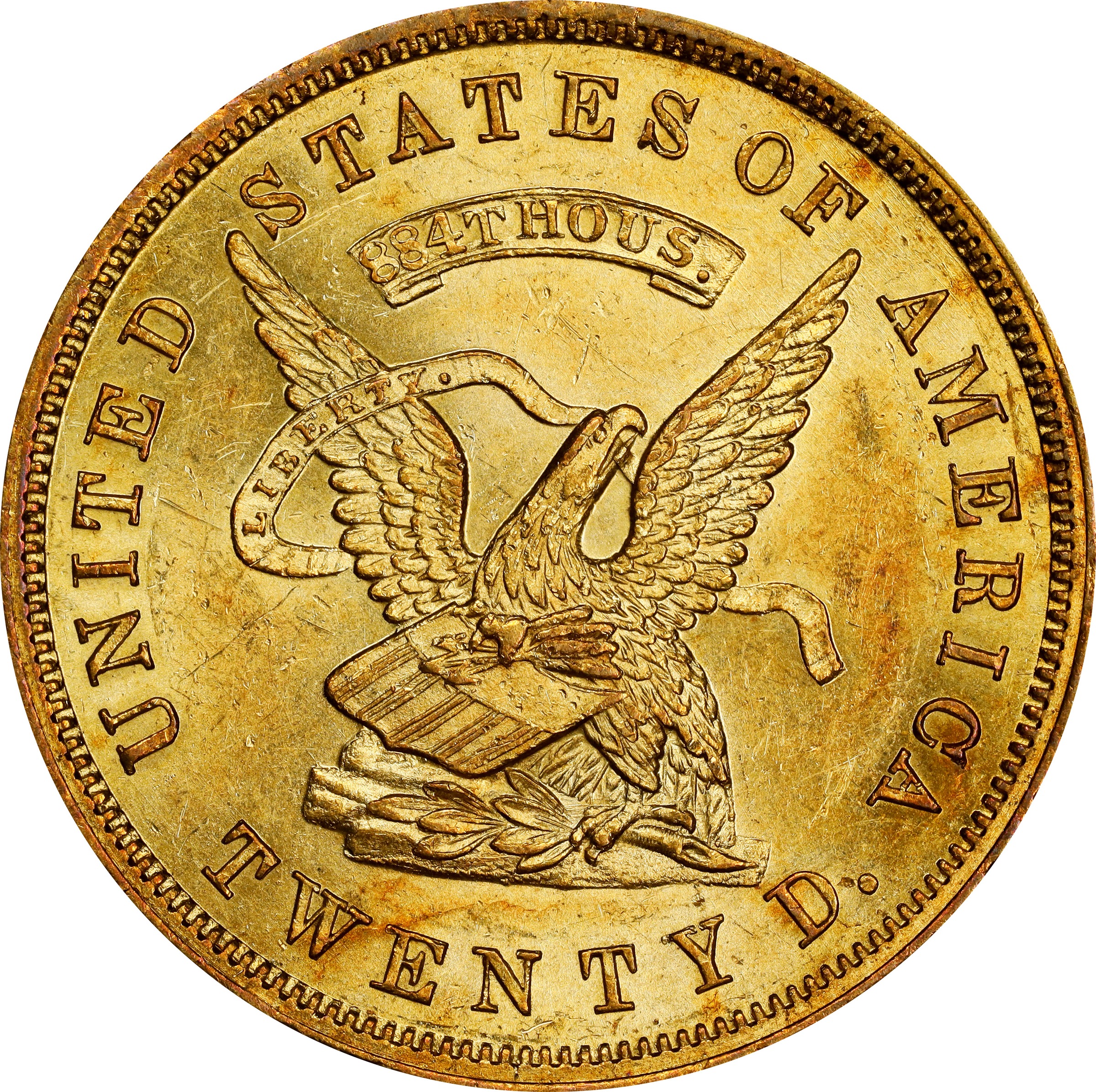
1853 "884" $20 U.S. Assay Office MS (PCGS#10010)
February 2026 Showcase Auction - The James A. Stack, Sr. Collection Part II
- Auctioneer
- Stack's Bowers
- Lot Number
- 23059
- Grade
- MS63
- Price
- 222,000
- Lot Description
- A truly majestic example of this type, tied for finest certified at PCGS and a strong candidate for finest known.<p><p>Spectacular gem-quality cartwheel luster spins briskly around both sides, spotlighting the richly original greenish-gold color of both sides. Frosty and magnificently attractive, bright and crisp as any connoisseur could hope for, with a blush of coppery toning in the fields that serves to heighten the impact of the originality. The perfect strike brought out every fine detail from the obverse and reverse dies, ideally centered on both sides. Scattered trivial marks and subtle hairlines are all that keep this piece from a higher grade, but if this was assigned an additional point, no one would mind. A horizontal hairline under ST of STATES on the obverse and a vertical one on the reverse between AS of ASSAY and OL of GOLD will serve as identifiers in the absence of something more grave. Under magnification or at arm's length, this is a beautifully preserved and exceptionally attractive coin.<p><p>The 884 THOUS issues of 1853 struck by the United States Assay Office were the penultimate gold coins coined in San Francisco before the establishment of the San Francisco Mint, struck before the 900 THOUS type that turned out to be a transition to full Federal control over gold coining in San Francisco. Political maneuvers to kill the Assay Office had resulted in a requirement that future issues be struck in the standard .900 fineness required by Federal law - all well and good for paper pushers in DC, of course, but impossible for the coiners without a ready supply of the parting acids required to refine gold to that level of purity. Dies were made for the new .900 issues, but the refining of deposits to that standard was a non-starter in the beginning of 1853. Of course, the demands of the commercial community of California continued, so the locals determined to strike coins of .884 fineness until a supply of acids became available. According to Kagin and McCarthy, "production of these coins began on February 23, 1853" and continued for only a week or so. Mintages were tiny of both the 884 THOUS $10 and $20 pieces, with modern extant populations estimated to be just a dozen or so for the smaller denomination and perhaps twice that number for the $20s like this one.<p><p>We've sold just four examples of this rarity in the last 20 years. The highest graded of these was an NGC MS-63, which we sold in April 2022 for $132,000. Neither of the other two specimens graded MS-63 by PCGS have sold in the last 10 years. One was last sold by Superior Galleries in June 1999. The other, with an august provenance to Mehl's 1947 Geiss sale and our (Stack's) 1984 Amon Carter sale, has been generally considered the finest known and serves as the plate coin in the 2023 Kagin-McCarthy book; it sold at Heritage in April 2014 for $176,250. CAC has approved just one example of this type, a PCGS MS-61 we sold in November 2014 and August 2018. The salvage of the <em>S.S. Central America</em> yielded just one example of this type.<p><p>This coin, unseen since Lyman Low sold it in 1916, has never appeared on any Condition Census of this type, though it ranks among the very finest known. While acquisition of any specimen of this historic and short-lived issue is a feat, acquisition of a better one is a possibility only in the realms of fantasy.