1804 1C S-266, Private Restrike, BN MS(PCGS#36422)
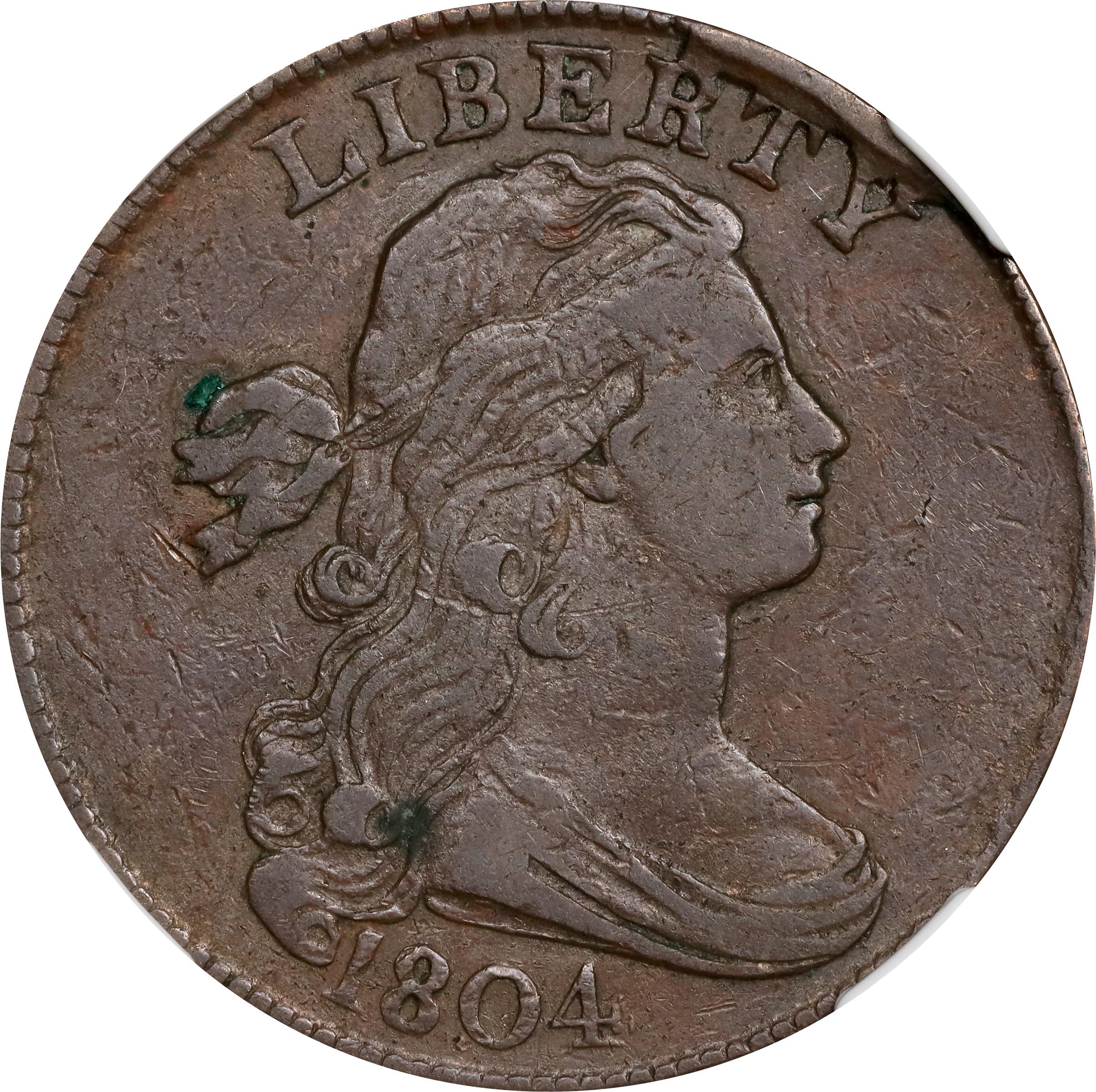
1804 1C S-266, Private Restrike, BN MS (PCGS#36422)
February 2026 Showcase Auction - The James A. Stack, Sr. Collection Part II
- Auctioneer
- Stack's Bowers
- Lot Number
- 25032
- Grade
- VF30BN
- Price
- 12,000
- Lot Description
- Breen Die State IV. Many 1804 large cents have come down to today's collecting community in well-worn grades or with heavy surface roughness or other problems, but we are pleased to report the present example of this highly desirable key date issue is essentially problem free to the unaided eye. A pair of tiny, ancient verdigris specks on the obverse are the only real exceptions, most of the scattered marks small enough to require magnification to discern, and none out of context with the assigned grade. The color is original and pleasing, generally medium brown with antique copper and reddish-rose intermingled on the reverse. Upper reverse a bit soft, although the words STATES OF are still legible, otherwise we note universally bold detail for the assigned grade.<p>The scarcity of 1804-dated cents relative to most other issues in the Draped Bust series has led numismatists to theorize that most of the coins struck during calendar year 1804 were from 1803-dated dies. This is probably true, although the mintage of 96,500 coins for the 1804-dated issue provided in many numismatic references is also conjecture and based on Breen's assumption that the final delivery of the year - on December 31 - represents the Mint's only delivery from the 1804-dated die pairing. There is no documentary evidence to support this mintage and, indeed, it is listed in italics in the <em>Guide Book</em> to denote that it is an estimate. Some or all 1804-dated cents may have even been struck during calendar year 1805, and possibly even in 1806.<p>Cents of 1804 have long been famous, and perceptions of the issue's rarity date to the 1840s, if not earlier. In 1841 James Morris, a storekeeper in Morgantown, Pennsylvania, recorded that he had "put away...a collection of cents beginning at 1793 and from thence to 1841 inclusive excepting only those of 1804 and 1815." Morris did not know that no such thing as an 1815 cent existed. For as rarely as they came over his store counter, 1804 cents might as well have not existed either, despite the fact that his business was located only 40 or so miles west of the Mint in Philadelphia. Morris was both a coin collector and an avid diarist. Though his numismatic activities have attracted little attention, Morris' diary is famous for one reason: it records the first observance of Groundhog Day known in the United States.<p>By the late 1850s, when numismatics in the United States experienced its first great surge in popularity, the perceived rarity of the 1804 cent had become so entrenched that a privately produced "restrike" was made to satisfy collector demand. The dies that produced this so-called "restrike" were initially used at the Philadelphia Mint to produce the obverse of 1803 Sheldon-261 and the reverse of 1820 Newcomb-12. They were found on the location of the First Philadelphia Mint "among general rubbish when the basement was cleaned" years after the Mint's 1833 departure from the site, probably in the mid 1850s according to a recollection published in the December 1910 issue of <em>The Numismatist</em>. These "restrikes," attributed as Breen-1761 in the author's <em>Encyclopedia</em>, were struck privately circa 1860, are not products of the United States Mint, and bear no relation to the regular issue 1804 cent. They remain popular, nonetheless, and are avidly collected today alongside the Draped Bust cent series.<p>Interest in the regular issue 1804 cent continued to grow throughout the late 19th century and, by the 1880s, numismatists had confirmed that the single die marriage of the issue came in three die states. That discovery is credited to David U. Proskey in the January 1881 installment of his "Coins of the United States" in <em>The Coin Collector's Journal</em>, the house organ of Scott Stamp and Coin Company. Proskey, considered the most knowledgeable cent specialist of his generation, correctly noted, "The pair of dies just described were new and the only dies from which cents were struck during 1804, and owing to both breaking, they were not used in any succeeding year." The familiar nomenclature attached to the die states of 1804 cents - Sheldon-266a, 266b, 266c - was introduced later, however, specifically in Charles McGirk's large cent attribution guide, published serially in <em>The Numismatist</em> in 1913 and 1914. McGirk's system forced collectors to measure spatial relationships and then check them against a columnar chart, dooming it to failure from the start. Perhaps the only relic of McGirk's system is the aforementioned description of 1804 cents as S-266a, 266b, or 266c. McGirk 1804 1A was the unbroken early die state, 1804 1B represented the scarce state with an obverse die break but no reverse die break, and 1804 1C referred to the state with breaks on both sides, as seen on the present example.<p>The fame and popularity of the 1804 cent continues the grow in the modern numismatic market, where it is firmly entrenched as a key date Draped Bust cent. At least part of the appeal of the 1804 cent stems from its association by date with some other key date issues from the early United States Mint, including both <em>Guide Book</em> varieties of the 1804 dime, the 1804 quarter and, most famously, the "King of American Coins," the 1804-dated dollar. Although much more is known about the 1804 cent today than when James Morris made his diary entry in 1841, the rarity is still sometimes exaggerated by overzealous catalogers and other numismatic writers. With upward of 1,000 coins extant in all grades, Sheldon-266 is not a rare die marriage in an absolute sense. Since it is the only one known for the date, however, an extant population of 1,000 coins or so confirms the scarcity of the 1804, especially when compared to most others in the Draped Bust cent series.