1804 $1 Class III PR(PCGS#6908)
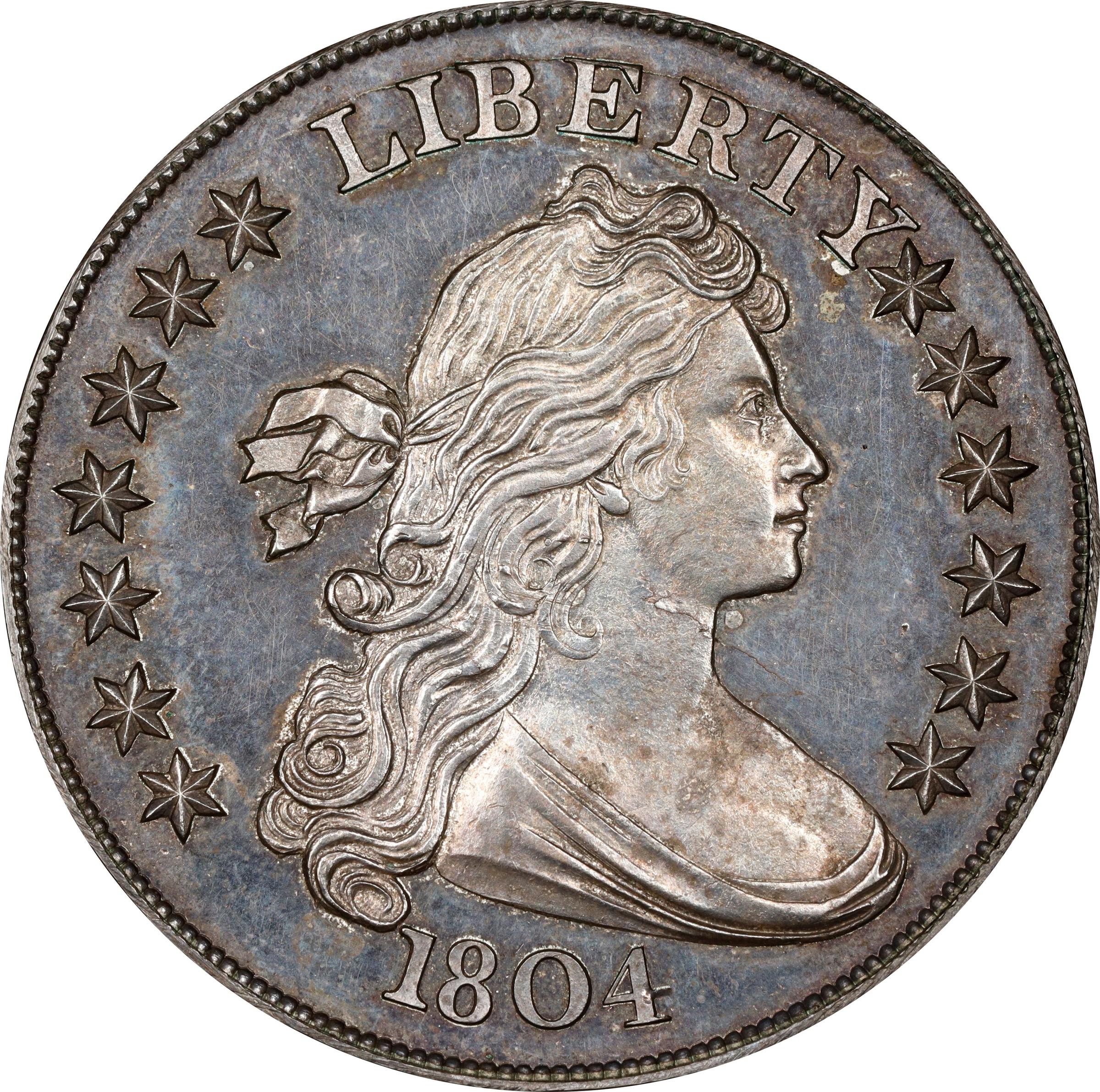
1804 $1 Class III PR (PCGS#6908)
December 2025 Showcase Auction - The James A. Stack, Sr. Collection Part I
- Auctioneer
- Stack's Bowers
- Lot Number
- 20006
- Grade
- PR65
- Price
- 6,000,000
- Lot Description
- 414.0 grains. The title <em>King of American Coins</em> does not get assigned without understanding the gravity of the implication. There is no Queen, Emperor, or Crown Prince of American Coins, And there's only one King. Coins are sometimes described as "carrying their own credentials." We have never seen a coin for which this phrase is as appropriate as this. When this coin was just a whisper and a rumor, questions about its origin and authenticity rightly swirled. Since the epochal discovery of the King of Siam set in 1962, the entire numismatic world has known there are only 15 dollars dated 1804. Every professional has seen their share of counterfeits, mostly crude and easily dismissed. There are crummy casts, altered dates, and electrotypes. Most are readily discounted within moments by professionals. No full-time numismatist working today has ever had the experience of hearing about a "new 1804 dollar" and having the discovery be anything other than a fake. Until now.<p><p>Upon seeing this coin, it's remarkable - breathtaking, even - how much it looks like an 1804 dollar. A tautology, perhaps, but these coins look like nothing else. Despite its familiar fabric, the quality of the piece - in terms of both production and preservation - have little in common with most other Class III survivors. The frosted devices stand out from reflective fields with cameo contrast on both sides. The fields are fully reflective, but not asymptotically approaching perfection like most Proofs. Instead, the planchet appears handmade, with fissures and flakes on both sides. The detail of the devices juxtaposed with these distinctive fields are enough to recognize this coin's nature from across the room.<p>The visual appeal is immense, with detail and mirrors that far more resemble the Class I presentation pieces than any Class III in private hands. Both sides are deep steel gray with a wide variance of subtle tones on the surfaces. The stars seem suspended in a deeper shade, gray imbued with a deep violet and maroon. The reverse flickers with pastel blue, subtle lilac, and hints of gold across the brilliantly reflective fields and around the devices. A planchet fissure across Liberty's throat divides and splits as it approaches, then separates, stars 12 and 13. The handmade planchet shows a bit of preparatory filing that was not obliterated by the strike at the curls above Liberty's drapery, and an amorphous planchet low spot is seen below Y of LIBERTY. Lint marks are seen on both sides: underneath the hair ribbon, between the ribbon and star 6, in front of her nose, between Liberty's chin and star 12, adjacent to the arrow talon, on either side of D of UNITED, in the gap between STATES OF, and elsewhere. We see no contact marks at all, and only trivial hairlines are scattered here and there. The aesthetic appeal, like the state of preservation, is superb. The lint marks tell us this piece was intentionally made to be shiny and beautiful. The grade tells us that whoever owned it knew it should stay that way.<p><p>A low spot on the 4 of the date, seen where the upright meets the crossbar, is essentially identical to the same characteristic seen on both the Linderman / Smithsonian coin and the Adams-Flannagan example. The Adams coin also shows central obverse planchet fissures that are remarkably similar to this one, suggesting that the planchets for these coins were not only similarly made, but come from the same source. A bubble in a cast silver ingot became a striation when that ingot was rolled into a sheet. That striation manifested on both coins' planchets when they were punched from adjacent positions on the sheet. While these striations appear in very similar formations near the central obverse of both this coin and the Adams coin, they also appear at the central reverse of the Idler Specimen.<p><p>Every strand of hair is fully detailed, unworn and clearly showing every graver stroke in the die. The same can be said for areas that usually appear weak on Class III 1804 dollars: the drapery, the textured clouds, the internal vein structures of the wing feathers. The eagle's head, pancake flat on the Adams coin, is rounded and detailed into fully struck relief here. While the Adams coin (and other Class IIIs like it) are the same "class" as this coin, they were made with very different processes and intentions.<p><p>The 1804 dollars are typically cataloged in three major groups, as defined by Newman and Bressett: Class I, Class II, and Class III. The Class I coins were struck as diplomatic gifts in the mid-1830s from a set of newly made dies: 1804 Obverse 1 and Reverse A. The two coins known to have been distributed to foreign heads of state are both gems (Siam and Muscat). The other Class I coins are mostly Mint State but show some evidence of handling. Only one shows signs of real circulation.<p><p>The Class II and Class III coins were struck from the same obverse (1804 Obverse 1) and a different reverse (Reverse B). The difference between the Class II and Class III coins is defined by Newman and Bressett as the edge device: the Class II has no edge lettering, while the Class III does. The unique Class II lacks edge lettering because it's overstruck on an 1857 Bern 5 Francs (usually called a "shooting thaler" in the literature) - a coin with a reeded edge.<p><p>A studied examination of the Class III coins suggests they fall into two different groups: those intentionally struck with bold detail and showing no artificial wear, and those that were more softly struck and/or later worn. Aside from this coin, only two are considered Mint State: the example in the National Numismatic Collection of the Smithsonian Institution (the Linderman Specimen) and the coin in the Money Museum of the American Numismatic Association (the Idler Specimen). The others show evident friction of a sort not caused by circulation. Instead, we believe these coins were intentionally worn so Mint officials could sell them as old - at least as old as the Class I coins, if not from 1804. The finest Class III aside from this one is known to have come from the collection of former Mint Director Henry R. Linderman. As Linderman knew line, chapter, and verse about how and when these were struck, his coin needed no artificial wear or intentionally soft detail to sell it to a willing buyer. The ANA example's provenance begins with William Idler, known for his close relationship with Mint personnel. The early provenance of the present piece is unknown, but we suspect the three Mint State survivors of the Class III have something important in common - namely, they were struck for people who knew enough about them to not need artificial wear as convincing evidence of their authenticity. Instead, we believe all three of these coins were struck for and retained by staff of the Philadelphia Mint who were involved in their production.<p>And of these three, this is the only one outside of an American museum.<p><p>Filing is seen around the entire circumference of both sides, which tells the viewer that the raised fin or wire rim was not localized, but instead was visible around the entire perimeter of both sides. This would only happen if the striking pressure was intentionally maximized. Interestingly and importantly, the only Class III specimens with similar filing are the Linderman and Idler specimens. We were fortunate enough to have an uncertified 1801 Proof dollar, a rare Philadelphia Mint "restrike" or novodel production struck in the mid 1870s, to study alongside of this coin. The differences - and similarities - are instructive. The filing is not as fine and practiced as it appears on the 1801 Restrike but instead appears quite granular in areas, maximally above AMERICA and below the date, where the filing is actually angled vis-a-vis the rim and the edge.<p><p>In initial discussions between numismatic experts on our staff and others with expertise on this issue, the method and order of the application of the edge device hinged on the question of whether the lettering of the edges preceded striking or followed it. All who studied the Stack 1804 agreed that the coin was struck in a restraining collar. Opinions coalesced around the conclusion that this piece was struck on a medal press with a plain or blank collar before the edge lettering was carefully added with a milling machine, a contraption with two parallel edge dies that would each add half of the edge device as the coin was cranked through. But this did not adequately explain why some of the letters appear crushed, similar to the Crushed Lettered Edge half dollar Proofs of the 1830s, but most letters do not. In fact, on the edge letters that appear crushed, it appears only their <em>lower halves</em> are crushed. This characteristic is also seen on the raw 1801 Proof restrike, but in a more regular and defined way. It took some teamwork, but we think we know why.<p><p>Both the 1804 dollar (likely struck in the late 1850s on a 414.05 grain planchet) and the 1801 Restrike (struck in the 1870s on a 419.9 grain planchet intended for a trade dollar) show light, parallel filing or polishing lines on their edges that pre-date striking. Both also show evidence of crushing, but only in some areas and only below the midpoint of the letters. Both show evidence of rim filing to reduce what coiners call a "fin" and what coin collectors and numismatists usually call a "wire rim" (or, less accurately, a "wire edge"). The filing seen on the rim of the 1801 is very fine, with a nearly microscopic grain, clearly accomplished by a very fine tool intended for the purpose in the hands of someone who knew what they were doing - and knew to accomplish the reduction of the fin down to the plane of the rim while leaving as little evidence as possible. The edge filing on the 1804 is of a very different character: bolder and less hidden, more angled in relation to the plane of the rim and not as flat as what's seen on the 1801, adding a facet at the intersection of edge and rim rather than merely reducing the rim. The filing on the 1804 looks essentially identical in skill, approach, and effect as that seen on medals struck at the US Mint in the 1850s and 1860s. It seems evident that the crushing seen on the lower half of the edge letters was left after the coins were struck and after their edges were applied: the crushing is from the coins being braced in a circular vice to accomplish the very delicate work of filing down the fin.<p><p>Our conclusions, based on the striking and weight of this coin are as follows:<p><p>1.This was not struck after 1873, when 420 grain Trade dollar planchets were available.<p>2.This was struck with the same care and technology as U.S. Mint medals of the era.<p>3.This coin was struck in a collar before the edge was applied.<p>4.The filing of the fin while the coin was gripped in a purpose-made vice was the final step in the process.<p><p>The obverse die crack begins subtly above star 6 before maturing above star 7 and arcing through the tops of LIBERT. Only a delicate crack connects TY. A patch of raised spalling or die rust is seen to the upper right of star 10. On the reverse, an area of rust or spalling is seen at the left upswing of U of UNITED, and a binary pair of spalling specks is noted left of star 5, the second to right star in the top arc. Some peripheral elements on the reverse show microscopic doubling, a trivial spread between the multiple strikes that were required to give this large diameter coin its extraordinary level of detail.<p><p>The edge device overlaps right of C of CENTS, where the impressions of the two edge dies were meant to abut. Most of CENTS appears doubled. The edge dies are apparently the same used on the 1801 Restrike, as both show the bottom half of D in HUNDRED polished away, in addition to other identifiably similar anomalies.<p><p>~~~~<p><p>The story of the dollars dated 1804 begins 30 years after that date, in 1834, with a tale of Executive Branch ego juxtaposed with the most basic kind of bureaucratic incompetence, namely, insufficient expertise and institutional memory. When President Andrew Jackson decided to present gifts to the autocratic crowned heads of Asia, he ordered, among other things, "a set of gold and silver coins of the U.S. neatly arranged in a morocco case." Government functionaries dutifully pursued execution of his wishes, looked into government records to see when silver dollars were last produced, discovered it was during the year 1804, and thus decided that would be the date on the new silver dollars they would create to fulfill the quixotic wishes of their mercurial boss. A bit more expertise and inquiry would have let them know that no dollars dated 1804 were struck in that year, but sometimes plans move too quickly for such efforts.<p><p>The Class I 1804 dollars were diplomatic gifts, struck from newly fashioned dies produced with a combination of old and new tooling at the Second Philadelphia Mint. While resembling their 1798 to 1803-dated Draped Bust counterparts with a Heraldic Eagle reverse, struck between 1798 and 1804, in a general sense, they would be flashier, more detailed, and made to impress rather than serve a coinage function. Eight of the Class I 1804 dollars exist today. Two retain their provenance to the monarchs to whom they were given: the Sultan of Muscat coin, last sold in our August 2021 sale for $7.68 million, and the King of Siam coin, whose discovery by the numismatic world in 1962 paved the way to our complete understanding of this complex issue.<p><p>Two other Class I 1804 dollars paved the way for the Class III restrikes like this one. Just as comic book enthusiasts celebrate issues that introduce a new character to the series, the Mint Cabinet specimen gets to wear the laurel of "first appearance" among the 1804 dollars. It was its 1842 publication, with an illustration by Joseph Saxton's medal ruling machine in <em>A Manual of Gold and Silver Coins</em> by Mint Assayer Jacob Eckfeldt and assistant assayer William E. Du Bois, that let the world of numismatics know there was such a thing as a United States silver dollar dated 1804. Du Bois, in addition to serving as assistant assayer, was also the keeper of the Mint Cabinet, and that coin remained in the Mint Cabinet until the entire collection was deposited at the Smithsonian Institution in 1923. It remains there today. The other Class I issue that is even more responsible for the existence of Class III dollars is the Stickney coin, later in the Eliasberg Collection and last sold by us in December 2020 for $3.36 million. That coin is the godfather of all that followed for one reason and one reason alone: when Matthew Adams Stickney of Salem, Massachusetts discovered on May 9, 1843 that he too could have an 1804 dollar for his personal cabinet, the supply created demand. An 1804 dollar, from that day forward, would be atop the want list of every advanced collector of rare American coins.<p><p>Joseph Mickley of Philadelphia was next, acquiring an 1804 dollar in the 1850s, from a former bank teller in the city who allegedly pulled it out of a deposit around 1850. That coin ended up in the Appleton Collection, then the Massachusetts Historical Society from 1905 to 1970. Our firm has sold it three times: in our (Stack's) October 1970 Massachusetts Historical Society sale, privately to Reed Hawn in 1974, and most recently in our (Stack's) October 1993 sale of the Reed Hawn Collection. Other Class I dollars trickled out in the next couple decades, often with vague stories of their discovery that suggest, like a fin spotted in the surf, treachery that will likely remain unknown.<p><p>By the late 1850s, coin collecting was very popular in the United States. It had existed as something of a fringe antiquarian interest for decades, with rare coins often included in "cabinets of curiosities" alongside rare eggs, fossils, and autographs. But when the large cent was retired in favor of a smaller replacement in 1857, a notion of nostalgia - and the usual attraction to profit - inspired an immense wave of interest in old American coins. The Philadelphia Mint increased production of Proof sets made for collectors, from perhaps just a dozen or two in the mid 1850s to an estimated 300 in 1858, 800 in 1859, and 1,000 in 1860. Best of all, from the perspective of the Mint, collectors were willing to pay strong premiums for what was essentially specially made pocket change. Mint officials took note, increasing enterprise offerings of all kinds, from Proof sets to medals to "pattern" coins, the last category representing standard coin denominations struck with never issued designs or in non-standard compositions. These delicacies were popular and profitable, and the Mint developed a significant retail following that served as a customer base for such productions.<p><p>Concurrently, Mint Director James Ross Snowden became a collector on behalf of the United States Mint, specializing in medals depicting George Washington. In an effort to build a significant collection of Washingtoniana within the Mint Cabinet, Snowden struck medals to serve as trade bait - and likely traded away vintage items from the Mint Cabinet as well. The Washington Cabinet was dedicated on Washington's birthday, February 22, in 1860, with a nice medal by Mint engraver Anthony C. Paquet produced to mark the occasion. The Mint had transitioned from a producer of numismatic items to a two-way participant in the numismatic marketplace. Buying, selling, and trading became de rigueur, and well connected collectors knew they could get things from, or trade things to, the Mint without much difficulty. Snowden celebrated his efforts in two books, the 1860 <em>A Description of Ancient and Modern coins in the Cabinet Collection at the Mint of the United States</em> (also known as the "Mint Manual of Coins of All Nations") and the 1861 <em>A Description of the Medals of Washington; of National and Miscellaneous Medals</em>. "In the early part of the year 1859," Snowden wrote in the preface to his work on the Medals of Washington, "it occurred to the writer that it would be interesting, and no doubt gratifying to the public taste, to collect and place in the Cabinet of the National Mint one or more specimens of all the medallic memorials of Washington which could be obtained." He ended up gathering 138 different pieces by the time his book was published, noting "many collectors of coins, with other gentlemen, have rendered the most valuable and efficient assistance." What Snowden omitted became clear to numismatists rather quickly: he had started digging into the Mint's vaults of old dies and had authorized the production of brand new specimens of old coins. James Ross Snowden was making restrikes.<p><p>Another novel aspect of collecting old coins also appeared at this time: professional numismatists. Coin dealers in Philadelphia and beyond had realized that the profits in selling old coins to ravenous collectors could become a full time vocation. And when the professionals of the day realized that both rare old coins and brand new specimens of "old" rarities could be acquired at the Mint, particularly in trade for Washington medals, they were not about to look a gift horse in its glimmering, lustrous mouth. William Idler, a jeweler and dealer in mineral specimens, became first in line, buoyed by his rich entrepreneurial streak and easy access to the Mint. If he made coffee at his home at 109 S. 11th Street in Center City, just a few doors off Chestnut Street, and poured it in a mug before he left for the Mint, it would have still been too hot to drink when he arrived. The walk was just about three blocks.<p><p>Between 1859 and 1861, it had become rather evident through the world of American numismatics what was happening at Chestnut and Juniper streets in Philadelphia. In January 1859, Mint Director James Ross Snowden, a former elected official who was now a political appointee, wrote to his boss, Treasury Secretary Howell Cobb, another political appointee, to explain the situation.<p><p><em>We are daily pressed upon by collectors of coins from all parts of the country either by letter or in person for specimens of pattern pieces of coins and rare types. A few of these having been in every case issued, some of them get into the hands of dealers, and are sold at excessive prices. I propose, with your approbation, to check this traffic, and at the same time to gratify a taste which has lately greatly increased in the country, and seems to be increasing every day, namely by striking some of each kind and offering a price to them, so that the profits may ensure to the benefit of the Mint Cabinet of coins and ones which is the property of the U. States, an exact account of which will be kept and rendered to the Department.</em><p><p>In other words: we've gotten into the retail business on the down low, and it's pleased some people while upsetting others. Do you mind if we give this shady practice a veneer of respectability by making it official?<p><p>Pioneering collector J.N.T. Levick, who was living in Philadelphia in the mid to late 1850s, recalled buying old coins at the Philadelphia Mint following the recall of large cents in 1857, writing in 1868 in the American Journal of Numismatics:<p><p><em>I quite well remember what an advantage the Mint was to us who lived in Philadelphia, for we had the privilege of going to the institution and had the privilege of selecting from trays or drawers subdivided for every date. From these I procured some excellent specimens of cents for their face value; and many of us collectors, knowing this channel, thus secured cheap cents. We also took precaution to lay aside quantities of fine pieces to trade with, and for some years afterwards, the market was well stocked with cents. The employees of the Mint, however, soon learned to know the increasing value of these coins, and also commenced laying aside the finer pieces and more unusual dates. Our game was blocked by this discovery, for we saw thenceforward that the desirable cents were missing.</em><p><p>Levick was stating the plain fact that the Philadelphia Mint had become a coin dealer, selling both old coins and new ones. And, it became clear soon enough, newly made "old" coins were added to the Mint's menu of offerings for those well-connected enough to access them.<p><p>James Ross Snowden did not institute the Mint practice of restriking, which was already underway when he arrived in office in the middle of 1853. After putting the kibosh on the abusive grifting years earlier, he appears to have been convinced of its usefulness - and, likely, its profitability.<p><p>With the change of presidential administrations, James Ross Snowden lost his job as Mint director in May 1861. In November of that year, a group of wealthy Boston collectors wrote to his replacement, Mint Director James Pollock, the strait-laced Republican who served as Pennsylvania's governor until 1858.<p><p><em>The undersigned, a committee of the Boston Numismatic Society, were instructed to call your attention to the abuses which have of late years been practiced at the Mint of the United States whereby a number of pattern pieces and coins from dies of former years have been freely struck and disposed of by Employees of the Mint to dealers who have in turn disposed of them at great prices. Two years since Members of this Society were offered specimens of the Dollar of 1804 of which, previously, only three or four examples were known; on applying to the Director of the Mint, he peremptorily replied that none had been struck; further investigation resulted in the fact being proven that three specimens had been struck, two of which had been sold for $75.00 each; various pattern pieces, in large numbers, have also been issued without the sanction of the proper officers. Under these circumstances, we respectfully urge the expediency of destroying the dies of the current coin, and also of pattern pieces at the close of each year.</em><p><p>Pollock's moralistic reply asserted that "the practice of striking pattern pieces and coins from dies of former years cannot be too strongly condemned" but also hedged that the practice could have ever happened at all: "The abuses to which you refer, if they have ever had an existence, can no longer be practiced in this Institution."<p><p>The collectors knew better, and the fruits of the labors of James Ross Snowden's side hustle within the U.S. Mint continued to change hands throughout the 19th century. Though many collectors with more financial resources than numismatic expertise were fooled early on, savvy numismatists were able to recognize Mint restrikes from James Ross Snowden's era for what they were. As time went on, what they were morphed from souvenirs of tomfoolery into genuine (though modern) rarities whose value was backed by significant demand.<p><p>~~~~<p><p>In 1913, Samuel Hudson Chapman was - literally - an <em>eminence grise</em> in the world of numismatics. A collector as a child - a young numismatist, in modern parlance - he'd been working in the business since he was a teenager, learning at the right hand of the longtime Philadelphia numismatist John W. Haseltine beginning in 1876. The young Samuel Hudson and his brother Henry were sponges for information, spending a lot of time with Haseltine and his young wife Rose Amelia (Idler) Haseltine, who was just a decade their senior and was the only daughter of coin dealer William Idler. Two years after starting in Haseltine's shop, his knowledge and confidence now robust, Samuel Hudson Chapman partnered with Henry in 1878 to start their own firm. The Brothers Chapman punched above their weight early on, besting their New York and Boston competitors in the contest to obtain the legendary Charles I. Bushnell Collection, which they cataloged and sold in 1882. Their relationship with Haseltine and the Old Guard of Philadelphia numismatists gave them access to many of the best cabinets of American coins ever formed, along with a particular insight into the products and behind-doors machinations of the Philadelphia Mint. Though the brothers decided to do business as sole proprietors after 1906, they each continued to see great collections cross their desks. With deep sourcing from their networks and unparalleled experience and expertise, their position among the ranks of American professional numismatists was secure in the years before World War I.<p><p>Against that backdrop, Hudson, as his intimates called him, received the cabinet of Boston banking titan John P. Lyman on consignment. The collection had been formed primarily between 1877 and 1884, Chapman noted in his preface, distinguished by "coins uniformly in the finest state of preservation." "It is a keen delight to an expert," Chapman wrote, "to have to describe a collection in which every piece shows the work of the engraver unmarred by the buffettings of circulation." While the highlights were many, Hudson's preface focused on one coin: Lyman's 1804 dollar.<p><p><em>One of the principal pieces that will arouse much interest is the 1804 dollar, the first specimen from the dies with this reverse to be offered at auction, which I have determined to be one of the restrikes made before 1870, and for which I have written a very full description and statement of all the matters known about the 1804 dollar in the body of the catalog.</em><p><p>Chapman continued:<p><p><em>The plate of the 1804 Dollar will be very important and useful as it will give the obverse die, which is the only obverse die known and the second reverse die, of which it will be the first photograph ever published, and the reverse die of the earliest Mint specimens on the reverses of 1801, 2, and 3 restrikes, and it will thus be of great value for reference in studying the numerous alterations that are offered to-day.</em><p><p><em>I have one regret in writing such a critical article on the 1804 Dollar, that it will be of assistance to future counterfeiters, and I would refrain from ever publishing a criticism on alterations as it would be directly playing into the hands of common forgers. I will take this opportunity to warn my patrons that more alterations of the 1804 Dollar are being offered than I have ever seen before. One collector brought to me last week two for my opinion and I have had four other specimens submitted within the year. No amateur ought to purchase an 1804 dollar without submitting it to an expert.</em><p><p><em>I guarantee all the coins genuine, original or restrike as described, and this guaranty will continue indefinitely.</em><p><p>His expertise was recognized and his reputation unimpeachable. While brother Henry Chapman has received the lion's share of the partnership's recognition - it was he, not Samuel Hudson, who was named to the ANA Hall of Fame - brother Hudson was considered by most contemporaries as the more erudite of the two. Hudson leaned into his inner nerd when he cataloged Lot 16, Lyman's 1804 dollar. While Hudson's numismatic passions ran more to the ancient than the modern, he more than gave the coin its due. Numismatic catalogers, then and now, recognize that their descriptions are written more to impress the next potential consignor than a potential bidder, as bidders tend to buy coins based upon their own opinions and desires rather than what is written in an auction description. This certainly proved to be the case with the Lyman 1804 dollar, as the winning bidder was not a new collector swayed by Hudson's authoritative writing. With a $570 bid, the Lyman 1804 dollar was hammered to none other than Hudson's little brother Henry. Hudson's writing shows he was writing not for the bidders on an unseasonably warm day in November 1913, he was writing for us.<p><p>In an era when Thomas Elder bragged that he could catalog 1,000 lots a day [cataloger's note: I cannot], Samuel Hudson Chapman wrote seven pages on the Lyman 1804 Class III dollar, a coin this firm offered in the Phillip Flannagan sale of November 2001. Some of Chapman's observations were not exactly on the mark, but the vast majority of the description shows his acuity at understanding a coin from examining and his masterful understanding of the facts that underlie this coin's production. Chapman divided the 1804 dollars into four categories. First, "Proofs, as the lettered edge specimen in the Mint. Six known." Chapman's group 1 is what we term Class I, which includes the Mint Cabinet specimen he references. There are eight known, including six recognized in 1913 and two more discovered in later years - the Sultan of Muscat (Childs-Pogue) coin and the King of Siam coin. Second, "Proof of or before 1870 with the same obverse, but with a different reverse, with the edge lettered, unique. The Lyman specimen." The Lyman specimen is a Class III dollar, like the J.A. Stack coin. In Chapman's own copy of the Lyman catalog, he has added "perfectly" after the phrase "with the edge lettered." Other Class III dollars do, indeed, show somewhat shoddy alignment of the edge dies. Third, "Proofs of about 1870, with dies as No. 2 with plain edge and with rust spot beside letter U more developed. Specimen in the Mint Cabinet and one abroad." Chapman's Group 3 is what we call Class II, representing the unique plain edge overstruck piece from the Mint Cabinet, now at the Smithsonian. The Mint made electrotypes from this coin, and the "one abroad" mentioned by Chapman is almost certainly one of these very high quality plain-edge electrotypes. The "Spiers 1804 dollar," described by John Nexsen in the <em>American Journal of Numismatics</em> in 1905, was long considered a genuine plain edge piece, having been in Spiers' collection since 1846, but was found to be "a combination of tin and copper, the former largely predominating, and it is plated with silver," i.e. an electrotype. Fourth, "Proofs of about 1876, dies of the first mentioned used, but invariably with errors in the lettering of the edges, two or three of the letters being doubled or tripled. Of this latter class there are four or five in existence." In Chapman's own copy, he has crossed out "of the first" and written in "of the No. 2," referring to his Group 2. Though he got the date of their production wrong (partially, at least), this is an accurate summation of the rest of the Class III dollars like the Lyman example. Notably, his census of the Lyman Class III and "four or five" others was dead-on correct but suggests this coin was unknown to the world of numismatics in 1913. Until the James A. Stack coin became publicized, the count of Class III dollars was six coins (i.e. Lyman plus five others). Samuel Hudson Chapman, well connected and always well sourced, seems to have known about all six Class III specimens then known, despite the fact that the Idler coin had not yet appeared publicly at that point. That coin, sold to H.A. Granberg of Oshkosh, Wisconsin privately in 1908, was previously in the collection of Chapman's childhood mentor, John W. Haseltine. So he was savvy enough to know about every example then documented, but this piece had not yet popped up on his radar.<p><p>The most important tidbit shared by Samuel Hudson Chapman in the 1913 Lyman sale gets a date wrong, but otherwise offers incredibly important insight into the production of this coin and its ilk. But first, we must backtrack.<p><p>Before the members of the Boston Numismatic Society complained to the new Mint Director James Pollock about the practice of restriking in 1861, at least one of them had been offered an 1804 dollar that they promptly dismissed as being a freshly struck production from new dies. The epochal fantasy-smashing work <em>The Fantastic 1804 Dollar</em> by Eric P. Newman and Kenneth E. Bressett (1962) published an excerpt from a letter to Mint Director James Ross Snowden from legendary Boston collector Jeremiah Colburn dated July 18, 1860 (a letter that was originally found and published by Walter Thompson in the August 1961 issue of the <em>Numismatic Scrapbook</em>, though cited as <em>The Numismatist</em> in an incredibly rare error by Mssrs. Newman and Bressett in their footnote on page 79). In that July 1860 letter, Colburn wrote to James Ross Snowden "I have just received from your city a dollar of 1804, the price of which is $75.00, the person who sends it says - I feel perfectly satisfied that if not an original that it is from the original die. I shall be greatly obliged if you will inform me if the die is in the Mint and if specimens have been struck from it." Colburn knew better and returned the coin. Newman and Bressett also quote a letter from the early New York coin dealer John K. Curtis to James Ross Snowden, querying "will you please inform me if the 1804 dollar has been restruck at the Mint as I have heard that several have been seen and offered for sale." A sudden growth in Snowden's nose may have smudged the ink when he responded, "I have to state that no specimen of the dollar of 1804 has been struck at the Mint, and I am informed by the foreman of the dies that there are no means of doing so." Snowden was a fibber.<p><p>Other sources confirm that 1804 dollars were floating around the market around 1860 - and they all seem to have had plain edges. In his final 1905 article on the 1804 dollars in the <em>American Journal of Numismatics</em>, John A. Nexsen noted "A number of pieces were surreptitiously struck from the dies in the year 1858 by some of the employees in the Mint, without the collar, and therefore having plain edges. These were recalled by the Mint officials, and <em>it is asserted</em> [emphasis ours] that all were destroyed but one, which the Mint retained." An earlier AJN article by Nexsen in the April 1891 issue mentions much the same information, along with his source: a piece in the April 1868 issue of <em>AJN</em> that noted, "It is perhaps not generally known that in 1858 certain dollars of 1804, re-struck from the original dies, without the collar, and therefore having plain edges, found their way out of the mint."<p><p>The same Walter Thompson who found the letter from Colburn to James Ross Snowden turned up something else remarkable, a document that was also republished in the <em>Numismatic Scrapbook</em>, this time in the December 1961 issue. Dated May 18, 1867 and signed by then Mint Director Henry R. Linderman, the document was entitled "List of dies sealed up in box by Director of the Mint July 30th, 1860 & resealed May 18th, 1867." The impressive list of dies includes many of the pieces modern numismatists recognize as those used to make restrikes, including many Proof half cent dies and dies for Gobrecht dollars of three different dates. But the first entry atop the list sticks out like a sore thumb: "Dollar Die 1804." The box having been sealed in 1860, this document provides a terminus ante quem for production of the Class III 1804 dollars.<p><p>Now, back to Samuel Hudson Chapman's 1913 cataloging of the Lyman specimen. Aside from the incorrect date (1870 is seemingly a typo for 1860), this recollection is important.<p><p><em>It is known and remembered by men living that about 1870 a nephew of the then Superintendent [sic, should be Mint Director, as the office of Superintendent was not instituted until 1873] surreptitiously struck about ten specimens with plain edges from these dies and sold several of them for $200 each. His action becoming known, the Superintendent through several friends secured the return of all the specimens that they could recover and had them destroyed, excepting one specimen which he placed in the Cabinet. There was one of the specimens which was purchased by an English collector and which no amount of urging could induce him to relinquish, and it still remains abroad. [sic, this appears to be an apocryphal way to explain the electrotype Chapman listed as a second plain edge piece in his 'Group 2'] Two of these friends of the Superintendent who assisted in the recovery informed me that all these impressions were with plain edges, and I remember one of these statements made thirty years ago.</em><p><p>Here, Chapman confirms Colburn's letter of 1860, the 1868 <em>AJN</em> piece, and Nexsen's observations. Two new facts come from this passage: that the Class III 1804 dollars were "surreptitiously struck" by the Mint Director's nephew and that "about 10 specimens with plain edges" were struck. The Mint director in question was James Ross Snowden. His nephew was A. Loudon Snowden, who was appointed Registrar of Deposits at the Philadelphia Mint through a choice bit of nepotism in 1857. He later served as chief coiner beginning in 1866 and was superintendent of the Philadelphia Mint from 1879 to 1885, during which time he offered the Mint's customers the opportunity to buy three different medals featuring his mustachioed visage (another was struck in large numbers in 1887, which proved to be much more popular because it was given away for free.)<p><p>The recollection of "about 10 specimens" is particularly interesting given Nexsen's apparent distrust of the fact that most of them had been destroyed ("it is asserted that all were destroyed but one") and in light of an offhand comment made by Curator of the Mint Cabinet William E. Du Bois at a coin club meeting in 1878. As cited in a brief note on the meeting of the Numismatic and Antiquarian Society of Philadelphia in the April 1878 issue of the <em>American Journal of Numismatics</em>, a letter was read at the meeting "calling the attention of the Society to the charge that dollars of 1804, surreptitiously struck at the United States Mint in this city, from the genuine die, had been placed on the market for sale." Du Bois was in attendance at the meeting and, according to the minutes provided, "The Curator of Numismatics stated that such was not the fact, but that about 1868 (sic, should be 1858) five such were struck, whereof four were recovered, of which three were destroyed in his presence, and the fourth is in the Mint cabinet. The fifth is lying around loose somewhere unknown, like a raging lion ready to prey on the unwary. The dies are now destroyed at the Mint regularly year by year, and in these latter days of virtue no such practices are indulged in." The typo is unfortunate, but Newman and Bressett happily noted the typo and other sources likewise attest to when this incident took place. The important part here is the math. If "about 10" plain edge 1804 dollars were struck in 1858 (as attested by Samuel Hudson Chapman in 1913), and Du Bois witnessed three being destroyed, that would indicate a net mintage of about seven 1804 dollars with plain edges. If Chapman's "about 10" was really 10 plus one funky overstrike, namely the unique overstruck Class II that was the piece Du Bois knew was in the Mint Cabinet, that net mintage of seven maps precisely onto the known population of seven Class III 1804 dollars, of which this is the seventh. By this reading of the documents - pretty much all of which have been cited here - it appears we should be expecting no further discoveries of genuine 1804 dollars in the future.<p><p>But how do we get from the plain edge pieces to the Class III dollars known today, all of which have an edge device?<p><p>Early in this description, we noted that the edge device on this coin matched that seen on the 1801 Proof Restrike, a coin whose 419.9 grain weight betrays it as being struck on a trade dollar planchet that could not have been made before 1872. It appears that the seven plain edge 1804 dollars that were released into the marketplace between 1858 and 1860 and were then successfully recalled simply sat at the Philadelphia Mint for the rest of the 1860s. New leadership, namely Mint Director James Pollock, meant that no such hijinks would be permitted. The dies used for restriking rarities were locked in a sealed cask between 1860 and 1867, when they were reviewed and re-sealed by the new sheriff in town, Mint Director Henry R. Linderman, a venal political appointee who had been chief clerk (and nepo-baby A. Loudon Snowden's boss) when the 1804 dollars were initially struck. It was during Linderman's term as Mint superintendent (1873-1878) that the Class III 1804 dollars started appearing on the market, now with edge devices. At the same time, the novodel Proof dollars of 1801, 1802, and 1803 appeared, along with other restrikes and concoctions. After Linderman's death, the United States government stopped the sale of several rare patterns that were in his personal collection, apparently expropriated for his personal use without permission.<p><p>Linderman, whose uncle was a United States senator, and A. Loudon Snowden, whose uncle was Mint director, were clerks in the same office at the Mint in 1858, low level officials with a front row seat and unclean hands when James Ross Snowden turned the Philadelphia Mint into a grifter's delight. Exiled during the Lincoln Administration when James Pollock cleaned up the place, both returned with vastly higher ranks in 1866, Linderman as Mint director and the younger Snowden as chief coiner. Both were implicated when Mint Director George Kimball eviscerated prior administrations in his 1887 Mint Report for abuses in "the whole business of Mint patterns" which cited an 1878 article in <em>The Nation</em> that estimated that "in 1859 and 1860, $50,000 worth of patterns were struck and disposed of at the mint, without any benefit to the Government at whose expense they were coined." Kimball pointed a finger at their second turn at the wheel in the same document, quoting the same article that "numerous pattern dollars, struck between 1869 and 1874, have since then turned up and passed into the hands of collectors, none of which appear in the Government collection."<p><p>The conclusion is simple to draw. Henry Linderman and A. Loudon Snowden, political appointees with important uncles, were the clerks in charge of logging in the returned plain edge 1804 dollars in 1860. When they returned to the Mint with positions of greater power and had a chance to take a second stab at profiting from their initial misconduct, they jumped at it. After applying an edge device to the safely stashed plain edge 1804 dollars a decade after they were returned to the Mint, they were able to successfully sell them off to collectors of the day, at great personal profit for themselves. They learned another lesson from before: Colburn immediately suspected his 1804 dollar was a restrike, probably because it looked new. In 1885, Ebenezer Locke Mason recalled that "one of these pieces was exhibited at a coin sale in New York" in the presence of himself, J.N.T. Levick, Professor Charles Anthon, and Ed Cogan, luminaries of the numismatic scene before the Civil War. Mason noted that it was "bright as a Proof." Linderman and Snowden wouldn't make that mistake again, and apparently made sure that after the coins were given old-looking edges, the surfaces would be appropriately worn to make sure they looked far older than they really were.<p><p>Linderman kept one of the 1804 dollars for himself, but his never received any such artificial aging. The Idler Specimen, owned by the Mint's favorite fence for newly minted rarities, also received no such artificial aging. Those coins are both now impounded, the former at the Smithsonian Institution, the latter at the American Numismatic Association. The only other one to receive no artificial aging is the presently offered specimen, the only example whose strike is as sharp as the one Mint Director Linderman kept for himself. The Linderman coin is the only Class III dollar (aside from the present coin) whose provenance does not lead back to John W. Haseltine, the favored Philadelphia coin dealer of the Linderman and Snowden era, who also happened to be William Idler's son-in-law.<p><p>Three main characters were involved in the production, sale, and distribution of the Class III dollars. Henry Linderman, first as chief clerk and later as Mint director, got a very nice Class III for himself and kept it. After Linderman's death in 1879, his collection remained with his widow until 1887, when Federal authorities stopped the cabinet's scheduled sale via Lyman Low. His coin was finally sold in 1888, almost a decade after he received whatever post-terrestrial punishment was due for his professional transgressions. William Idler (and, later, son-in-law John Haseltine) foisted the coins on the coin collecting community, selling one to C.P. Nichols of Springfield, Massachusetts in 1858 before the coins were recalled. Idler, too, kept a very nice example. The Idler specimen is the only Class III 1804 dollar aside from this example with no 19th century auction appearances, as it was retained by the original owner's son-in-law (i.e. John Haseltine) until he sold it in 1908. All other Class III 1804 dollars have auction appearances in the 19th century because, with the exception of the Linderman coin, they were made for the merchant trade. This one doesn't, because this one wasn't.<p><p>The final main character in this melodrama, as involved in this scandal as the two men mentioned above, was Archibald Loudon Snowden, who was present at the creation, recall, and redistribution of these coins, first as a junior clerk, finally as Mint director.<p><p>Where is A. Loudon Snowden's coin?<p><p>Snowden wasn't above graft. Not only was he implicated in the restriking during his uncle's tenure, and quite clearly guilty of more when he rose to power a decade later, but after he left the Mint, he was accused (in December 1903) of using his position as chair of the Fairmount Park Commission to take a substantial share of $325,000 in illegal profits funneled through crooked contractors. It's almost impossible to imagine he wouldn't have taken one of these famous rarities he'd help to create home as a souvenir. And if he did, wouldn't it have been one just as nice as that taken by his confederate Linderman?<p><p>A. Loudon Snowden died in 1912. Three of his four children survived him, though son Charles died the following year in 1913. His daughter Mary Buchanan Snowden Samuel died in 1935. His elder daughter, Caroline Smith Snowden Wainwright lived until 1960; singer songwriter Loudon Wainwright is her grandson and A. Loudon Snowden's great-grandson.<p><p>James A. Stack collected in earnest from the late 1930s until his death in 1951.<p><p>This coin has never before appeared at auction. That a coin as famous and valuable as this has no documented provenance before Mr. Stack has puzzled some people. Of course, it's been in the James A. Stack Collection for no less than 75 years. Prior to that, Stack acquired the coin privately, likely from one of the major coin dealers with whom he did business. In 1944, Stack wrote to Celina Coin Company, then a major retailer entrusted with major rarities from the Green and Brand collections on consignment from B.G. Johnson. In an effort to establish credit, he cited six major coin dealers with whom he regularly conducted business. The Stack's firm on W. 46th Street in New York was one (though he noted "I am no relative of theirs.") Three other New York firms were mentioned (Wayte Raymond, J.C. Morgenthau, and New Netherlands), along with Ira Reed in Philadelphia and James Kelly in Dayton, Ohio.<p>Snowden's daughters passed away in New York City and Philadelphia.<p><p>We know no provenance for this coin before it was acquired by James A. Stack. We have no documents, and we've heard no rumors. But only one provenance makes any sense at all.<p>