1874 $3 MS(PCGS#7998)
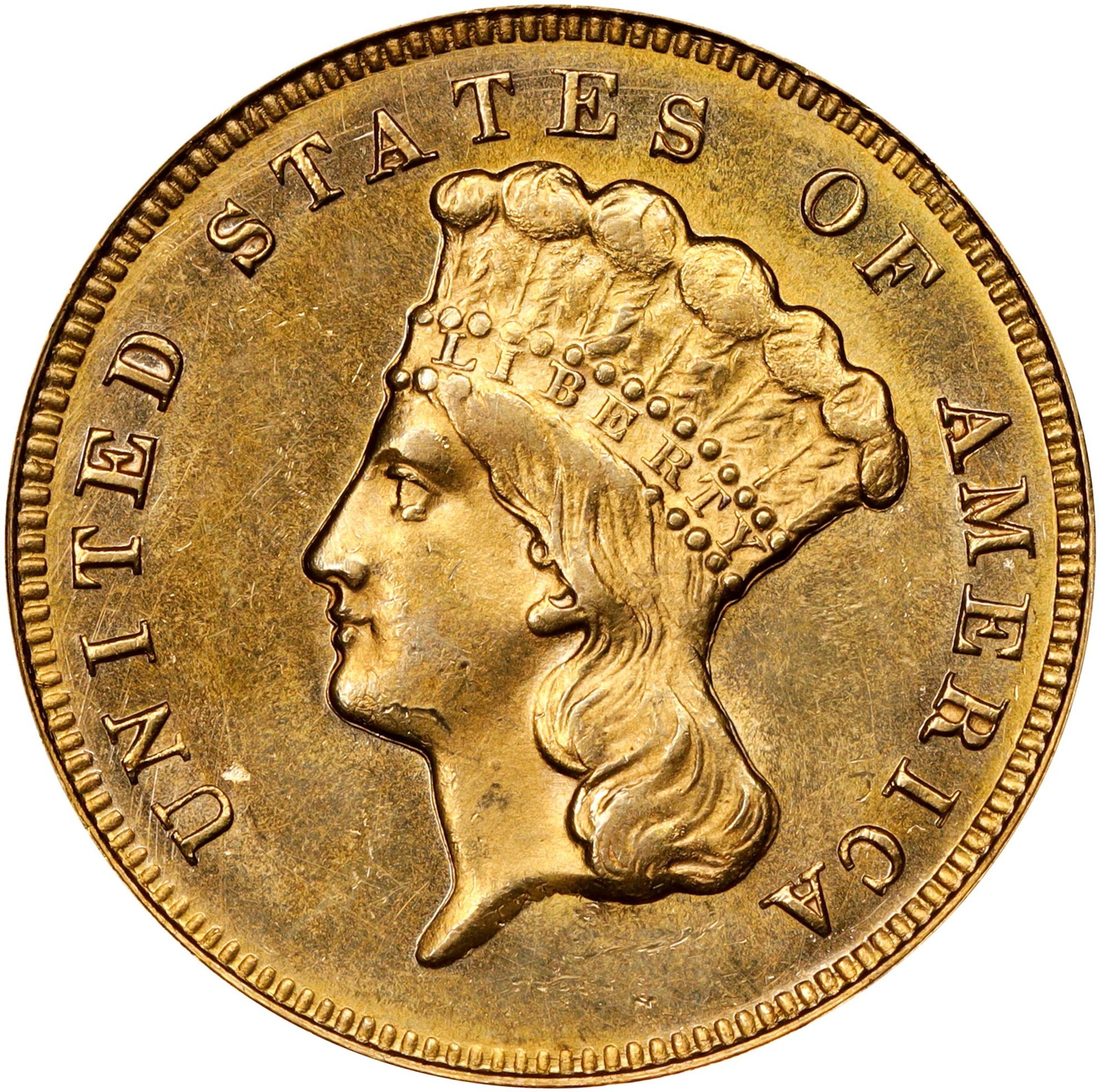
1874 $3 MS (PCGS#7998)
Summer 2025 Global Showcase Auction U.S. Coins
- Auctioneer
- Stack's Bowers
- Lot Number
- 3261
- Grade
- MS62
- Price
- 5,520
- Lot Description
- There are hints of semi-reflectivity in the fields for this otherwise satiny 1874 three, but it is still difficult to understand its cataloging as a "Brilliant proof" when offered in B. Max Mehl's famous February 1944 sale of the Belden E. Roach Collection. Lightly struck on the high points of the obverse portrait, also at the digits 18 in the date and over and around the ribbon knot on the reverse, although appreciably bolder definition is noted elsewhere. The golden-orange surfaces reveal no singularly mentionable marks apart from an obverse nick low on Liberty's jaw.<p>Among the many provisions of the Act of February 12, 1873, was the requirement to "renovate" the nation's gold coin situation with regard to pieces that had lost some of their intrinsic and, by extension, face value due to wear. In the <em>Annual Report of the Director of the Mint</em> for the fiscal year ending June 30, 1874, Mint Director James Pollock commented:<p><em>It seems a remarkable omission in our laws, that there is no limit at which our coins shall cease to be legal tender on account of wear. In England, the sovereign, or pound sterling, is not legally current when it has lost more than half a grain....It has not been a serious trouble in this country from the fact that our coin is so apt to be exported. And yet it makes difficulty at the Customs Houses and national treasuries, as we have had occasion to know. The collectors and treasurers hardly know what they are to do when coins much abraded are offered to them. In some sections where gold is much used, as on the Pacific Coast and in the extreme southwest, the wear is very marked.</em><p>The relevant provisions in the Act of 1873, however, gave Pollock some hope in the government's ability to rectify this situation. By its terms, the Mint destroyed $32,717,185.50 in worn gold coins, mostly from Treasury Department stocks. These coins had sustained a loss in value of $193,568.90, or 0.017% of face value, and their destruction prompted Pollock to write: "The renovation of the gold coins is now about complete, except as to the light or worn pieces in circulation in the Pacific Coast states and territories; and if some provision were made for their withdrawal, the entire gold coinage would then be in good condition." Bullion recovered from the melted pieces was recoined into new gold issues.<p>Today's gold type collectors can certainly be thankful for this chain of events, since this recoinage of melted pieces resulted in an unusually high mintage of 41,800 circulation strikes for the 1874 three-dollar gold piece. This is the highest total achieved for the denomination since 1855. Thanks to this mintage, the 1874 now numbers among the more readily available issues in a series replete with rarities. Even so, the 1874 must be regarded as a scarce coin in lower Mint State grades relative to market demand. This MS-62 offering from the Floyd T. Starr Collection is particularly intriguing, for it was honestly offered by B. Max Mehl - and accepted by Mr. Starr - as a Proof in the different numismatic market of the early to mid-20th century. As with several of the threes in this collection, it turned out to be a circulation strike when evaluated using today's more advanced scholarship and stricter standards.