1830 $2.50 Templeton Reid MS(PCGS#10320)
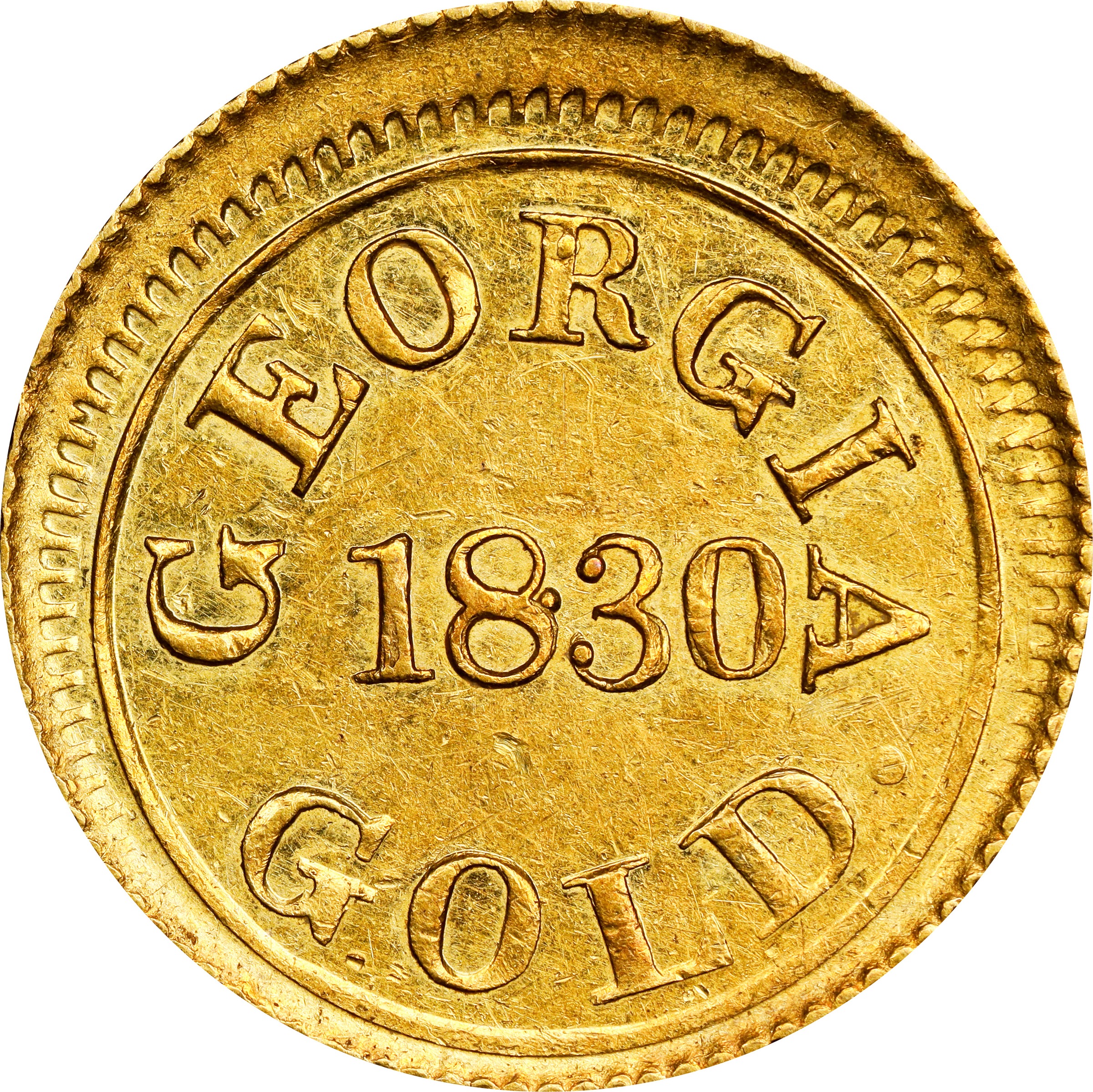
1830 $2.50 Templeton Reid MS (PCGS#10320)
February 2026 Showcase Auction - The James A. Stack, Sr. Collection Part II
- Auctioneer
- Stack's Bowers
- Lot Number
- 23042
- Grade
- AU58
- Price
- 504,000
- Lot Description
- An immensely desirable example of this historic rarity from Milledgeville, Georgia, the first private gold emission from an American gold rush. Thoroughly lustrous over beautiful light yellow gold surfaces, with abundant prooflike reflectivity remaining. The high rims, typical of the issue, are unbent, undamaged, and intact on this piece. The reverse is perfectly centered, while the obverse is significantly misaligned to 6 o'clock, an alignment that suggests an anchored anvil die and a handheld hammer die. The strike was crisp and boldly brought the relief into full detail. The alignment shows that the denticles were not an added design element, created through shaped punches, but were instead scalloped away from the die face. Scattered infinitesimal marks and trivial hairlines are seen on both sides. The only significant mark, a dogleg-shaped abrasion above the second A in ASSAYER, looks fresh but is actually visible in the Nygren sale plate from 1924. Another similar abrasion extends from the right side of that A to the bottom left serif of the Y at its right. The reeding is sharp and the edges appear perfect. The flashy aesthetic appeal and superb bright color of this piece make it stand out amidst even the rarefied air of this extremely elusive issue.<p><p>The rarity of this issue makes it notable to coin collectors, as its population of fewer than 25 known specimens in all grades puts those who own any Templeton Reid coin into an exclusive club indeed. Lots of things are rare though, and while rarity is necessary, it is insufficient on its own to give a collectible the sort of stature a gold coin struck by Templeton Reid enjoys. Its real importance is historical, and if there were 500 Templeton Reid coins to choose from that significance would be undiminished. Private gold coins are a vital part of America's numismatic story. With apologies to Mssrs. Brasher and Barry, whose golden contributions to the Confederation-era money supply were issued under very different circumstances, the story of private and territorial gold begins with Templeton Reid.<p><p>America's first gold rush began in North Carolina in 1799, when John Reed's son Conrad discovered gold on the family farm north of Charlotte. The same geological feature that brought gold to the surface in North Carolina was present in Georgia. When stories began to emerge around 1829 of gold on Cherokee lands in Georgia, new settlers rushed into the area, buoyed by Andrew Jackson's December 1829 State of the Union address, which first detailed his planned Indian removal policy. With the 1830 Indian Removal Act, federal policy blessed what was already happening on the ground in the gold regions of Georgia: abundant new miners drawn by the promises of gold.<p><p>The amount of Georgia gold received at the Philadelphia Mint in 1830 was enough to strike almost 100,000 quarter eagle coins. Getting the gold to the Mint to deposit and turn into spending money required real effort - or the inclusion of middlemen in the new economy. Into this void stepped German-born Templeton Reid, a blacksmith and mechanic who used his skills to make rifles, watches, and more. His skillset was easily mapped onto a minting operation, and Reid set himself up in Milledgeville in 1830. The <em>Georgia Journal</em> of July 24, 1830, cited by Kagin and McCarthy, noted that Reid's operation was created "for the purpose of putting gold into a shape more convenient than that in which it is originally found." Word spread quickly across the South and elsewhere. Within a week, the <em>Charleston Daily Courier</em> in South Carolina was reporting from the <em>Southern Recorder</em> of Milledgeville, GA:<p><p>About $1500 worth of Gold has been stamped by our ingenious townsman, Mr. Templeton Reid, with handsome dies, shewing the actual value of each piece of metal, in parcels of $2.50, $5, and $10. The pieces of ten dollars have on one side the inscription: "Georgia Gold, 1830" - and on the other, "Ten Dollars, Templeton Reid, Assayer." The die of the five dollar pieces is not inferior in execution to the stamp on the coin issued from the National Mint. Mr. Reid informs us that the gold thus stamped by him will be taken at the Mint and at most of the Banks for the value it purports on its face to bear. This will give it a pretty general currency, and make it answer the purposes of money.<p><p>Reid's claims about the Mint weren't idle marketing either. When Eckeldt and Du Bois published <em>A Manual of Gold and Silver Coins </em>in 1842, they found that a Templeton Reid $10 assayed at a value of $10.06. Mentioning that they had seen all three denominations of Reid's Georgia gold coins, Eckfeldt and Du Bois wrote "on two occasions they were brought to this mint in quantities, but not since 1831. They were soon discontinued, and probably by this time are nearly forgotten, even at home."<p><p>The rapid re-coining of Reid's coins at the Philadelphia Mint may have destroyed most of the mintage within the first year or two. Undoubtedly the construction of the mint and assay office at Dahlonega, Georgia in 1837 sped the destruction of the remaining Reid coins. While Reid's first mint was in Milledgeville, Georgia's centrally located capital, he quickly moved to Gainesville, just 20 miles from Dahlonega in northern Georgia. By late 1830, his success had begun to backfire, and national newspapers began to question the legal and Constitutional authority of a private citizen to strike gold coins. The widely read <em>Niles Weekly Register</em> picked up an article from the <em>New York American</em> in October 1830 that was critical of Reid:<p><p>But, as the constitution does not express that Congress shall have the <em>sole</em> power of coining, and as states only, and not individuals, are forbidden to coin, this Mr. Reid, who is doubtless of the Virginia school of strict constructionism and who is not a state, finds himself at Liberty to exercise this high attribute of sovereignty.<p><p>By February 1831, the <em>Alabama State Intelligencer</em> was using the past tense when referring to Reid's exercise of individual sovereignty. Talking about the amount of native gold deposited at the Philadelphia Mint the previous year, the paper noted "Georgia herself has furnished of this sum $212,000, exclusive of the large sums coined by Templeton Reid, who, for several months, had a private mint near the mines." The only other 1831 newspaper reference to Reid found in a commonly used database comes from Macon, <em>Georgia's </em><em>Weekly Telegraph</em>, which referenced him in October 1831 when they reported "there has recently been brought to this market N. Carolina Gold in a new shape, that of $5 pieces coined in Rutherford County by C. BECHTLER, Assayer. … This Mr. Bechtler is the <em>Templeton Reid</em> of N. Carolina. We believe Mr. Reid has the credit of originating this new way of making money." While Reid continued to be high profile in his area of Georgia, advertising himself as "Templeton Reid, Cotton Gin Maker, also, Silver, White, and Gun Smith," his coins would seemingly never make the papers again. In 1852, a newspaper in Sydney, Australia republished a piece on California private gold coins from <em>Bankers' Magazine</em> which mentioned Reid's 1849-dated $10 and $25 "California Gold" coins. An 1862 report from the Congress of the Confederate States of America on gold mining and money made the papers in Richmond, noting that Reid's "coinages were rude, but serviceable 'tokens of value,' before branch mints were opened in Southern States near the mining region." Subsequent references to Reid were all numismatic in nature, and by the 1860s, his rare coins were collectibles.<p><p>The earliest auction offering known to us was in the April 1892 Chapman brothers' sale of the Colin E. King Collection, where a Reid $2.50 was described as "Very fine. Of excessive rarity, the only specimen known to us and we cannot find where any has been previously offered. This is probably the first coin issued by private enterprise in America." There was one in the 1908 Elder sale of the James B. Wilson Collection, and the few appearances in the 1910s were mostly the same coin. It's puzzling that San Francisco collector and private gold specialist Arthur C. Nygren was able to gather three of these, perhaps the second largest hoard ever assembled after the remarkable half dozen brought together by Virgil Brand. It is telling that of Nygren's three, this one brought the most and was selected by one of the most recognized quality connoisseurs of the era, Hillyer Ryder. It brought $235 in 1924. The lot prior to this in the Nygren sale sold for $210 to Brand, the last of his six to be acquired. As Henry Chapman stated in the sale catalog, "Note. It is remarkable to see three examples of this rarity offered in one sale, but Mr. Nygren seems to have truly loved rarities." He did, perhaps too much. Deeply indebted, he left San Francisco for his boyhood home in Illinois and killed himself there in July 1923 at the age of 47.<p><p>We have not offered a Templeton Reid $2.50 since our August 2018 ANA sale. We've sold just three in the last 20 years: An NGC MS-61 in our November 2006 Archangel Collection sale (at $299,000), a VF-35 (PCGS) in July 2008, and an AU-58 (PCGS) CAC in August 2013 at $329,000. The last example sold anywhere was a PCGS AU-58 CAC (earlier from our August 2013 sale) in Heritage's sale of January 2024 at $384,000. The current record price is for a PCGS MS-61, the finest certified, which brought $480,000 in the February 2020 Kagin's auction.