1837 10C Capped Bust PR(PCGS#4559)
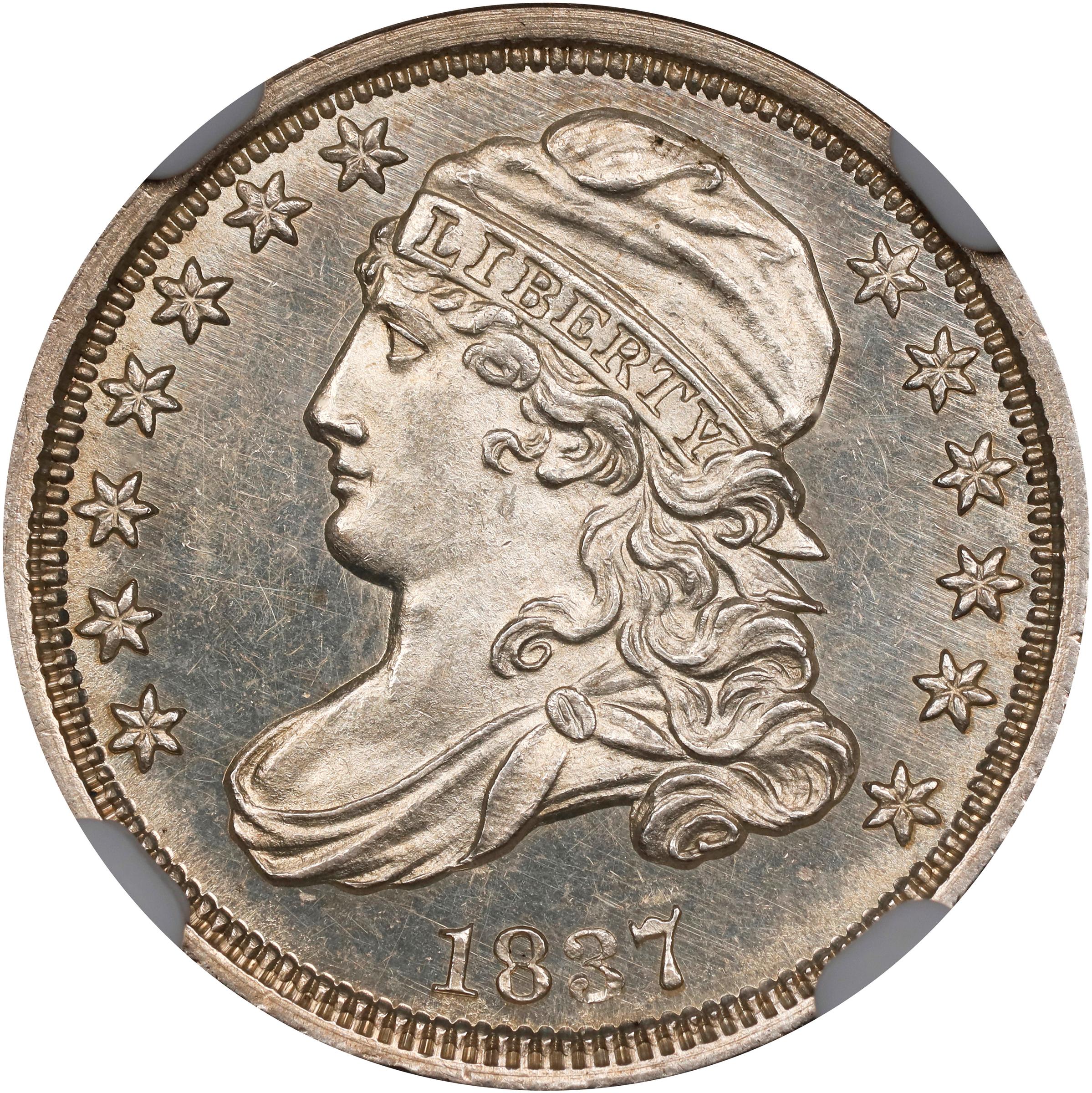
1837 10C Capped Bust PR (PCGS#4559)
Summer 2025 Global Showcase Auction U.S. Coins
- Auctioneer
- Stack's Bowers
- Lot Number
- 3031
- Grade
- PR64
- Price
- 72,000
- Lot Description
- This is an intriguing coin, and also an exceedingly rare one. The pre-1840 years offer significant challenges to numismatists when it comes to the United States Mint's Proof coinage. This is the era in which the Mint struck these special coins almost exclusively for presentation and other official purposes, as the number of collectors in the United States at the time could be counted on one hand. Examples were produced on an as-needed basis, often at different times throughout the year, and always in extremely limited numbers. In some years no Proofs were struck, either at all or for certain denominations. No records were kept; these issues were not included in the yearly Mint Director's reports. The quality and appearance of the coins themselves and, in some instances confirmed provenances, are all that numismatists can use to identify the surviving Proofs from this era.<p>The year 1837 was a transitional one in the dime series which saw the last of the Capped Bust and the fist of the Liberty Seated coins delivered by the Philadelphia Mint. Proofs are known for the incoming 1837 Liberty Seated dime, at least "some 30 brilliant Proofs struck for presentation to Treasury officials and other VIPs," as related by Walter Breen in his 1988 <em>Encyclopedia</em>. For Proofs of the outgoing 1837 Capped Bust dime, however, in the 1989 edition of <em>Walter Breen's Encyclopedia of United States and Colonial Proof Coins</em> the author states, "Draped [sic] Bust design: rumors persist, unverified, Wayte Raymond saw one." This is a curious comment inasmuch as the present example was known to the numismatic community at least as early as 1977, when it was auctioned by Paramount in their Dr. Franklin E. Altany Collection sale of February. Lot 220:<p><em><strong>1837, Bust Type, Proof-60.</strong> Bold strike and deep, fully reflective surfaces. Light violet toning and only a few very light insignificant hairlines in the fields. All proofs of this type are very rare and this is the first 1837 that I can recall seeing, although possibly as many as four or five exist. Far more rare than the Seated Liberty proof of this same date of which a reported 30 specimens were struck and perhaps as many as 15 or 20 remain today. The 1837 Seated Liberty proof dime in our 1976 Grand Central Sale brought $3200 and since this piece is perhaps four or five times as rare, it could bring a substantially higher figure.</em><p>The coin went on to appear in RARCOA's session of Auction 82, as lot 666, in which it was cataloged, in part, as:<p><strong><em>1837</em></strong><em> Capped Bust Type. Last year of type. <strong>CHOICE</strong> LILAC AND GOLDEN TONED <strong>PROOF</strong>. EXCESSIVELY RARE and very seldom offered or even seen in Proof.</em><p>These two auction appearances were picked up by the John Reich Collectors Society and reported in their 1984 reference <em>Early United States Dimes: 1796-1837</em>, in which they declare that this coin is the only Proof seen from the JR-2 dies. The authors report one other Proof for the 1837 Capped Bust issue, a JR-3 example from our (Stack's) December Sale of 1969.<p>Moving into the market of the 21st century, we find that PCGS has yet to certify a Proof of any die pairing for the 1837 Capped Bust dime. The offered coin, certified as a Specimen by NGC, is the only Specimen or Proof of this date certified by NGC. The term "Specimen" is probably one of the most unevenly applied and easily misunderstood of those used on third party certification holders. With regard to the present example, it is your cataloger's opinion that the Specimen certification by NGC is an attempt to recognize a coin that was obviously prepared under special circumstances, and with special intent, by the coiners, but which lacks documentation and/or a confirmed provenance confirming beyond doubt its status as a Proof as that term is understood for later date U.S. Mint coins. As above, this is the familiar set of challenges for pre-1840 U.S. Mint Proofs.<p>That this is clearly a special coin is obvious even after a cursory glance. The planchet was specially prepared with raised diagonal lines (as made) evident in the reflective fields. The strike is full for all major design elements, and evidence of double striking is seen at most of the letters in the peripheral legend on the reverse, as well as at the digits 18 in the date. On the other hand, and for accuracy's sake, we note that the denticulation on the reverse is not crisp in all areas, and the polishing in the fields is not seen to the same extent within the vertical stripes of the shield. These trivial shortcomings could easily have been seen as perfectly acceptable for a Proof coin by the U.S. Mint of 1837, and the point was probably not even considered by the coiners at the time. Yet Specimen is the designation that NGC has assigned to this coin, it is a good one here, and adequately defines this as the closest thing to a Proof 1837 Capped Bust dime known to numismatists in today's market. Lightly toned in champagne-gold iridescence, this is an elegant Choice Specimen that belongs in an advanced collection of early U.S. Mint Proof and related coinage.