1856 1C Flying Eagle, CAM PR(PCGS#882037)
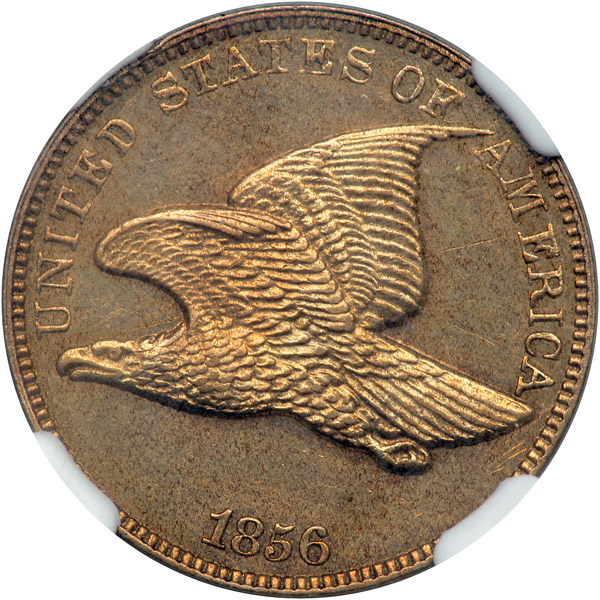
1856 1C Flying Eagle, CAM PR (PCGS#882037)
September 2010 Pre-Long Beach Auction #60
- Auctioneer
- Goldberg Auctioneers
- Lot Number
- 1293
- Grade
- Proof 63
- Price
- 13,800
- Lot Description
- A nice bold strike with pleasing even light tan toning throughout. We note a few minor hairlines, one on the reverse beneath CEN. This Key Date rarity appears more like a mnt state example. In 1856 one master die was made for the Flying Eagle cent (today the letters are called the Style of 1856 letters and, among other characteristics, have a somewhat squared center in the 0 in OF; A and M in AMERICA touch, but the M is slightly higher than the A). This identical master die was used to make all 1856-dated dies and, very early in 1857, to make 1857-dated dies with Style of 1856 letters. In all probability, the letter punches used to make this and other master dies were ordered from a private source outside the Mint.<BR><BR>After working dies were made to strike Flying Eagle cents, the dies were dressed or finished to remove burrs and surface irregularities. Proof dies were given special mirror finishes. The Proofs dated 1856 were polished less thoroughly than those dated 1857 and 1858. However, among nearly all Proof Flying Eagle cents, the Proof surface is not as mirrorlike as that found, for example, on 1856-1858 Proof silver or gold coins.<BR><BR>A truly beautiful Proof 63, tightly buttoned down grade concealing no defects. Reflective surfaces in line with the choice quality one expects. This combines with finely textured motifs to give the coin nonstop eye-appeal. The obverse and reverse both are naturally toned. Unquestionably the most famous of all 19th century small cent rarities, certainly a date whose celebrity is generations old within the collecting fraternity. Scholarship has for the time being settled the argument as to the number of 1856 flying eagle cents that were made: perhaps 1,500 to 2,500, some in 1856, and others over the course of the next few years to supply those who missed out on the original allocation. The 1856-dated pieces were made to sway congressmen and others of the need for smaller-sized cents to replace the old unwieldy large cents.