1793 1/2C, BN MS(PCGS#1000)
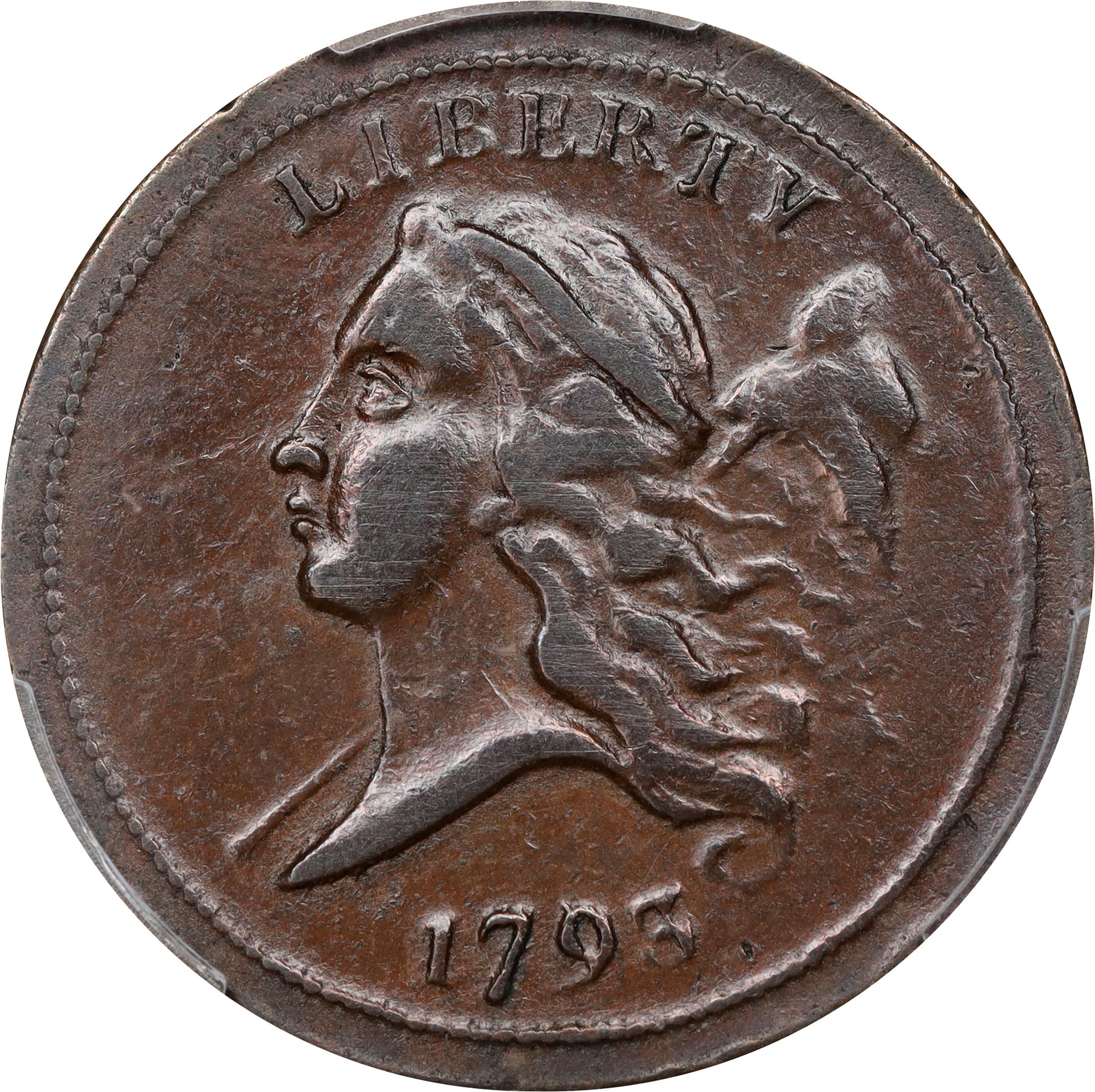
1793 1/2C, BN MS (PCGS#1000)
February 2026 Showcase Auction - The James A. Stack, Sr. Collection Part II
- Auctioneer
- Stack's Bowers
- Lot Number
- 25003
- Grade
- XF40BN
- Price
- 27,600
- Lot Description
- Exceptional quality for the assigned grade, this thoroughly PQ example exhibits reddish-russet highlights to dominant medium brown patina. Sharply defined in most areas, the strike is also ideally centered on a nice, broad planchet. The in-hand appearance is remarkably smooth in the absence of troublesome marks. The reverse is rotated approximately 45 degrees clockwise from normal coin alignment, an attribute we have noted in several other 1793 half cents of the C-2 die pairing.<p>The 1793 half cent is significant as the first United States half cent, the only issue of the Liberty Cap, Head Left design type and one of just two denominations struck during the Mint's first full year of coinage operations (the other is the large cent). Henry Voigt engraved the dies, and by mid-May the Mint had already prepared more than 30,000 planchets for the half cents, including having their edges lettered. All of the planchets were made from sheet copper. Actual coinage did not commence until July 19, however, with production on that date probably accounting for most or all of the 7,000 examples delivered to the treasurer the following day. The remaining 24,934 half cents were struck from July 23 to 25 and delivered on July 26, for a total mintage of 31,934 pieces for the 1793 Liberty Cap issue. The oft-published mintage of 35,334 pieces for this issue includes an additional 3,400 coins delivered with the Liberty Cap cents on September 18, 1793, that William R. Eckberg (<em>The Half Cent, 1793-1857: The Story of America's Greatest Little Coin</em>, 2019) believes were actually cents based on the records of Mint Treasurer Tristram Dalton. When half cent coinage resumed in 1794, the denomination featured a modified Liberty Cap design by Robert Scot with the portrait facing to the right.<p>Given its current popularity, it may be surprising that the 1793 half cent seems to have been generally overlooked by contemporary collectors. No notable high grade pieces appeared from English or other European sources in the 20th century, suggesting that few, if any, Mint State examples were set aside by numismatists and others who visited the early United States. It was not until the 1850s that numismatics as a hobby began to gain widespread popularity in the United States, and the earliest known interest in the 1793 half cent as a valuable collectible dates to that decade. In 1855 collector Winslow Howard purchased a lot of two examples in the Pierre Flandin sale, one of the first major numismatic auctions held in the United States. Mr. Howard paid $7 for his two 1793 half cents, a sizable sum, especially since half cents could still be found in commerce during the 1850s, at least in major Eastern cities like Philadelphia and New York. It is almost certainly the retrieval of coins from circulation during the decade preceding the Civil War that accounts for the majority of 1793 half cents known today, a theory that squares nicely with an extant population comprised almost exclusively of worn coins.<p>The exact number of Mint State 1793 half cents extant is a matter of debate, although it certainly represents an infinitesimal proportion of all survivors. Given their undeniable rarity, the best that most collectors can hope to acquire for this issue is an AU, although the sharp-eyed bidder will recognize this premium EF-40 as conservatively graded and difficult to improve upon in a lightly circulated example.<p>Numismatic researchers have identified four different die pairings for the 1793 half cent. Cohen-2, represented by the present specimen, shares its obverse with C-1 and its reverse with C-3. Bill Eckberg asserts that this variety was struck on July 23, 1793, and delivered with the C-3 and C-4 coins on July 26. The author's estimate on the number of survivors for the C-2 pairing is 250 to 325 coins. Although all four die marriages of this issue are of roughly equal availability in an absolute sense, the C-2 is very rare above Extremely Fine with Ronald Manley observing that examples are "usually available only in low grades."