1943-S 1C Bronze, BN MS(PCGS#82715)
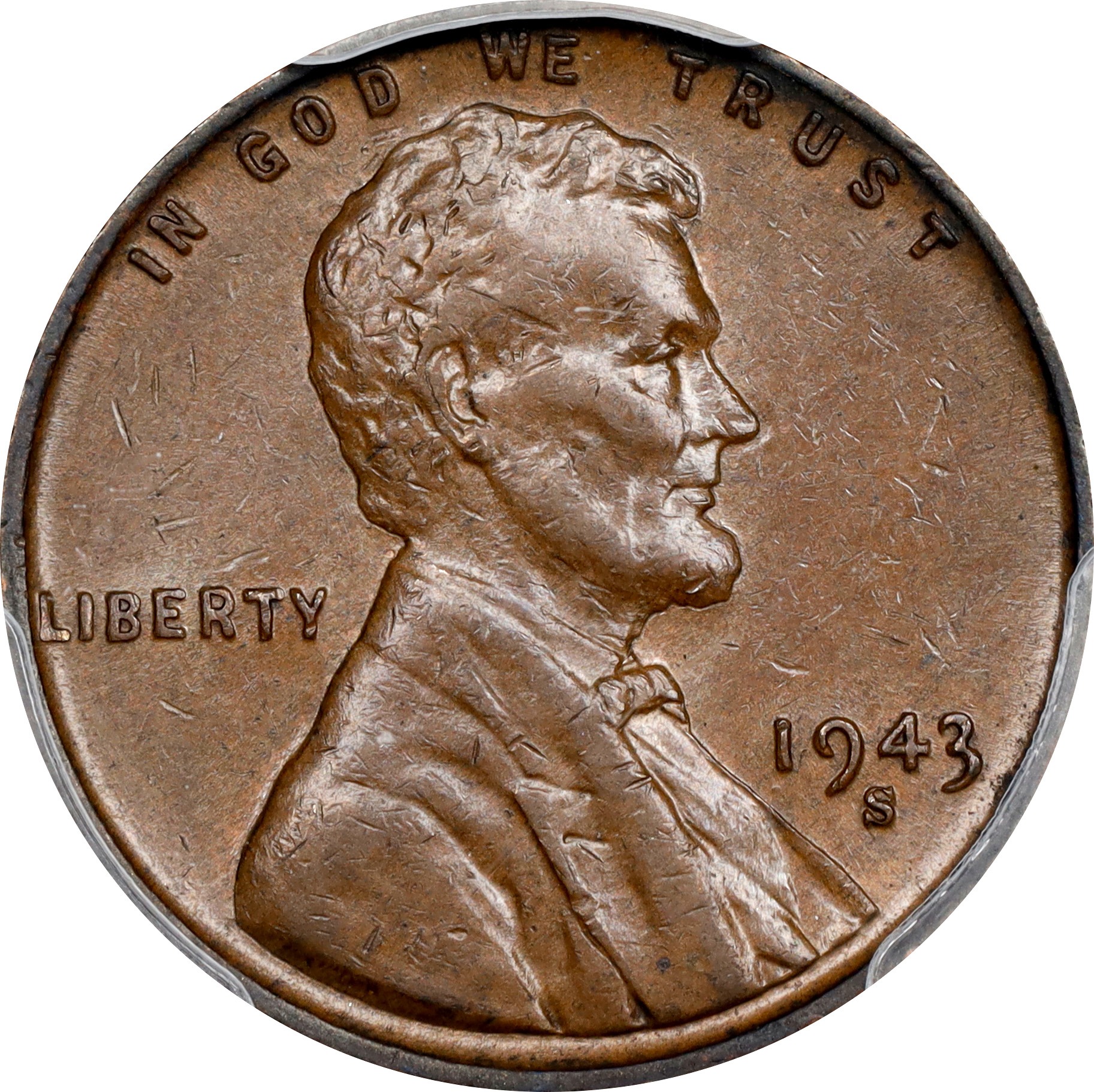
1943-S 1C Bronze, BN MS (PCGS#82715)
Spring 2026 Showcase Auction U.S. Coins
- Auctioneer
- Stack's Bowers
- Lot Number
- 3024
- Grade
- AU55BN
- Price
- 456,000
- Lot Description
- The 1943 bronze cent, or "1943 copper penny" as it is more widely and affectionately, if less formally known, is one of America's most beloved numismatic rarities. Millions of Americans have experienced at least a fleeting moment when they dreamed of finding one of these treasures in pocket change. A very few did, the vast majority did not, but the success stories helped to keep the dream alive for treasure hunters, while at the same time creating and fueling a vast publicity campaign that has made the "1943 copper" one of the few U.S. Mint rarities that is as well known to numismatists as it is to non-collectors. Writing in the first (1996) edition of their book <em>The Authoritative Reference on Lincoln Cents</em>, John Wexler and Kevin Flynn sum up the extreme popularity of the 1943 bronze cents when they write:<p><em>In the 1940s, 50s, and 60s, millions of Americans were drawn into the frenzy of searching their pocket change in hopes of finding one of these elusive coins. False rumors that Ford Motor Company would give a new car if one was found and other high publicity stunts made this a fantasy coin.</em><p>The hunt continues today, although mostly among advanced numismatists eagerly awaiting the return of one of the few confirmed examples to the open market after years, if not decades spent in a tightly held collection. Yet even so, newly discovered (or rediscovered) examples are still occasionally revealed to the numismatic community, one of the most recent within the past few couple of years and involving your cataloger (JLA). But first, however, we must return to 1943, the pivotal year of the Second World War in which the Allies finally turned the military tide against the leading Axis powers of Germany and Japan, and the year which gave us the beloved "1943 copper penny."<p>The history of the 1943 bronze cents begins with the United States government's classification of copper as a critical war material, most significantly for use in producing shell cases for artillery and other weapon systems. (Soviet dictator Joseph Stalin famously called artillery the "God of War" in a wartime speech delivered in 1944, and firsthand accounts by German military personnel contain numerous references to engagements during the North African campaign of late 1942 and early 1943, in Italy from 1943 until the war's end and, especially, in Western Europe beginning with the landings at Normandy on June 6, 1944, in which their forces were severely disadvantaged by the United States Army's generous use of artillery.) After receiving authorization from Congress in 1942 to find a suitable alternative for bronze in the nation's one-cent coin, the Treasury Department began experimenting with several different compositions, including aluminum, plastic, pressed fiber (a material already being used in the production of coal scrip and OPA ration tokens), and even various forms of glass. Ultimately, zinc-coated steel was selected, a singularly poor choice for, as David W. Lange observes in his 1996 reference <em>The Complete Guide to Lincoln Cents</em>:<p><em>Zinc readily corrodes to a whitish, powdery texture, while the underlying steel is subject to plain old rusting. A worse combination of metals for coinage could not have been devised by a madman, and their use during 1943 reveals the critical situation in which the United States of America found itself.</em><p>Lange continues:<p><em>By the middle of 1943 it was already evident that this experiment was an unqualified failure. So many complaints were received from persons who mistook these cents for dimes that the Mint was already preparing to return to the copper and zinc alloy used for most of 1942. It waited until the first of the year, however, as every precaution was taken to prevent further confusion and the creation of unintentional rarities. In the meantime, steel cents were distributed only when existing supplies of the earlier cents had been exhausted. This happened all too quickly, as the demand for cents during 1941-43 was seemingly insatiable.</em><p>Fortunately, all three operating mints had churned out more than a billion steel cents to meet this anticipated demand, divided as follows:<p>-Philadelphia Mint: 684,628,670<p>-Denver Mint: 217,660,000<p>-San Francisco Mint: 191,550,000<p>Recognizing the inadequacy of the zinc-coated steel composition for coinage, in 1944 the Mint reverted to bronze planchets for cent production, finding a ready supply in melted shell cases whose rounds had been prodigiously expended on the battlefields of a global war.<p>With such a substantial output of cents that year, and operating under wartime conditions, it is little wonder that the Mint's quality control procedures failed at times and, despite its best intentions, unintentional rarities were produced and distributed alongside the normal 1943 steel cent coinage. As related in an article published in the August 11, 2008 edition of <em>Coin World</em>, a 1943-S Lincoln cent struck in bronze as opposed to the authorized zinc-coated steel composition had been "found in circulation by 14-year-old collector Kenneth S. Wing Jr. around 1944 in Long Beach, Calif., while he was trying to assemble a set of Lincoln cents." The Simpson specimen, now certified MS-63 BN by PCGS, was allegedly "Found in the year of issue in a Mint-sewn bag of 1943-S steel cents" by Merl D. Burcham, as claimed by Superior Galleries in their cataloging for the February 1974 Dr. Charles L. Ruby Collection sale, Part I. In 1947, another teenager, 16-year old Don Lutes, Jr., found a 1943 bronze cent struck at the Philadelphia Mint in change received from his high school cafeteria. Since the Wing specimen had remained within his family for 60 years and was unknown to the numismatic community, and the backstory of the Simpson coin was unsubstantiated, the Lutes specimen was long thought to be the discovery coin for the 1943 bronze cent.<p>These finds, coupled with the fact that most of the known examples are in circulated grades, support the widely accepted theory on the creation of the 1943 bronze cents as summed up by Jeff Garrett and Ron Guth in their reference <em>100 Greatest U.S. Coins</em> (fifth edition, 2019):<p><em>Presumably, the error occurred when left-over bronze planchets were mixed with a batch of the new steel planchets and went through the usual striking methods, then escaped into circulation, evading the quality control procedures at the Mint.</em><p>Given their nature it is no wonder than controversy often accompanies many major Mint error coins, and so it is with the 1943 bronze cent. In fact, the very manner of these coins' creation has been questioned at times, with some numismatists asserting that they are intentional fantasies - perhaps even backdated ones - produced by Mint employees. Proponents of this theory point to the unique 1943-D bronze cent tracing to a former Denver Mint employee, as well as the two-coin set of 1943 bronze and 1944 steel cents that a "female acquaintance" of former Mint Engraver John R. Sinnock sold to dealer William Girchin sometime around 1961. More recently, numismatists have identified several different alloys among extant examples, including planchets intended for foreign coinage struck at the U.S. Mint, while author and researcher Roger W. Burdette has also discovered specific documentation that reveals the Mint was striking experimental cents on planchets made from bullet shell casings in late 1943. In the end, however, the numismatic community as a whole, and certainly average Americans who are familiar with these coins, see no distinction between individual examples - in other words, a "1943 copper penny" is a "1943 copper penny." And to underscore the fact that most documented discoveries have been by regular citizens finding the coins in circulation, the most recent example to make its existence known to the numismatic community is also an early pocket change find. This is the 1943-S in PCGS VF-30, which a California resident and personal friend of your cataloger found in circulation decades ago. The coin, which remains with the discoverer and has never been offered for sale, was certified by PCGS in 2023 through Stack's Bowers Galleries.<p>Such new discoveries are rare, however, and the total number of 1943 bronze cents known is likely to remain more or less fixed for the foreseeable future. Saul Teichman has published detailed census and provenance information on these special coins on the <em>Newman Numismatic Portal</em>, which confirms only 17 distinct examples of the Philadelphia Mint 1943 bronze and a mere seven coins for the 1943-S bronze. The 1943-D bronze remains unique in the form of the PCGS MS-64 BN specimen that sold for $840,000 in Heritage's January 2021 sale of the Bob R. Simpson Collection.<p>That these coins remain as popular now as they did when Americans first began searching for them in the 1940s is confirmed by the ranking of the 1943 bronze cent as an issue both as No. 11 in the aforementioned 2019 edition of the Garrett-Guth reference <em>100 Greatest U.S. Coins</em>, and as No. 4 in the equally influential book <em>100 Greatest U.S. Error Coins</em> by Nicolas P. Brown, David J. Camire and Fred Weinberg (2010). These are the only coins to be included in both listings for, while the 1943 bronze cents are technically Mint errors - wrong planchet errors, to be precise - their fame and popularity have long established them as an integral part of the Lincoln cent series.<p>The 1943-S offered here is one of the finest, and also among the best-known examples of this prized rarity. It is the only 1943 bronze cent from any of the three issuing mints to have received coveted Gold CAC approval and, indeed, with plenty of softly frosted luster remaining on both sides, it is a top-tier Choice About Uncirculated coin. Nearly complete strike detail remains in the absence of all but trivial friction - further confirmation that the AU-55 grade returned by PCGS is very conservative. One will need a loupe and good lighting to discern a few small, well-scattered marks from a brief stint in active circulation, as none are noticeable, let alone distracting to the unaided eye. A minor mark at the back of Lincoln's forehead, above the ear, slants down to the right and joins a tiny divot in the reverse field above the letters ST in STATES to identify this coin in future market appearances. Bathed in warm chocolate-brown patina with a hint of autumn-orange, both sides also exhibit subtle lilac-blue and pale pink undertones to further enhance the eye appeal.<p>The offering of any 1943 bronze cent is always greeted with great enthusiasm, and this thoroughly PQ and visually appealing Choice AU specimen from the San Francisco Mint will surely see spirited bidding as it transitions into another world-class collection.