1794 $1 MS(PCGS#6851)
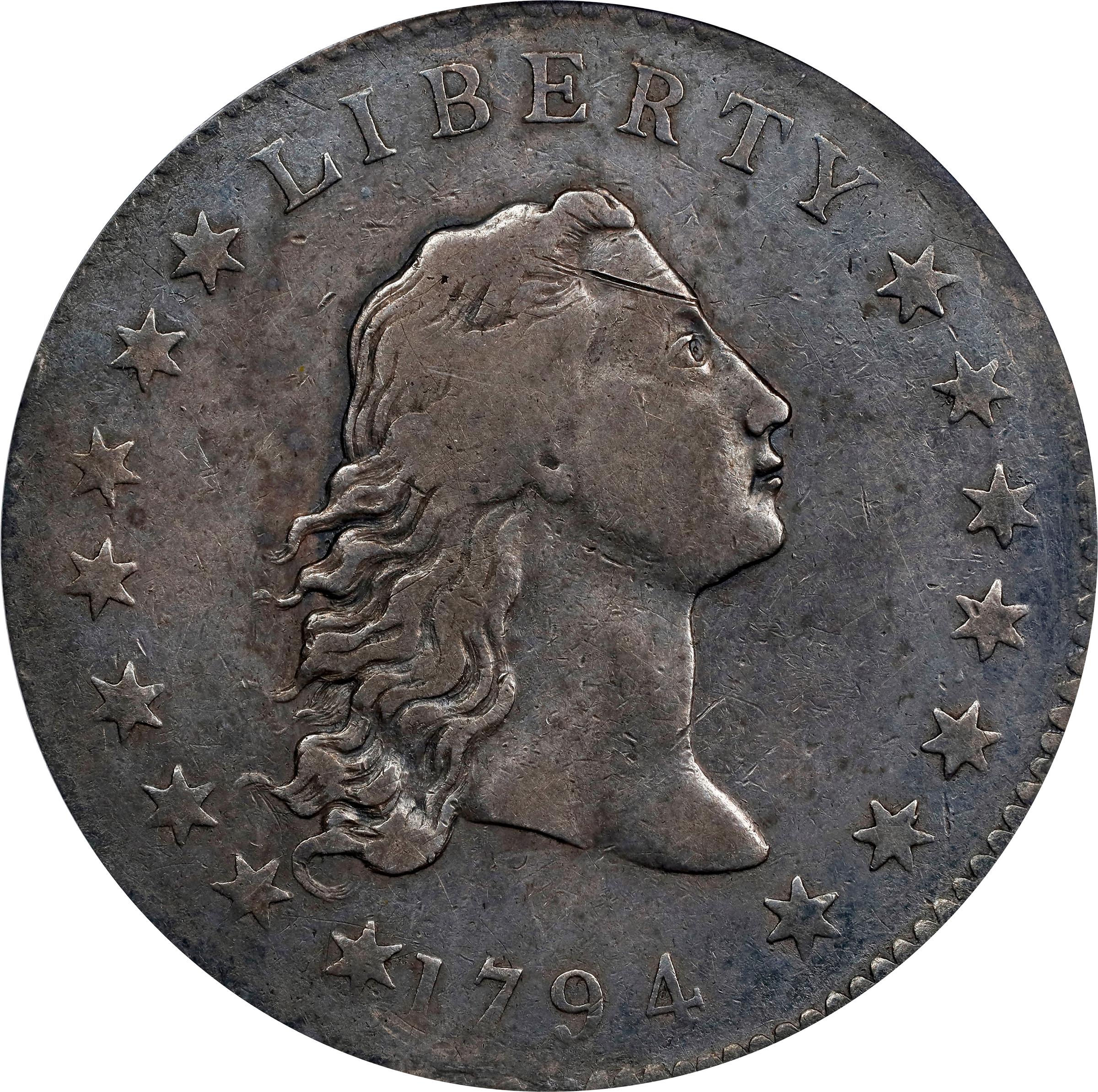
1794 $1 MS (PCGS#6851)
February 2026 Showcase Auction - The James A. Stack, Sr. Collection Part II
- Auctioneer
- Stack's Bowers
- Lot Number
- 25078
- Grade
- VF35
- Price
- 312,000
- Lot Description
- BB Die State III. The 1794 silver dollar is an American classic and one of the bluest of the blue chip coins known today. The present example has been held in well known collections since it was first sold in the Bushnell Collection in 1882, and has a solid provenance since that time. The color is deep silver-gray and generally even save for a few mottled areas at the peripheries. Although a later die state, the strike is sharper than usually seen, especially on the left hand stars, with each well outlined by the obverse die. On the area opposite in the reverse legend, there is minor softness at the tops of some of the letters, but again most of these show. Free of any heavy rim marks or similar issues. Close examination will find traces of adjustment at the reverse border, but these marks are as made and lighter than usually seen. There is a short scratch on Liberty's forehead which identifies this coin nicely and confirms its numismatic provenance.<p>The most important silver dollar ever struck - and also one of the rarest - is the 1794 Flowing Hair. The first of its kind and a famous numismatic rarity in all grades with a mintage of just 1,758 pieces, the 1794 Flowing Hair silver dollar is a coin of which legends are made. Eager anticipation greets survivors when they are offered for sale either through auction or via private treaty. Such is the importance and popularity of the 1794 Flowing Hair dollar that it has been honored with the No. 3 ranking in the fifth edition (2019) of the popular and influential reference <em>100 Greatest U.S. Coin</em>s by Jeff Garrett and Ron Guth.<p>The design of the nation's first silver dollar was entrusted to Chief Engraver Robert Scot, whose obverse features the most mature evolution of the Flowing Hair Liberty portrait that had been featured first on Augustin Dupre's Libertas Americana medal of 1783. By the time Dupre's Liberty found her way onto the silver dollar, however, she had been turned to the right and no longer displayed the liberty pole and cap. The basic design is superficially similar to its earliest inception, nonetheless, with Liberty's hair free flowing along the back of her head and neck, thus explaining the widely used name. Scot's dollar obverse also exhibits 15 stars around the border arranged eight left, seven right, in honor of the number of states that made up the Union in 1794. The word LIBERTY is at the upper border, and the date 1794 is at the lower.<p>The reverse of the Flowing Hair silver dollar mirrors Scot's work for the Flowing Hair half dime and half dollar. A spread-wing eagle is surrounded by two branches bound at their base by a thin ribbon with the legend UNITED STATES OF AMERICA around the border. Curiously, the denomination is not featured on either the obverse or reverse of the Flowing Hair silver dollar - something that might appear as a sign of ineptitude on the part of early Mint employees to someone familiar with United States coinage of the 21st century. The omission was intentional, however, as United States coinage was new to the world market of the 18th century. In order to facilitate the coins' acceptance in as many quarters as possible, the Mint omitted the denomination from the design and opted to let the silver dollar's weight and precious metal content establish its value. For those willing to look closer, they would find the denomination on the edge, which is lettered HUNDRED CENTS ONE DOLLAR OR UNIT with decorations between the words.<p>By the time Mint employees had posted the necessary bonds to begin working with precious metals - which was not until 1794 even though the silver dollar had been authorized by Congress in 1792 - Mint Director David Rittenhouse wanted to begin production of these coins as soon as possible. His decision was a bold one, for the press he had on hand was better suited for striking smaller coins such as dimes, quarters and half dollars. In recognition of the silver dollar's status as the basic unit of our national currency and the largest silver coin authorized by the Act of April 2, 1792, however, Rittenhouse insisted that it be the first precious metal coin struck in the United States Mint.<p>Difficulties in achieving Rittenhouse's goal arose immediately because bullion was lacking. The early United States Mint did not strike silver and gold coins on its own account but, rather, was dependent upon private deposits of these precious metals. The first deposit of silver to arrive at the United States Mint came from the Bank of Maryland on July 18, 1794. Composed of French coins, Assayer Albion Cox's tests of the metal's fineness averaged just .737 fine, meaning the deposit would have to be heavily refined to bring it up to the congressionally mandated .8924 standard for silver coinage. With the refining department understaffed, Rittenhouse made a bold choice: rather than follow the letter of the law, whereby depositors received finished coins based upon the order of their initial deposits, Rittenhouse himself jumped the line. On August 29, 1794, he made two deposits, composed of silver ingots of relatively fine purity (.900 and .8665 fine) that added up to $2001.33 worth of silver, or enough to strike almost exactly 2,000 silver dollars.<p>On October 15, 1794, Chief Coiner Henry Voigt delivered 1,758 silver dollars to David Rittenhouse, representing the entire mintage for the year. The Mint's workmen could have struck all of these coins in a single afternoon, using a press ill-suited for the rigors of striking the large diameter dies. Rittenhouse later received $242.50 in half dollars, plus six half dimes, to complete the total initial deposit, but according to traditional numismatic wisdom the original mintage of 1794 dollars amounted to 2,000 coins. Proponents of this theory believe that the remaining 242 examples were judged to be underweight and/or too poorly struck to be released, the coins either remelted or used as planchets for 1795-dated silver dollars. At least one poorly struck 1794 dollar was used as a planchet for a 1795 dollar, but since that coin's discovery in the 1960s, no other examples have come to light. If the original mintage of the 1794 dollar was 2,000 pieces, the remaining 242 or so coins were almost certainly melted. Alternatively, the total mintage might be just 1,758 pieces, the failure of the press under the rigors of striking these large coins ending the day's work prematurely and prompting the chief coiner to make up the balance of Rittenhouse's bullion deposits in half dollars and half dimes, as related above. We will never know for sure because no details were recorded and no ceremony was held, despite the historical significance of the event.<p>Indeed, even those 1794 dollars that were deemed acceptable for distribution exhibit many of the coining difficulties suffered by the early United States Mint. Virtually all of the known examples are softly struck to one degree or another at the left obverse and reverse borders. This is due not only to the Mint's use of a press that was intended for smaller-size coins, but also because the dies eventually "slipped" and became misaligned in the press. On some 1794 dollars the misalignment is so pronounced that the date can be difficult to discern. Additionally, many examples display adjustment marks that represent the Mint's filing down of overweight planchets to make them conform to the legally specified weight range for this issue. While these adjustment marks are often innocuous, they are sometimes so numerous as to severely compromise one or more elements of a coin's design.<p>Regardless of striking quality or level of preservation, any 1794 Flowing Hair silver dollar is an extremely important numismatic find, and the ownership of even a low grade or impaired example is the mark of an important collection. Writing in the 2010 edition of the reference <em>The Flowing Hair Silver Dollars of 1794: An Historical and Population Census Study</em>, Martin Logies accounts for a surviving population of only 134 distinct examples. A more liberal estimate would be between 135 and 150 coins extant, which range actually represents a rather high percentage of the mintage based upon most statistical survivorship models of early American coins. This high percentage reflects the early date at which collectors placed a premium on 1794 dollars, thus saving low grade specimens that would have been consigned to the melting pot if they were of any other date. Indeed, many of the known examples are significantly impaired due to cleaning, repairs, edge damage, or other problems.<p>Even most problem free 1794 Flowing Hair dollars that have survived did so only after acquiring some degree of wear. The offered coin presents nicely for a mid grade example and is eagerly awaiting inclusion in another world-class numismatic cabinet.