1827 $2.50 MS(PCGS#7666)
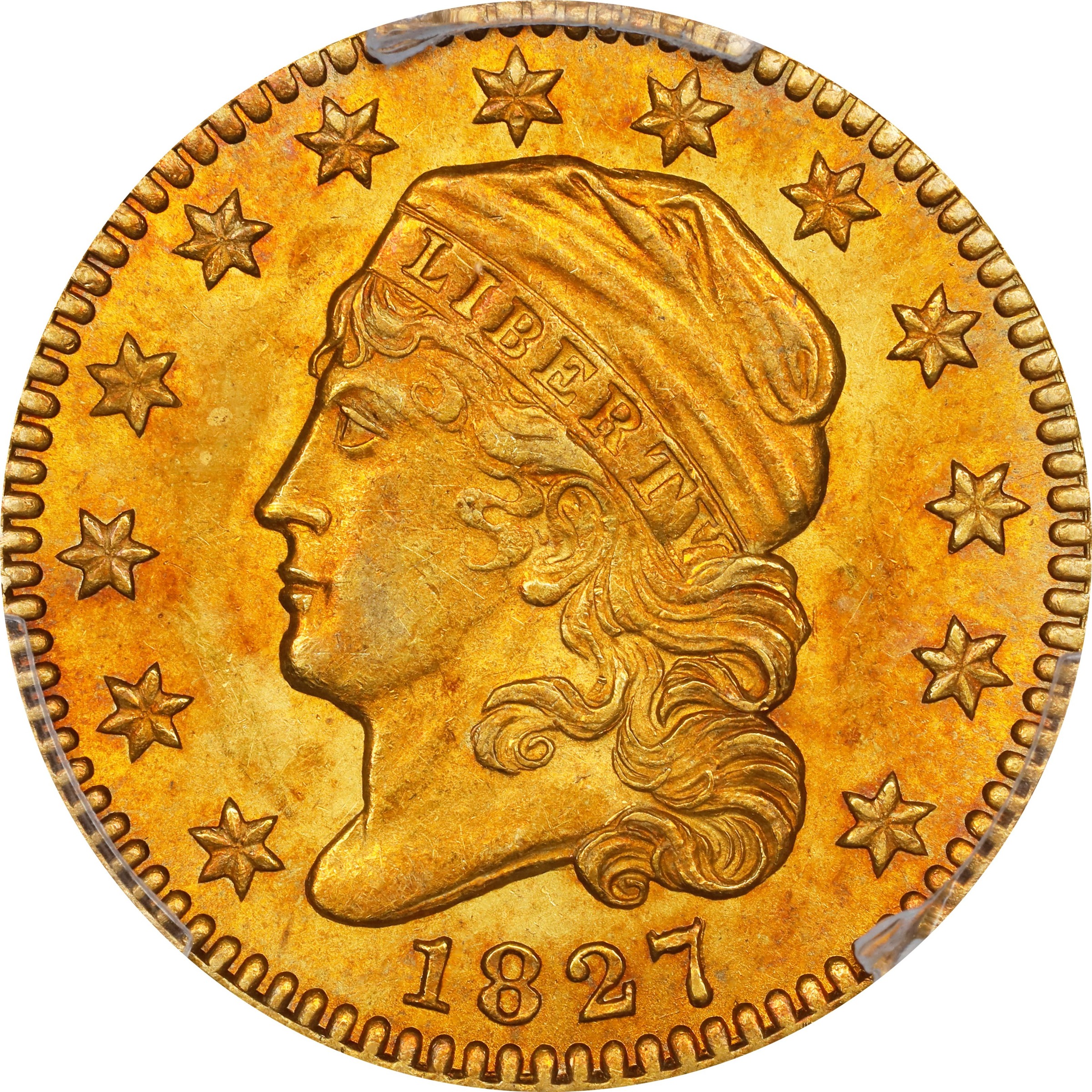
1827 $2.50 MS (PCGS#7666)
February 2026 Showcase Auction - The James A. Stack, Sr. Collection Part II
- Auctioneer
- Stack's Bowers
- Lot Number
- 23006
- Grade
- MS62+
- Price
- 138,000
- Lot Description
- An astonishingly attractive example of this rare early quarter eagle, with better color and a sharper strike than any example we've seen since we cataloged the remarkable Bareford-Pogue gem a decade ago. Gem quality satiny luster envelopes both sides, over surfaces dappled with flawlessly attractive ruddy coppery tones against an orange-yellow backdrop. The strike is profound, offering a rounded high relief appearance on the portrait rarely encountered with any date of this design type. Both sides are well centered and free of adjustment marks or similar production flaws. The obverse shows some horizontal slide marks over the highest relief of Liberty's cheek, but no contact marks or defects to mention. The reverse shows a contact mark on the upper flag of the E of STATES, a shallow arc-shaped abrasion in the field between the eagle and UNUM, and a trivial abrasion on the ribbon under N of UNUM. The rims are intact, and the fields are free of abuse. This piece has the arm's-length appeal of a gem, and magnified scrutiny does little to dissuade a viewer from that initial impression. Evidence of a subtle die clash, and the raised die file marks left when the clash was remedied on the die face, are visible left of the tip of the eagle's beak.<p><p>Very few early United States gold coins look like this anymore. Coins that trade frequently are liable to a market's changing taste, which sometimes means rich toning gets removed from coins when such toning is out of vogue, but can also mean toning gets added when its presence adds value or liquidity. A coin like this, off the market for more than 75 years, was shielded from such whipsaw reactions of the market and simply allowed to be. That benign neglect gave modern collectors the ultimate numismatic gift: a coin that looks as it should, fresh and original, allowed to mature and mellow in a way unlike most coins of this vintage. Coins that look like this appear only when great cabinets are brought to market after generations away, and they only survive when this sort of visual appeal is valued by the market with a significant enough premium to safeguard it forever. <p><p>The finest 1827 quarter eagle is the Bareford-Pogue coin, graded MS-65 (PCGS), which brought $152,750 in our September 2015 Pogue II sale. We've sold just three since that time. This piece outranks nearly all examples we've seen in terms of strike and eye appeal, and it compares favorably to the Bareford-Pogue coin on both aspects. The Bareford and Stack names are often mentioned in the same breath by savvy numismatists who identify these collectors as twin titans of connoisseurship, known for their exacting quality standards and the preponderance of wonder coins in their cabinets. The two men were nearly contemporaries (Bareford bought his 1827 quarter eagle just months after Stack died), and both extensive cabinets were sold through multiple Stack's sales in the 1970s and 1980s.<p><p>Mr. Stack bought this in the December 1944 sale of Jacob Shapiro's world-class cabinet of gold coins, sold under the pseudonym "J.F. Bell." Jacob Shapiro, a Chicagoan, was the lead consignor to no fewer than three major auctions of rare date gold coins. The earliest was the December 1944 J.F. Bell sale, which included over 1,000 lots, every one of them gold. Despite the sale, he continued collecting, and in late 1945, Shapiro entered into a deal with Abe Kosoff to purchase the entire F.C.C. Boyd collection of U.S. gold coins. His financing, perhaps predictably, fell through, so the Boyd gold coins instead went to auction, and Shapiro ended up being a major buyer in the sale. Two years later, he was back to auction mode, consigning most of his Boyd purchases to Numismatic Gallery's first California auction, entitled "A Memorable Sale," held in March 1948. The next Shapiro/Bell sale would not be conducted until 1963, by which time his son David was a principal in RARCOA. The J.F. Bell Collection of U.S. Gold Coins, today known as J.F. Bell II, was sold at the 1963 Central States Numismatic Society convention. While the 1944 J.F. Bell catalog used enough stock photographs to make plate matching a provenance researcher's fool's errand (and their quality was not great to boot), the James A. Stack, Sr. collection ledger lists a price paid for this coin that matches the exact sum - $230 - that the J.F. Bell specimen realized. Given how few 1827 quarter eagles changed hands during Stack's collecting era (and the fact that only one of them brought $230 at public auction), we feel strong confidence that this is the J.F. Bell example.<p><p>Only one die variety of 1827 quarter eagle exists, represented by around 50 specimens in all grades. No quarter eagles were struck in 1828, and 1829 saw a shift to the "Small Dentils" type coined through 1834, making this the last issue of the design type. Few examples of any date of quarter eagle of this design could surpass this in terms of overall quality and aesthetic appeal.