1787 NY 1/2P Excelsior, Eagle Right, BN MS(PCGS#424)
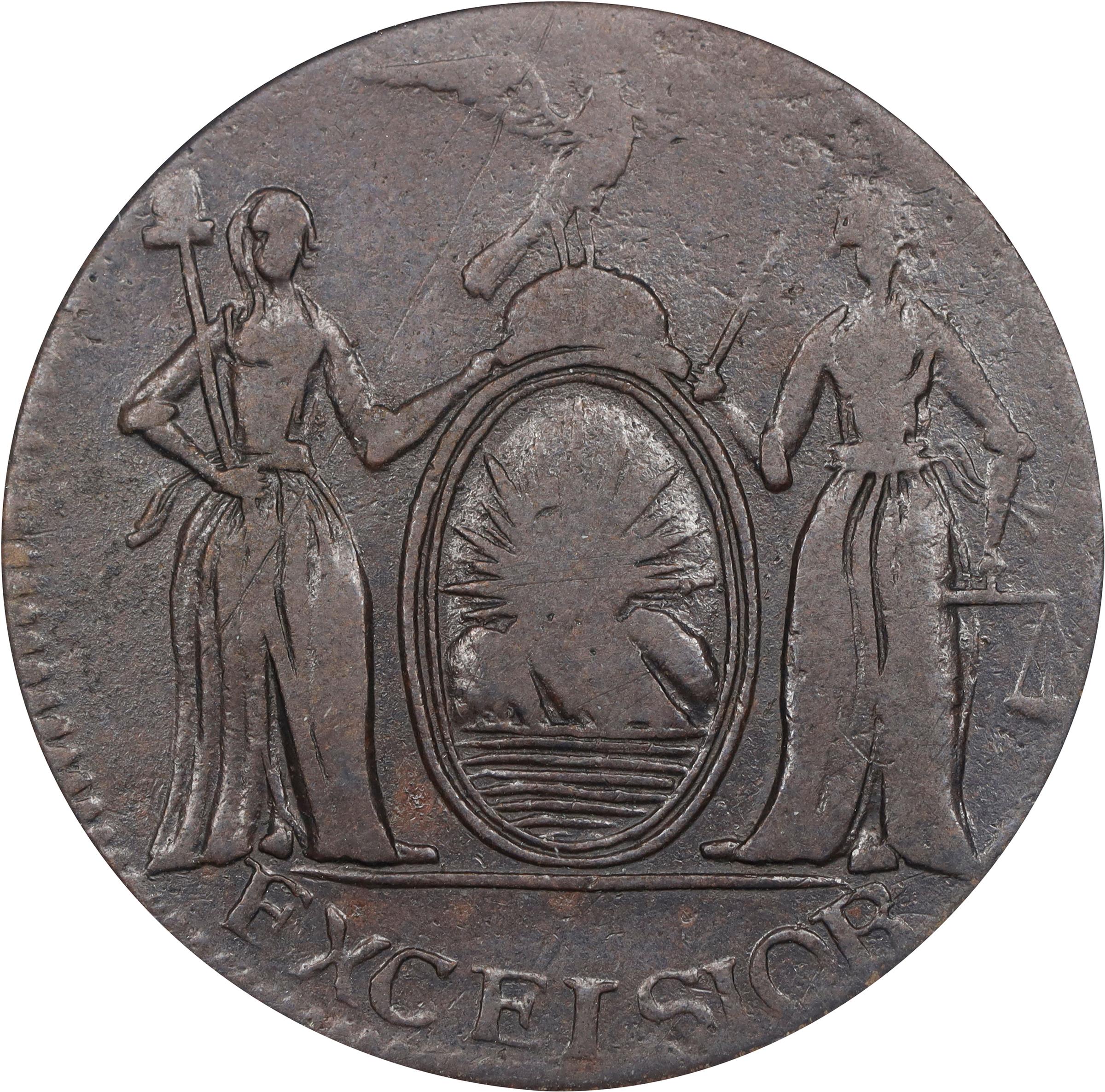
1787 NY 1/2P Excelsior, Eagle Right, BN MS (PCGS#424)
Summer 2025 Global Showcase Auction U.S. Coins
- Auctioneer
- Stack's Bowers
- Lot Number
- 1298
- Grade
- VF35BN
- Price
- 15,600
- Lot Description
- An important and well-pedigreed example of this notable Confederation-era rarity. Smooth dark chocolate brown surfaces display far better metal quality and visual appeal than typical examples of this type or variety. The upper right obverse and lower right reverse periphery are a bit soft, the result of axial misalignment of the dies or a tapered planchet, but other design elements are well rendered. Both sides are a bit off center to the right, allowing a frame of denticles to be seen at the left periphery. A thin old scratch blends in, toned over from the centuries, from the eagle atop the obverse to the thighs of the figure of Liberty at left. A shorter scratch runs unobtrusively through the first digit 7 in the date. The only noteworthy mark is a dull impact on the lower half of the reverse shield. The eye appeal is excellent, buoyed by the smooth and glossy surfaces of this often corroded type.<p>This was sold as the second to last lot of the March 1988 Norweb II sale, there described as, "purchased by Albert Holden from Henry Chapman's sale of the Andrew C. Zabriskie Collection (June 3, 1909), lot number unrecorded." Alas, the Zabriskie example of this variety was plated as lot 78, and it wasn't this coin, so the provenance before this coin's inclusion in the Norweb sale is unclear. We trace no earlier offering, and we also find no offering of the very similarly graded Zabriskie coin after 1909, but the Henry Chapman bid book makes plain that Albert Holden was indeed the winning bidder on the Zabriskie coin. Presumably that coin was sold as a duplicate (or donated to an institution) at some later point and the provenance was lost.<p>Michael Hodder enumerated nine examples in our (Bowers and Merena's) March 1988 Norweb sale, with at least two duplicate listings:<p>1 - The Norweb coin, <em><strong>the present example</strong></em>.<p>2 - The NN48 coin (New Netherlands, November 1956, lot 771). Earlier ex Bushnell and Jackman, later in the 1988 Dabney Caldwell and 2000 ANA sales. Very Fine.<p>3 - The Robison coin, later sold in our August 2024 Syd Martin sale.<p>4 - The Garrett coin (Bowers and Ruddy, November 1979, lot 598). Ex Stickney. Extremely Fine, or so, with minor planchet defects.<p>5 - The Roper coin (Stack's, December 1983, lot 272). Sold (without provenance) in the May 2022 Henry Dittmer "Long Island Collection" sale as NGC AU-58 for $105,000.<p>6 - Massachusetts Historical Society. Unseen.<p>7 - Crosby plate. (Same as #9)<p>8 - Noted Eastern Collection. This is the Anton-Partrick piece, sold by Heritage (April 2021: 3025) as NGC EF-40 for $45,600.<p>9 - F.C.C. Boyd estate. This was Ford II:310, ex Parmelee and Crosby Plate. (Same as #7)<p>In addition to those eight specimens, the primary Syd Martin example wasn't on the list (despite selling earlier in Stack's J.E. Stiles Collection sale the same decade as Norweb). Also missing was the very nice example Heritage sold in November 2017 (lot 16606) as PCGS EF-45, two fairly rough/corroded examples sold by Heritage in 2003 and 2014 (the first raw and the second NGC VF-25), the specimen sold in our Spring 2024 Auction, lot 3104, which was earlier in Heritage's April 2020 CSNS Signature Auction, and the Ross Family example last sold in our sale of November 2024. The mention of an example from the Eliasberg Collection in the Ford catalog was a red herring; Eliasberg's was a different variety. On their merits taken as a whole, we would probably rank the Roper-Dittmer coin best, followed by Ford's and the primary Syd Martin coin on the next tier, then three other pretty nice ones (Garrett, Anton-Partrick, Heritage 11-2017), then the rest. There appear to be about 15 or so of these known.<p>The historical importance of this issue is linked to the moment in the spring of 1787 when New York was considering a coinage of their own. There are not enough for this to have ever been a large scale production, intended to earn profits by circulating coppers of good weight. As a pattern issue, intended to influence the politically connected, the mintage is healthier than normal, indicating a very strong push to win a coinage contract. While the original documents refer to "the several petitions of John Bailey and Ephraim Brasher, relative to the coinage of copper," it is unknown if they issued these coins working together or if their petitions were separate. The George Clinton and Standing Indian coppers are related, but probably the work of a different petitioner: Thomas Machin. Another petition was filed by silversmiths Daniel Van Voorhis and William Coley, a partnership that created dies like those for Ryder-10 and Ryder-11, coined at the Vermont mint.<p>Clearly, most of these coppers were disposed of into circulation rather than being cherished as something extraordinary at the time. Their importance as coins (or patterns) was ephemeral, and their relevance became moot at the time the Constitution reserved the coining prerogative to the Federal government in 1789. Today, they are highly sought after by collectors.