1792 1C Washington Getz Pattern Circles & Squares Edge, BN MS(PCGS#959)
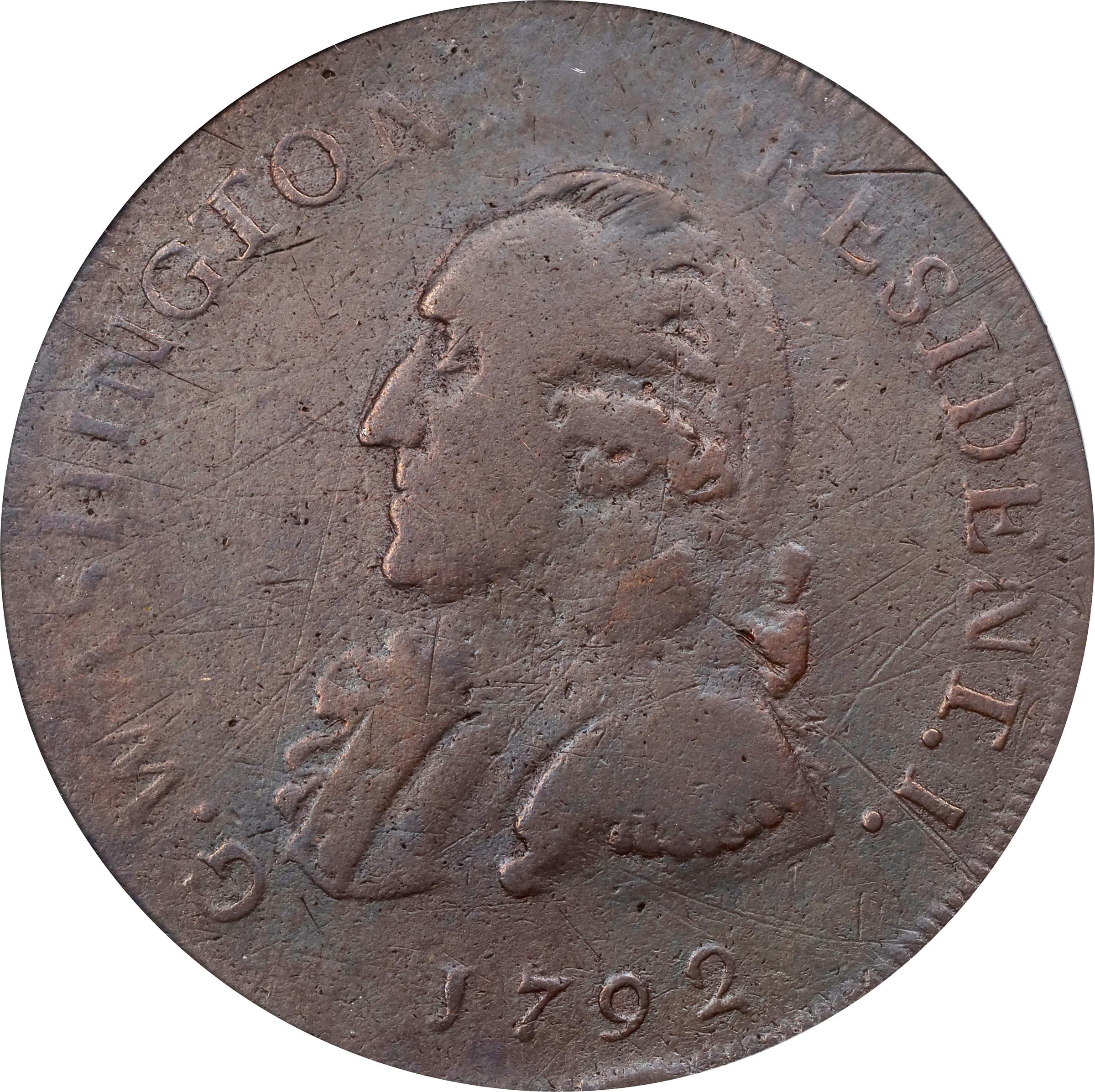
1792 1C Washington Getz Pattern Circles & Squares Edge, BN MS (PCGS#959)
Summer 2025 Global Showcase Auction U.S. Coins
- Auktionator
- Stack's Bowers
- Losnummer
- 1338
- Erhaltungsgrad
- F12BN
- Preis
- 9.000
- Losbeschreibung
- A fabled rarity among Washington portrait pieces, offered here in attractive mid grade preservation. This is an evenly toned, generally deep copper-brown example with a tinge of warm rose color overall. There are a number of old, light scratches on the faintly porous surfaces, most of which are on the obverse, and one which extends from the border past the Roman numeral I into the back of Washington's portrait and serves as a particularly useful identifier. The in-hand appearance is actually quite smooth, the strike is well centered, and the detail is suitably bold for the grade apart from the often-seen softness at the lower left obverse border, where the letters ASH in WASHINGTON are faint and difficult to discern at some viewing angles.<p>In April 1792, the Congress sent off a Mint Act for President Washington's signature. It was essentially the House version of the bill, insisting that American coins depict "an impression emblematic of Liberty." The Senate version of the bill, which never saw the president's desk, was much different, and Washington's opposition to the concepts therein may have helped kill it. By the terms of the Senate version, United States coins would have depicted:<p><em>An impression or representation of the head of the President of the United States for the time being, with an inscription which shall express the initial or first letter of his Christian or first name, and his surname at length, the succession of the presidency numerically, and the year of the coinage; and upon the reverse of each of the gold and silver coins, there shall be the figure or representation of an eagle, with this inscription - 'United States of America.'</em><p>If that design prescription sounds familiar, it is because it is precisely what appears on the Getz patterns, down to the Roman numeral I representing "the succession of the presidency numerically" that follows G. WASHINGTON PRESIDENT.<p>It appears Getz's dream of work with the United States Mint did not cease when the coinage act's language made his patterns obsolete. These dies may have been put back into use early in 1793, producing small planchet pieces whose weight intended to meet the standard for the new cent coinage. One specimen, in the Lasser Collection at Colonial Williamsburg, is overstruck on a 1794 cent. This portrait punch also created new dies: the 1796-dated die used on the unique silver "Drumheller Dollar," which also used this exact reverse die; as well as the 1797 Getz Washington Masonic medal. These dies look to have made their way into the hands of Philadelphia mechanic John Harper, whose August 1797 estate listing cites "2 Dies of General Washington Heads, 1 [ditto] of the face Masons coat of arms." The nature of Getz's relationship to Harper has yet to be uncovered.<p>Far rarer than plain edge Getz patterns, the so-called Circles and Squares type show an edge that imitates that found on Spanish colonial coins of the era, underlining the dominance of Spanish colonial silver coins in American pockets during this period. For some reason, the specimens with this circles and squares edge are always far lighter and on far thinner stock than the plain edge specimens. Among the 53 copper examples from these dies recorded in George Fuld's 2009 survey, just 11 were of this edge variety, of which five are in institutions (British Museum, Smithsonian Institution, Massachusetts Historical Society, Connecticut Historical Society, and Colonial Williamsburg). At least two specimens were overlooked by Fuld, but there are still fewer than ten of these available to collectors. Interestingly, when Fuld published the updated Baker in 1965 (still our favorite edition of this standard reference), he estimated that at least 70 plain edge specimens survived (the real number looks to be significantly lower) and of this edge type estimated the population at "at least six known, prob. more." His guess on this very rare variety seems prescient today.