1859-S $20 MS(PCGS#8928)
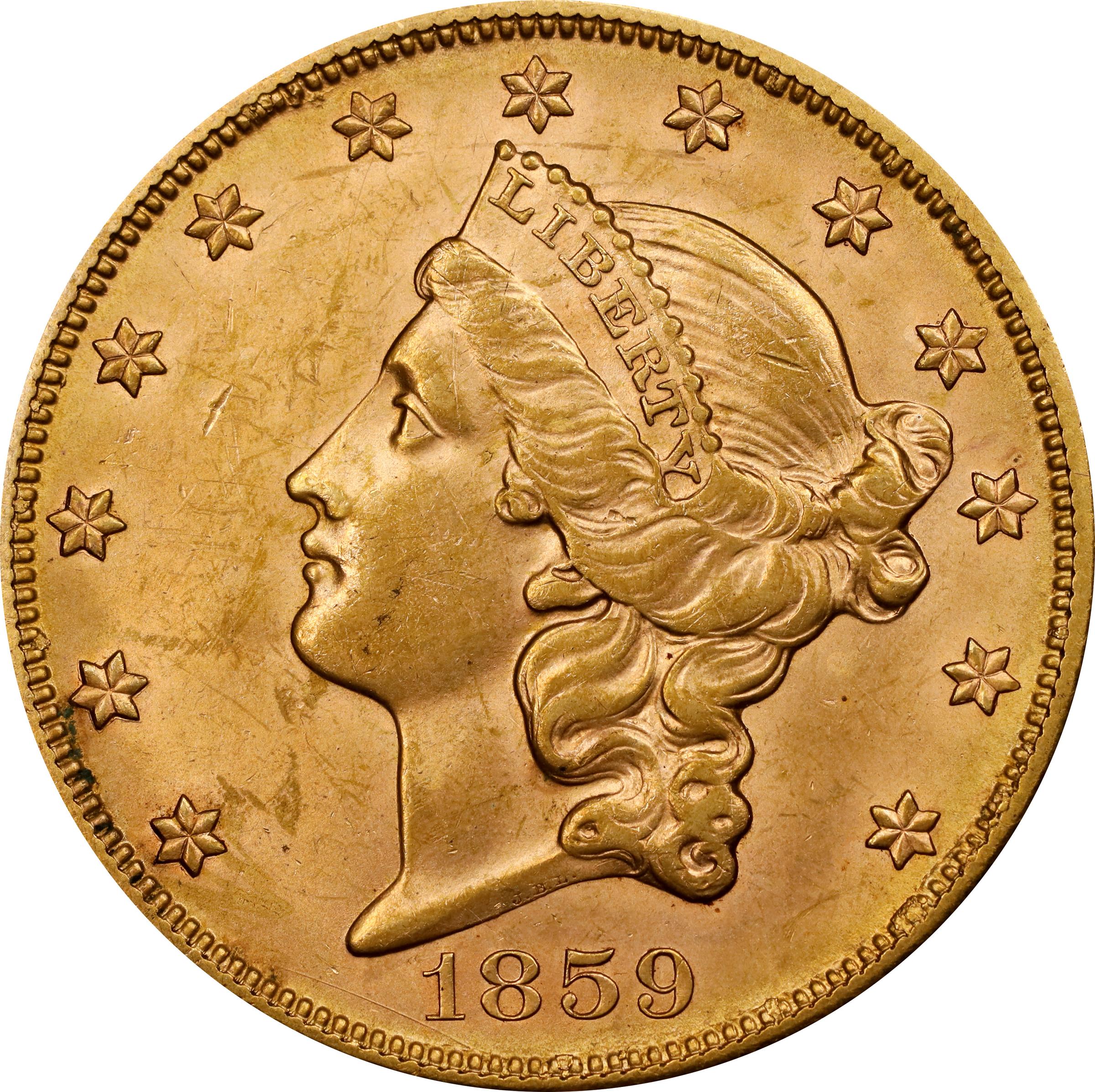
1859-S $20 MS (PCGS#8928)
December 2025 Showcase Auction - The James A. Stack, Sr. Collection Part I
- Auctioneer
- Stack's Bowers
- Lot Number
- 20029
- Grade
- MS63
- Price
- 108,000
- Lot Description
- Offered is one of the two finest 1859-S double eagles certified by PCGS, and the only MS-63 to have received CAC approval. This is an outstanding MS-63 Type I Liberty Head twenty. Undeniably original surfaces are drenched in bold rich rose-honey color and billowy satin to softly frosted luster. Wisps of pale silver-olive are also present at the peripheries offering further color and visual appeal. A bit of ancient carbon along the denticles outside stars 1 and 2 join with a few equally trivial handling marks on the obverse to preclude a higher grade, but the MS-63 assessment is spot on as confirmed by both PCGS and CAC. The appearance is impressively smooth, in fact, and there is no finer 1859-S double eagle currently known or rumored to exist.<p>In July 1852, federal legislation authorized the transition of the United States Assay Office of Gold into a full-fledged United States branch mint. On April 3, 1854, the building was reopened as a United States Mint, and deposits were immediately accepted to be struck into official United States coins. The mint was located in the offices of the highly regarded private coiners Moffat & Company at 608-610 Commercial Street until 1874, when it was replaced by a larger facility better suited for mass production. The first coins struck in 1854 were the five main gold denominations: the gold dollar, quarter eagle, half eagle, eagle, and the double eagle. Problems plagued the San Francisco Mint during its earliest years, however, and in particular a chronic shortage of parting acids forced the intermittent closure of the facility. Under such trying conditions it could not hope to meet the needs of the regional economy, with its seemingly insatiable demand for gold coins for both domestic circulation and export. Responding to the appeals of local merchants and bankers to help alleviate the shortage, the private firms of Kellogg & Co. and Wass, Molitor & Co. delivered what can really be characterized as several emergency issues in 1854 and 1855. Emphasis was on the higher denominations, to maximize the face value of specie placed into circulation, with Kellogg & Co. concentrating on the $20 and Wass, Molitor & Co. issuing more $50s than $10s or $20s.<p>By the end of 1855, the output of the San Francisco Mint had become large and steady enough to bring an end to the era of private coining in Gold Rush California. However, growing pains and outright problems continued at the Mint throughout the 1850s and into the early 1860s. Nancy Y. Oliver and Richard G. Kelly describe many of these in their 2014 reference <em>The Inconspicuous Gold Rush Mint: San Francisco, 1854-1874</em>, including a scandal over the loss of $152,000 in gold bullion in 1857, the suspension of operations from April 23 to August 10 that same year (partly to make repairs to the building), concerns regarding employees, and even a fire in the facility in the spring of 1861.<p>It was against this backdrop that the San Francisco Mint delivered 636,445 double eagles in 1859, a mintage that was down more than 200,000 pieces from the tally of the previous year. The high grade rarity of this issue is nearly unknown outside of the field of specialized double eagle collectors for the 1859-S has not been represented in any significant hoards, either shipwreck treasures or repatriations from foreign holdings. While the S.S. <em>Republic</em> shipwreck did yield 67 1859-S double eagles, only one of those coins has been designated as Mint State. The James A. Stack, Sr. specimen is not a shipwreck find, in any event, and it is undoubtedly the finest and most desirable example of the issue that we have ever had the privilege of bringing to auction.