1796 $1 Small Date, Small Letters MS(PCGS#6859)
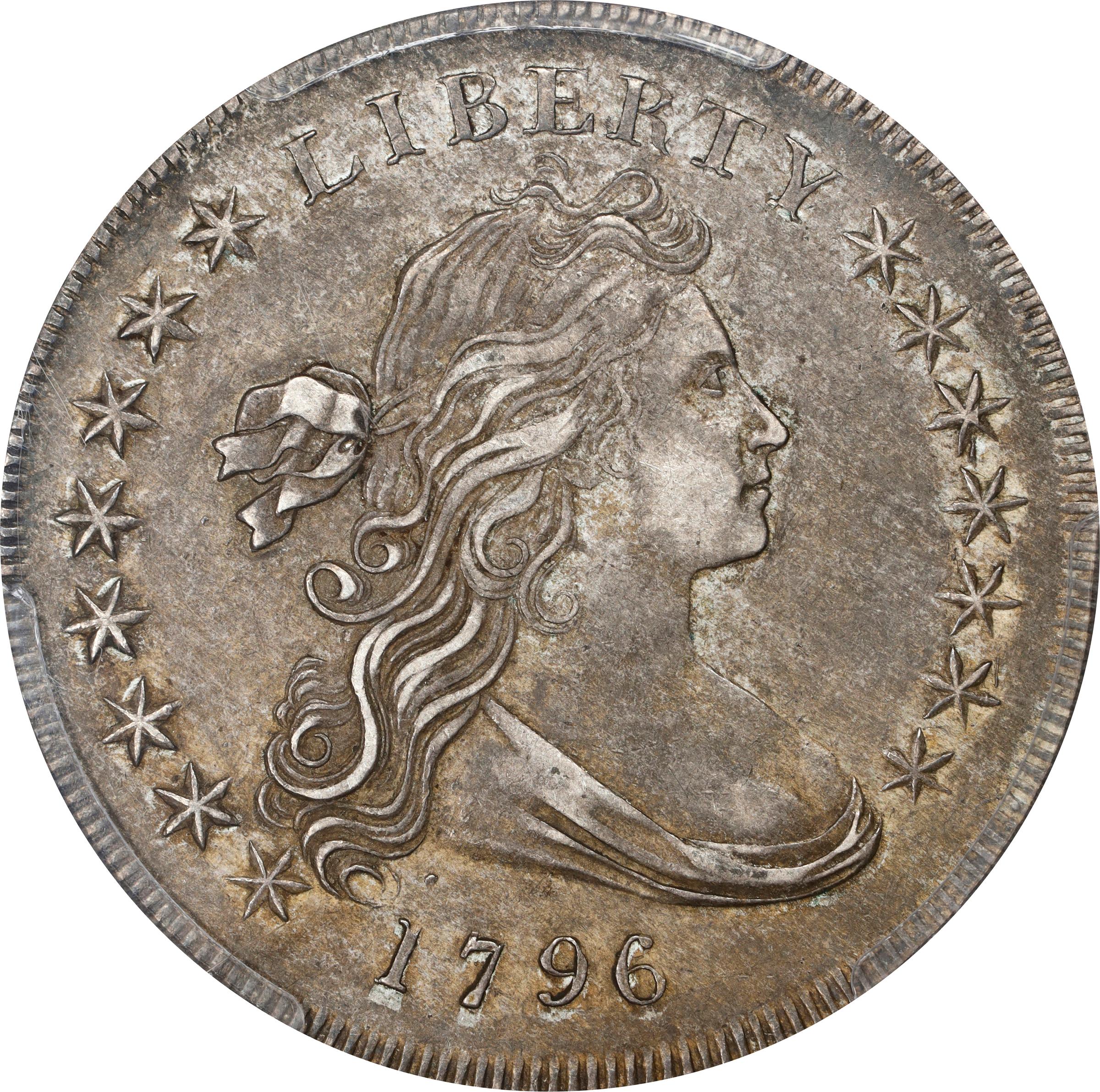
1796 $1 Small Date, Small Letters MS (PCGS#6859)
Spring 2025 Showcase Auction U.S. Coins
- Auktionator
- Stack's Bowers
- Losnummer
- 3071
- Erhaltungsgrad
- AU55
- Preis
- 90.000
- Losbeschreibung
- A landmark offering for advanced early silver dollar variety enthusiasts. The variety now known as Bowers-Borckardt 62 is a celebrated rarity in the Draped Bust series. Although first described by John W. Haseltine in his 1881 Type Table, where it was listed as H-3, the muddled fashion with which the dies were described combined with the extreme rarity of examples led many numismatists to doubt this variety's existence. More than half a century later, in 1950, M.H. Bolender reported, "While many 1796 dollars have been listed as H-3, this has been erroneously done. I have purchased a dozen or more H-3s, every one of them wrongly attributed." Even so, he reported that three specimens were known, which must represent coins whose verbal report he considered reliable; his own reference collection lacked an example, forcing him to use a composite image in his early dollar book.<p>Only in 1959 was this variety - now widely known as Bolender-3 - positively identified and illustrated using a confirmed example. Over the ensuing 42 years only one other example surfaced, in 2001, and the census of 1796 B-3 dollars would remain at just two specimens for nearly a quarter century thereafter.<p>When Harry E. Salyards published his reference <em>Eagle Poised on a Bank of Clouds: The United States Silver Dollars of 1795-1798</em> in 2022, he took on the issue of whether additional examples of this variety - known as BB-62 since the 1993 publication of Q. David Bowers' silver dollar <em>Encyclopedia</em> - were awaiting attribution in old collections. In the author's words:<p><em>Do Other Examples of BB-62 Exist, Unrecognized?</em><p><em>Stack's 2001 catalog listing raised the question, answering it with a tentative "We suspect [so]." Since it is one among three Small Date / Small Letters varieties dated 1796, that is certainly possible, for it requires actual die variety attribution for identification. To any non-numismatist owning an "old silver dollar" that has been passed down in the family from generation to generation, the very concept that coins of the same date might have been made with differently engraved dies would never occur. A collector of dollars by Redbook variety might have one filling the Small Date / Small Letters slot, without realizing that it was the "excessively rare" one, as Stack's put it in 1959. It could even exist as a generic 1796, encapsulated by either of the major third party grading services - remember, </em>die<em> variety identification is by request only. Finally, its identification suffered from 78 years of ambiguous verbal descriptions, before an actual illustration of the coin appeared in print [in 1959] - in a source that was not widely disseminated.</em><p>Salyards' discussion proved unusually timely, for since January 2024 two (!) additional examples of the 1796 BB-62 dollar have surfaced, bringing the census to four specimens, as follows:<p>1 - <strong>PCGS AU-55. CAC</strong><strong>.</strong> <em><strong>The present example</strong></em>, consigned to us uncertified and unattributed, and subsequently graded by PCGS and verified by CAC for the first time ahead of this sale. It is now far and away the finest known 1796 BB-62 Draped Bust dollar. (See below for additional discussion.)<p>2 - <strong>PCGS EF-45+</strong><strong>.</strong> Ex our (Stack's) sale of the Philip G. Straus Collection, May 1959, lot 2065; W. Earl Spies; our (Stack's) sale of the W. Earl Spies Collection, December 1974, lot 24; our (Stack's) 68h Anniversary Sale, October 2003, lot 2715; Warren Miller Collection. This coin was previously certified AU-53 by NGC as part of the Miller Collection, which certification is still listed in the <em>NGC Census</em>. It is the first 1796 BB-62 dollar positively confirmed to exist.<p>3 - <strong>PCGS Fine-15</strong><strong>.</strong> Ex our (Stack's) sale of the Cornelius Vermeule III Collection, September 2001 (actually sold November 2001, due to the 9/11 terrorist attacks), lot 421; Warren Miller, sold privately to the following, as NGC VF-25; Ira & Larry Goldberg's sale of the Dr. Robert Hesselgesser Collection, September 2011 Pre-Long Beach Auction, lot 5024, as PCGS Fine-15; Ira & Larry Goldberg's Pre-Long Beach Auction of May 2012, lot 1273, as PCGS Fine-15. The second positively confirmed 1796 BB-62, and the first since 1959.<p>4 - <strong>NGC VF Details--Scratches</strong><strong>.</strong> Ex Heritage's FUN Signature Auction of January 2024, lot 4089. This is the third 1796 BB-62 dollar positively confirmed and, according to the Heritage cataloger, "is from an old-time collection of early dollars (not the Dr. Stark Collection) that was consigned for the FUN auction."<p>As the foregoing list makes clear, this variety was missing from such notable early dollar variety collections as Ostheimer, Gilhousen, Willasch and Reiver, in addition to Bolender. It has kept out of sight so well that many specialists have never even seen an example and, despite the 1959 and 1974 sales of the Straus-Spies specimen, the fifth edition of the Bolender early dollar reference published in 1988 stated, "Most experts now question whether this variety actually exists."<p>Exist it does, for the diagnostics of BB-62 are distinct and clearly illustrated by the present example. The obverse die, previously used in the BB-61 pairing, is readily identifiable by a small die dot in the lower field between the digit 1 in the date and the bottom of Liberty's bust. The reverse proved a workhorse die and was first used in the 1795 BB-51 Off-Cent Bust pairing. After striking the 1796 BB-62 variety, it went on to coin the 1796 BB-63, BB-66, 1797 BB-72 and 1798 BB-81 varieties. It is quickly identifiable by the presence of a small berry on the branch below the letter A in STATES. Only a single die state of the 1796 BB-62 is known, BB Die State II, Salyards Obverse Die State IV, with relapping of the obverse die effacing the upper and lowermost hair curls on Liberty's portrait.<p>An exceptional Small Eagle Bust dollar irrespective of variety, this is a wonderfully original and fully PQ Choice AU example. The obverse is warmly toned in steely-olive and pewter gray with hints of original luster peering from the protected areas around the design elements. The lighter reverse, with a halo of steel-gray peripheral toning around an antique silver center, allows ready appreciation of strong frosty mint luster. The strike is ideally centered and sharply executed, the design elements crisp apart from a touch of high point rub that does little more than define the grade. There are no handling marks of note, and a concentration of adjustment marks along the lower reverse border is as made and easily overlooked during in-hand viewing.<p>New discoveries for rare die varieties in the early U.S. coinage series usually come along only once in a long while. When such a find yields the finest known example of a legendary attribution, as here, the significance is so much the greater. The excitement and strong competition that will accompany this offering confirms that only the most aggressive bidding strategy will prevail. We wish advanced early dollar variety specialists luck with their bidding and look forward with eager anticipation to the final realized price for this important early dollar.