1796 1/2C With Pole, BN MS(PCGS#1027)
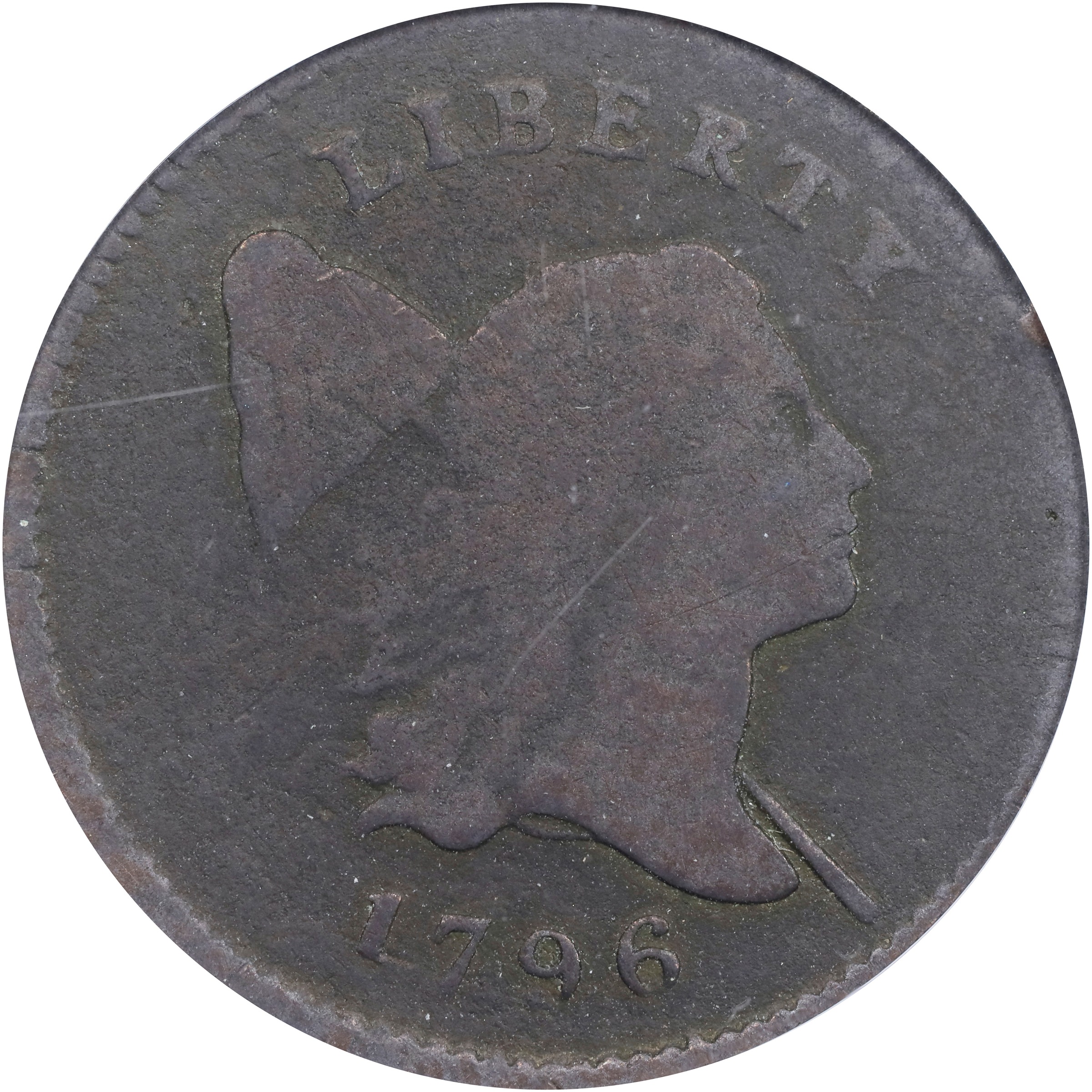
1796 1/2C With Pole, BN MS (PCGS#1027)
Spring 2026 Showcase Auction U.S. Coins
- Auctioneer
- Stack's Bowers
- Lot Number
- 2017
- Grade
- G4BN
- Price
- 18,000
- Lot Description
- An impressive numismatic provenance identifies this as one of the most famous of the rare 1796 Cohen-2 half cents. When offered in our (Bowers and Merena's) May 1996 Eliasberg Collection sale, the cataloger assigned a grade of Good-6 for the obverse, AG-3 for the reverse; the PCGS grade of Good-4, therefore, is a perfect compromise. The obverse is indeed the better defined of the two sides with all major design elements discernible to well outlined, although the hair strands at the back of Liberty's portrait and a few letters in LIBERTY are somewhat faint. The reverse is worn nearly smooth in the center and at upper right, but the letters UNITED STAT, the denomination 1/200, and the lower left portion of the wreath are more or less bold. Deeply toned ebony-brown surfaces are microgranular, yet present as smooth in hand apart from a tiny obverse rim nick at 2 o'clock that is well concealed by the PCGS holder.<p>With only 140 or so coins extant in all grades (per Bill Eckberg, 2019), the 1796 is the rarest date in the entire half cent series of 1793 to 1857. Most survivors are from the C-2 dies, as here, examples of which have been honored rarities ever since numismatics became widely popular in the 1850s. Since then the appearance of a 1796 has been a special occasion.<p>Although not as rare as its C-1 No Pole counterpart, the 1796 C-2 is still very scarce. Perhaps surprisingly for such an elusive variety, there are several Mint State coins known, including at least three Gem Red and Brown coins. One of these, the D. Brent Pogue specimen in PCGS MS-66 RB realized $470,000 as lot 3009 in our February 2016 sale. Another is the PCGS MS-65+ RB from the Missouri Cabinet, which sold for an extraordinary $718,750 in Ira & Larry Goldberg's January 2014 sale of that collection. Beyond the handful of Mint State coins, however, the census for this variety quickly drops to the lowest circulated grades.<p>Planchet stock for this variety was derived largely from rolled sheet copper, and at least two of the survivors have Mint-made planchet clips. Whether the C-1 or C-2 was struck first remains a matter of debate, although we believe that the No Pole (C-1) with its cracked obverse die was produced first and used as a stopgap measure, until the well made obverse of the C-2 pairing was ready for coinage. Opinions differ, however, with Bill Eckberg, for one, asserting that the C-2 coins were produced in April and June 1796, with the C-1 coins following in October of that year.