1838 $10 MS(PCGS#8575)
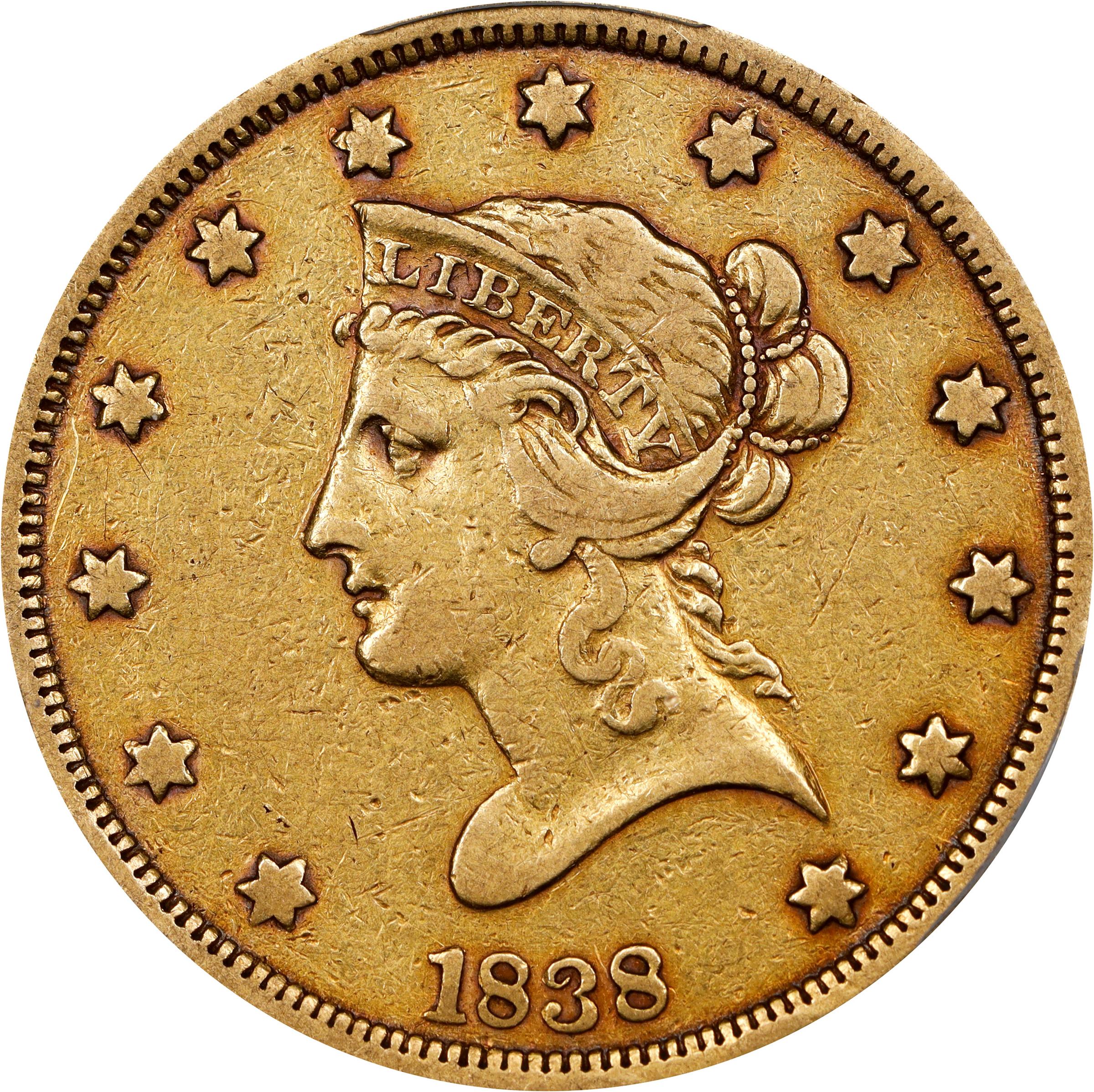
1838 $10 MS (PCGS#8575)
June 2025 Showcase Auction U.S. Coins
- Commissaire-priseur
- Stack's Bowers
- Numéro du lot
- 2400
- Grade
- XF40
- Prix
- 9 000
- Description du lot
- Offered is a rare and desirable coin, a solid Extremely Fine Liberty Head eagle of the brief and challenging Type of 1838 design. Handsome deep honey-olive and rose colors blanket pleasingly original surfaces. Faint traces of a semi-prooflike finish remain in the fields, the texture otherwise frosty with suitable overall luster for the assigned grade. The stars around the obverse periphery are soft and lack full radial lines, typical of an early date Liberty Head eagle. Otherwise we note bold detail at the EF-40 level. Wispy hairlines are noted for accuracy, but we see no marks that are worthy of individual attention.<p>The longest-running $10 gold eagle series produced in the United States Mint, the Liberty Head eagle was struck without interruption from 1838 through early 1907. It is the first eagle produced since 1804, as President Thomas Jefferson halted production of this denomination and the silver dollar that year as rising bullion prices made the coins highly susceptible to exportation and melting. From 1805 through 1837, the largest gold denomination that the United States Mint produced was the $5 half eagle. By 1838, however, two laws had been passed that made it possible for the Mint to resume eagle coinage. The first was the Act of June 28, 1834, which reduced the weight of standard U.S. gold coins and, in so doing, placed the nation's monetary system on a gold standard. The second was the Act of January 18, 1837, a general overhaul of the nation's coinage laws that, among other things, standardized the fineness of gold and silver coins at 900 thousandths.<p>When eagle production finally resumed in 1838, the Mint settled upon the Liberty Head design of Christian Gobrecht, featuring a portrait of Liberty facing left, her hair tied in a bun at the back of her head and wearing a coronet inscribed LIBERTY. Thirteen stars encircle the border, and the date is below the portrait. The initial portrait utilized in 1838 and early 1839 had deeper curvature to the truncation of the bust with Liberty's hair pulled back over her ear. The design was modified slightly in 1839 to create the Liberty Head motif that would remain in use through 1907.<p>The basic reverse design also remained unchanged from 1838 to 1907, featuring an eagle with outstretched wings and a shield on its breast. The eagle clutches a group of three arrows in its left talon and an olive branch in its right talon. The legend UNITED STATES OF AMERICA is around the border and the denomination TEN D. is below the eagle. The reverse was modified in 1866, however, with the addition of the motto IN GOD WE TRUST on a scroll above the eagle. To distinguish them from their No Motto predecessors, the Motto eagles of 1866 to 1907 are known as the Type II Liberty Head design.<p>As above, the first iteration of Christian Gobrecht's new Liberty Head eagle bore a distinctive obverse featuring a sweep of hair completely covering Liberty's ear and a peculiarly deep curve to the bust's truncation. Benjamin West's painting <em>Omnia Vincit Amor</em> ("Love Conquers All") served as Gobrecht's model, even down to the beaded cord and coronet style. The first eagles using this design were struck at the end of 1838, with 7,200 pieces intended for circulation on top of four "specimen" coins presented to Secretary of the Treasury Levi Woodbury. In 1839, the same obverse design was employed for the first 2,801 eagles struck bearing that date before the design was modified. As the first Liberty Head eagle, and one of just two of the Type of 1838, Large Letters design, the 1838 is eagerly sought by both advanced gold type collectors and series specialists. This is by far the rarer of the two issues of the Type of 1838 design, and of the 7,500 pieces struck, <em>PCGS CoinFacts</em> accounts for just 80 to 100 survivors in all grades. Mint State coins are of the utmost rarity and, indeed, this issue largely passed into circulation with little attention from contemporary Americans. Straight-graded Extremely Fine coins such as this are very scarce and eagerly sought for inclusion in specialized gold cabinets.