1867 $20, DCAM PR(PCGS#99082)
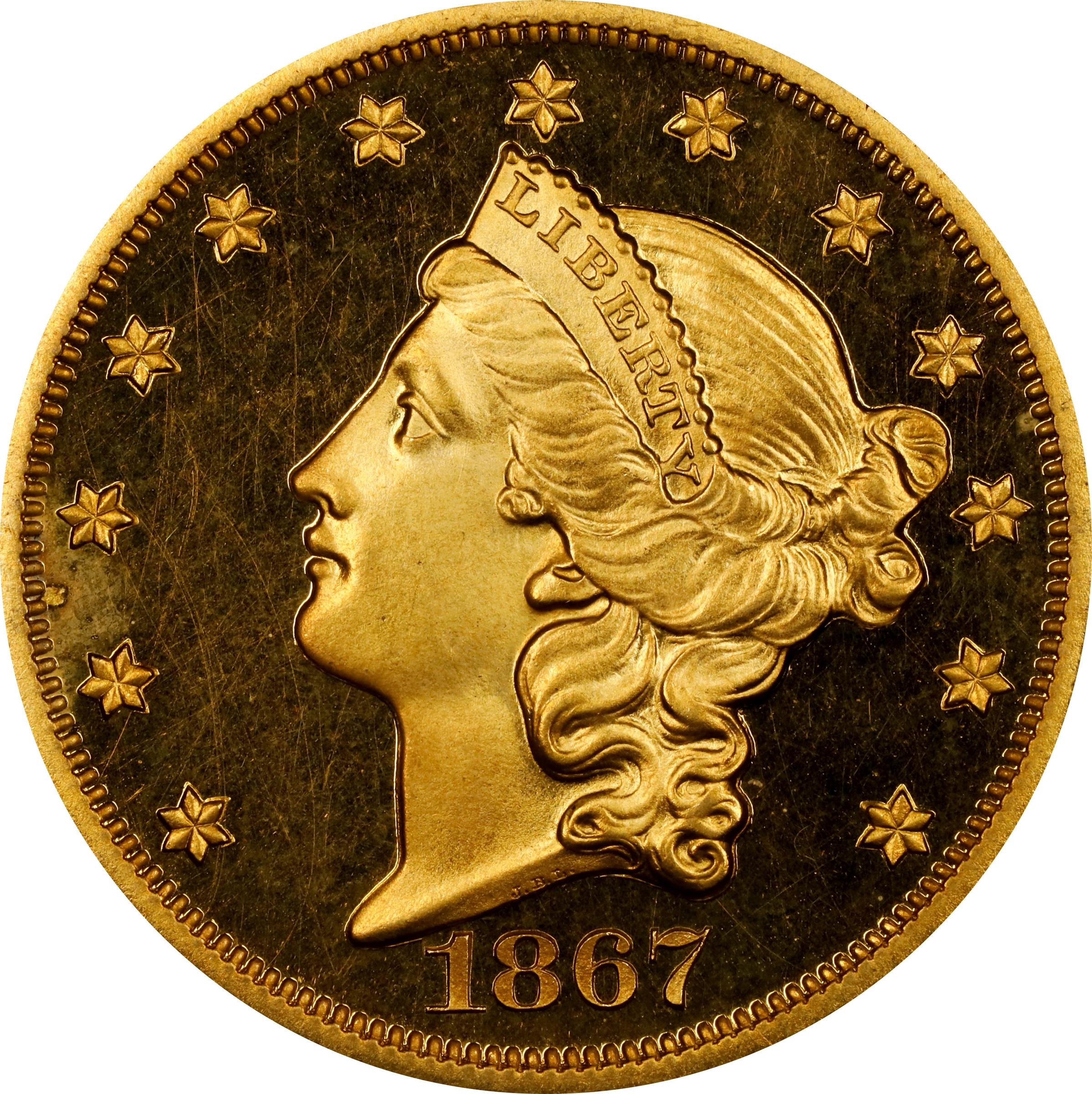
1867 $20, DCAM PR (PCGS#99082)
December 2025 Showcase Auction - The James A. Stack, Sr. Collection Part I
- Auctioneer
- Stack's Bowers
- Lot Number
- 20035
- Grade
- PR64+DCAM
- Price
- 660,000
- Lot Description
- A phenomenal rarity and a leading highlight of the landmark Proof double eagle offerings from the James A. Stack, Sr. Collection. Proofs of this denomination are universally rare, especially those of the Type II Liberty Head design, for which mintages were paltry and survival rates extremely low. So it is with the Proof 1867, of which just 50 coins were struck and only 12 specimens have been positively confirmed.<p>The extreme rarity of Proof Liberty Head double eagles has long frustrated attempts at in-depth numismatic research. With so few coins known for most issues, and market appearances for those in private hands generally few and far between, numismatists simply do not have the opportunities they need to tackle such critical issues as die varieties and census listings. In the volume on gold coins published in 2018 as part of his excellent series <em>United States Proof Coins</em>, John W. Dannreuther summarized the then-current research on the Proof 1867 double eagle. The author reported a single die pairing for the issue, using a reverse die that went on to strike all other Proofs of the Type II design through 1876, and offered as estimate of 10 to 12 specimens known. The provenance for 10 of these were specifically traced in the Dannreuther census, including the two specimens in the National Numismatic Collection at the Smithsonian Institution and one in the American Numismatic Society Collection that are not available for private ownership.<p>Thanks to more recent work begun by David Stone and expanded upon by Saul Teichman, however, we now have a more accurate understanding of both the Mint's striking of Proof double eagles in 1867 and the number of coins extant for this issue. In an article published in the February 2021 issue of <em>The Numismatist</em>, Saul Teichman confirmed that the Mint actually used two reverse dies to strike Proof 1867 double eagles. One of these is the reverse previously described by Dannreuther for his JD-1 attribution, on which the word IN in the motto IN GOD WE TRUST is set low relative to the letter G in GOD. The other reverse is actually that which the Mint used to strike the 1865 transitional patterns in gold (Judd-452, Pollock-524) and copper (Judd-453, Pollock-526). On the <em>uspatterns.com</em> website, Saul Teichman asserts that these patterns are believed to have been struck in 1865, "as they use an unique reverse die with the motto hand cut into the die [with] a high N in IN and a low tilted G in GOD." These are the most useful diagnostics of this die which, as confirmed by recent research by Stone and Teichman, the Mint also used to strike some regular issue Proof double eagles in 1866 and 1867. The die pairing of the Proof 1867 that uses this reverse is unlisted in the Dannreuther reference, but we have assigned it the attribution JD-2.<p>Since the Mint's delivery of 50 Proof double eagles in 1867 is neatly divided into 25 coins on March 5 and 25 coins on July 2, it is likely that the two batches of coins also neatly refer to the JD-1 and JD-2 attributions, respectively. Unfortunately, however, we have no way of knowing which of the reverse dies was used for each 25-piece delivery. Fortunately, and again thanks to the research efforts of Saul Teichman, we are on firmer ground regarding the relative rarity of the two varieties. The current census of 12 specimens for the Proof 1867 double eagle that he has posted to the <em>Newman Numismatic Portal</em> includes eight coins struck from the familiar JD-1 variety that uses the Reverse of 1867-1876, but only four struck from the newly confirmed JD-2 variety that uses the Reverse of 1865 Judd-452:<p><strong>1 -</strong> <strong>NGC/CAC Proof-65+ Ultra Cameo.</strong> Ex Heritage's FUN Signature Auction of January 2011, lot 5280.<p><strong>2 - </strong><strong>PCGS/CAC Proof-64+ Deep Cameo.</strong> Ex James A. Stack, Sr. Collection. <em><strong>The present example.</strong></em><p><strong>3 - </strong><strong>Choice Cameo Proof.</strong> Ex Harlan P. Smith's sale of the Hebeard Collection, April 1883, lot 380, part of a six-piece gold Proof set; T. Harrison Garrett, to Robert and John Work Garrett, by descent, 1888; Robert Garrett interest to John Work Garrett, 1919, transfer completed 1921; John Work Garrett to The Johns Hopkins University, by gift, 1942; our (Stack's) sale of the Garrett Collection for The Johns Hopkins University, March 1976, lot 416.<p><strong>4 - </strong><strong>PCGS/CAC Proof-61 Cameo.</strong> Ex F.C.C. Boyd; Numismatic Gallery's sale of "The World's Greatest Collection" (Boyd), January 1946, lot 870; King Farouk of Egypt; Sotheby's sale of The Palace Collections of Egypt, February 1954, lot 181; Abe Kosoff, May 2, 1954, privately to the following; John Jay Pittman; David W. Akers' sale of the John Jay Pittman Collection, Part I, October 1997, lot 1146; Superior's Pre-Long Beach Sale of February 2001, lot 4674; Heritage's Long Beach Signature Auction of October 2001, lot 9685; Superior's Santa Clara Elite Coin Auction of July 2005, lot 576; Heritage's Chicago ANA Signature Auction of August 2014, lot 5743.<p>The James A. Stack, Sr. specimen, therefore, is an extreme rarity by die variety within an issue that is already a landmark rarity in the 19th century Proof double eagle series. It is also a carefully preserved and breathtakingly beautiful coin at the threshold of full Gem quality. When viewed at most lighting angles, in fact, this coin meets all the requirements for a Proof-65 numeric grade. It is fully struck down to even the most intricate design elements, and reveals a generally smooth texture that speaks to the care with this coin was preserved since leaving the Mint more than 150 years ago. The surfaces are also undeniably original and attractively so, with warm, even, vivid orange-gold color. Tinges of pale pinkish-rose iridescence add to the appeal. A few faint hairlines and other equally trivial blemishes in the obverse field before Liberty's portrait explain the Proof-64+ assessment from PCGS, but these are of no concern on a coin with such outstanding technical and aesthetic merits. A deeply cameo finish that contrasts thickly frosted design elements with deeply mirrored fields enhances this coin's tremendous eye appeal and awesome desirability.<p>It has been a pleasure for us to catalog and otherwise prepare this coin for auction, and it will be a pleasure for us to congratulate the winning bidder who takes home this prize. They will have the honor of securing a beautiful and exceedingly rare coin for their collection, in which it will be recognized and cherished as a numismatic treasure of the utmost importance.