1803 $10 BD-6 MS(PCGS#45740)
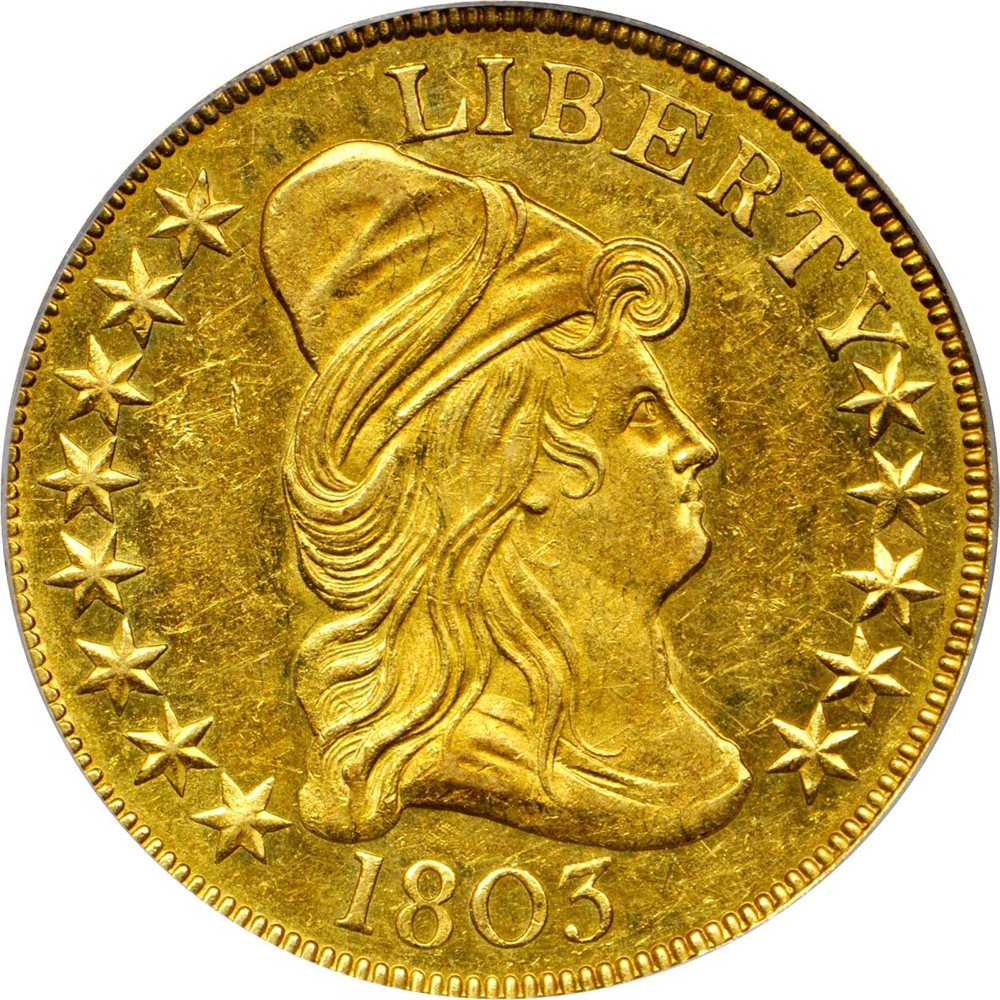
1803 $10 BD-6 MS (PCGS#45740)
August 2019 ANA U.S. Coins Auction Rosemont, IL
- Auktionator
- Stack's Bowers
- Losnummer
- 4040
- Erhaltungsgrad
- MS61
- Preis
- 66.000
- Losbeschreibung
- Historically Significant and Exceedingly Rare 1803 BD-6 Eagle The Final Early Eagle Variety Struck for Circulation Missing from the Bass Collection 1803 Capped Bust Right Eagle. BD-6, Taraszka-32. Rarity-7. Large Reverse Stars, 13 Stars. MS-61 (PCGS). Type and Style:Type II: Capped Bust Right, Heraldic Eagle. Style VII: Head of 1795 with 13 large stars arranged eight left, five right; Reverse of 1799 with 13 large stars in the field below the clouds and a short, thick neck on the eagle. The head and eagle punches are attributed to hubs prepared by Robert Scot. Die Variety: BD-6, Taraszka-32, Breen 1-F, HBCC-Missing. This variety represents the final of six uses of this obverse die, the only one of the 1803-dated issue, and the second of two uses of this reverse die. The reverse die, previously used to strike the 1804 BD-1 variety, is readily identifiable as the only Large Reverse Stars die of the 1803-dated issue with only 13 stars. The other Large Reverse Stars variety of the issue is the Extra Star BD-5 variety with a tiny additional star within the final cloud. The BD-6 variety is also attributable by repunching to the base of the first letter T in STATES, a berry positioned below the left center of the final letter A in AMERICA, a leaf point in the olive branch pointing between the letters RI in AMERICA, and the presence of a tiny die rust lump within the top of the space between vertical stripes 4 and 5 in the shield. Die State: BD Die State h/c. This is the only known die state of this highly elusive variety. The obverse inherited the single clash mark at the letter L in LIBERTY from Die State g of the 1803 BD-5 variety. In the 1803 pairing there is now also a spindly crack from the border through the two lower points of star 5. The reverse die state is significant, for it confirms that all known examples of the 1803 BD-6 variety were struck after the 1804 BD-1 variety, making this a backdated variety. In Die State c, the reverse inherited two cracks from the 1804 BD-1 pairing: through the letters UNITE in the word UNITED and from the letter U in the same word through the bottom of the eagle's tail to the final letter A in AMERICA. In the 1803 BD-6 pairing, additional cracks are evident from the lower border through the arrow feathers to the eagle's right leg, from the left border through the letter D in UNITED to the top of the scroll at the letter E in the Latin motto E PLURIBUS UNUM, and branching from the second crack down through the edge of the scroll into the field before turning to the right to cross the bottom of the eagle's right wing feathers to terminate at the shield border. Estimated Mintage for the Issue: According to Walter Breen, the mintage for the 1803-dated eagle is 15,017 coins, divided into 8,979 pieces for the Small Reverse Stars Guide Book variety and 6,038 coins for the BD-5 Large Reverse Stars, Extra Star die pairing. Most numismatic references, including the Guide Book, have long accepted this figure for the 1803 eagle. The author further divides the Small Reverse Stars mintage into 4,816 coins delivered on August 19, 1803, and 4,163 coins delivered on November 19, 1803. Breen attributes the 6,038 eagles delivered from June 1 to December 11, 1804, to the BD-5 Large Reverse Stars, Extra Star variety. Dannreuther, however, provides a range of 13,850 to 20,450 eagles struck from 1803-dated dies, the higher estimate likely closer to reality since we know that the 1803 BD-6 is a backdated variety struck after the 1804 BD-1 and, hence, is not included in Breen's estimate given above. Estimated Mintage for the Variety: Dannreuther estimates that only 300 to 600 examples were coined from the 1803 BD-6 dies. Estimated Surviving Population for the Variety: Just six to 10 coins are believed extant in all grades (per Dannreuther). Strike: This is a boldly to sharply struck example overall with minor softness of detail confined to the bottom of Liberty's portrait, star 1 on the obverse, the eagle's wing tips, and several of the clouds and stars on the reverse. Both sides are expertly centered on the planchet with fully denticulated borders framing the design. Surfaces: Gorgeous deep gold surfaces exhibit a tinge of pale olive. Otherwise satiny, there is a hint of semi-prooflike reflectivity in the obverse field. Very smooth for the assigned grade with strong visual appeal. A tiny vertical nick in the upper left obverse field is the most useful identifier. Commentary: BD-6 vies with BD-2 as the rarest die marriage of the 1803 eagle. The desirability of this variety is enhanced by a number of other factors. First, this is a backdated variety. As related above, the progression of reverse die states confirms that the 1803 BD-6 eagle was struck after the 1804 BD-1 variety. As such, the mintage for the 1803 BD-6 die pairing is almost certainly included in the Mint's delivery of 3,757 eagles from December 28 to 31, 1804 (see below in our description of the 1804 BD-1 eagle). Second, the fact that this variety was struck after the 1804 BD-1 confirms it as the final eagle struck for circulation before President Thomas Jefferson suspended production of this denomination on December 31, 1804. Finally, this is the only early eagle die variety that Harry W. Bass, Jr. was never able to acquire for his collection. Although two early eagle varieties are missing from the Harry Bass Core Collection, an example of the 1803 BD-4 was originally part of the collection but was sold in error. We have been able to positively confirm the existence of only seven 1803 BD-6 eagles, all but two of which are included in the list of "Significant Specimens" for the variety in the Taraszka early eagle reference. We have updated the provenances and added to the author's census to account for later auction appearances, as follows: 1 - PCGS MS-61. Ex our (Bowers and Merena's) Harry Einstein Collection sale, June 1986, lot 444; Heritage's Portland ANA Auction of August 1998, lot 7744; Anthony J. Taraszka. The present example. 2 - NGC MS-62. Ex our (Stack's) sale of September 1977, lot 1531; Heritage's Summer FUN Signature Coin Auction of June 2008, lot 2106. 3 - NGC AU-53. Ex our Chicago ANA Sale of August 2014, lot 13240. 4 - NGC AU-53. Ex Superior's sale of the Miguel Munoz Collection, Part III, June 1981, lot 362; Heritage's FUN Auction of January 2009, lot 4112; Heritage's Fort Worth ANA Signature Auction of March 2010, lot 2400; Heritage's Summer FUN Signature Auction of July 2010, lot 4718; our sale of the Dr. James A. Ferrendelli Collection, August 2014 ANA, lot 11116; our Rarities Sale, February 2016, lot 224. 5 - AU-55. Ex Superior's session of Auction '84, July 1984, lot 410; our (Bowers and Merena's) Estates of Philip M. Mann, Jr. and Glenn B. Smedley sale, September 1988, lot 538. 6 - PCGS EF-45. Ex Heritage's sale of the R.M. Phillips Limited Partnership Collection, August 2009, lot 1297. 7 - NGC VG Details--Mount Removed. Ex Heritage's Charlotte ANA National Money Signature Sale of 2003, lot 6347; our Philadelphia Americana Sale of September 2011, lot 5967. Our offering of the Taraszka specimen in this sale presents the advanced early gold variety specialist with an opportunity to do something that Harry W. Bass, Jr. was never able to do -- acquire an example of the rare and historic 1803 BD-6 eagle. Interested parties are urged to bid strongly and expect intense competition for the honor of securing this important coin. Provenance: From the Anthony J. Taraszka Collection. Earlier from our (Bowers and Merena's) Harry Einstein Collection sale, June 1986, lot 444; Heritage's Portland ANA Auction of August 1998, lot 7744. The plate coin for the die variety in the book United States Ten Dollar Gold Eagles: 1795-1804by Anthony J. Taraszka. PCGS Population (both die marriages of the Large Reverse Stars variety): 5; 16 finer (MS-65 finest). PCGS# 45740. NGC ID: 2629. Click here for certification details from PCGS.