1892-S $1 MS(PCGS#7218)
1892-S $1 MS (PCGS#7218)
Summer 2025 Global Showcase Auction U.S. Coins
- Auctioneer
- Stack's Bowers
- Lot Number
- 3131
- Grade
- MS67
- Price
- 456,000
- Lot Description
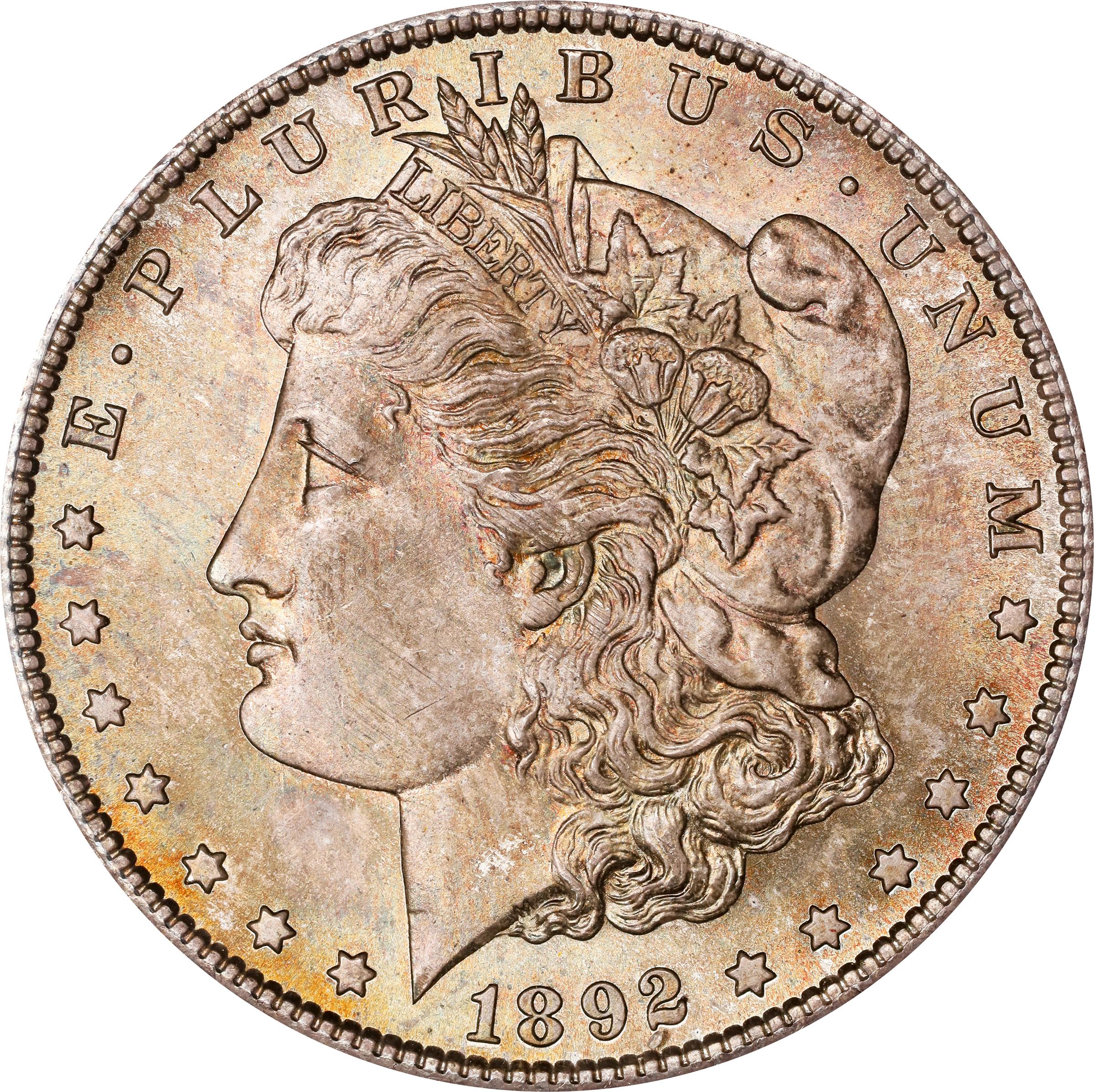
- As one of the leading condition rarities in the Morgan silver dollar series of 1878 to 1921, the appearance of even a low end Mint State 1892-S at auction is a noteworthy event. In our November 2020 Auction we had the privilege of selling the Jack Lee-Larry H. Miller specimen which, in PCGS MS-68, is the finest certified example of the 1892-S as well as one of the most famous Morgan silver dollars in numismatics. It realized $630,000 in that sale, in recognition of its awesome rarity and significance. Yet its status as the finest known 1892-S silver dollar is in jeopardy with the return to market of the exquisite premium Superb Gem example offered here. Off the market for nearly four decades, this coin has the added distinctions of being housed in a Generation 1.2 PCGS rattler holder and having received CAC approval at the MS-67 grade level. (CAC reports no stickered examples in MS-68 which means that, as of this writing at least, the Jack Lee-Larry H. Miller coin has not met with their approval.) And, of course, it is a simply beautiful example with superior technical quality, undeniable originality, and outstanding eye appeal.<p>This coin has that special appearance that we have noted before in high grade Morgan silver dollars that were acquired directly from the mint in the year of issue. The surfaces are virtually pristine with strong, intense luster in a soft satin texture. Richly and originally toned, it was obviously preserved with great care since the time of striking. The obverse displays a subtle mottling of olive-gold and pearl gray iridescence, while the reverse exhibits warm mauve-gray patina in the fields and atop the devices with bolder and more vivid steel-blue iridescence nestled in the protected areas around the motifs. There is not so much as a hint of numismatic conservation here and, again, this is a completely original coin that was almost certainly acquired directly from the San Francisco Mint in 1892. There is a touch of softness to the central high points, with associated fine planchet roller marks (as made) discernible at and around Liberty's ear on the obverse. This is a typical quality of strike for a Mint State 1892-S - most are not 100% full - but here the softness is trivial and well concealed by the toning. The strike detail is razor sharp to full elsewhere. The surfaces are so well preserved and close to pristine that they yield little in the way of useful provenance markers, although the persistent viewer aided by strong magnification will discern three minuscule signs of contact low on Liberty's forehead, immediately above the eye, that will be beneficial in this regard. In sum, this is a gorgeous, solidly graded, upper end Superb Gem that ranks among the most significant and desirable Morgan dollars that we have offered through the years.<p>The San Francisco Mint's silver dollar output in 1892 was 1,200,000 coins. This is a smaller total by the standards of the Morgan series, to be sure, but as often related it is the distribution (or lack thereof) of the coins rather than the number struck that was the determining factor in rarity vs. availability. It is distribution, not mintage that explains why an issue like the 1885-CC, with a mintage of just 228,000 coins, is plentiful in all but the finest Mint State grades while the 1896-S, of which five million examples were produced, is scarce to rare at all Uncirculated grade levels. The 1892-S is akin to the 1896-S in this context, and it is one of the rarest of all Morgan silver dollars in Mint State.<p>Distribution also plays a role in determining rarity and availability of many Morgan dollar issues in circulated grades. Using the 1885-CC as an example once again, that issue is a formidable rarity in worn condition, the "king of Morgan dollars" in such grades, as described by Q. David Bowers (1993). Obviously, much of that mintage went into government storage at the time of striking and avoided destruction through melting under the 1918 Pittman Act. In stark contrast, the 1892-S is very common in circulated grades, indicating widespread distribution into commercial channels beginning in the late 19th century. As we related in our November 2020 cataloging for the Larry H. Miller 1886-O, this is an unusual situation in the Morgan dollar series.<p>While quantities of 1892-S dollars were likely held back by the Treasury Department, few survived the mass melting of the early 20th century. Reports of examples being paid out from government vaults are few and far between, although Bowers states that at least one bag emerged from the San Francisco Mint circa 1925 to 1926. Those coins largely escaped the attention of contemporary numismatists, however, and circulated long enough that they may account for many of the EF to AU examples encountered today.<p>Interestingly, the 1892-S seems to have been overlooked by numismatists until the mid-to-late 20th century. Bowers writes of auction appearances for coins described as Mint State during the late 1890s through the 1910s that resulted in realized prices of less than $1 over face value. Apparently many dealers and collectors of earlier generations were of the opinion that thousands of Mint State 1892-S dollars remained in government vaults, and that subsequent releases would provide plenty of coins for collectors. Then came the San Francisco Mint distributions of the 1940s and 1950s, which yielded no known bags of this issue, followed by a similar absence from the Treasury Department releases of 1962 to 1964. Only after these events did numismatists finally realize the true rarity of the 1892-S in Mint State.<p>This had an adverse effect on this issue in the numismatic market of the 1970s and early 1980s. As collectors and investors scrambled to find, and dealers worked feverishly to provide, coins that did not exist, many About Uncirculated 1892-S dollars traded hands as Mint State coins. Writing in 1982 Wayne Miller warned:<p><em>Beware of high-grade 1892-S silver dollars which are toned on both sides. Such toning is often artificial, and is intended to cover up wear, abrasions, carbon spots, etc....</em><p>Dave Bowers suggests that this was not always done with malicious intent, for "years ago nearly all coins that were called 'Uncirculated' were, upon careful examination, what we would call AU today." Yet the confusion and bad blood created by transactions involving such coins damaged the reputation of the 1892-S and, for many years, made it less desirable in Mint State than it should have been. The result, as reported by Wayne Miller in 1982, was that "The 1892-S has been denigrated as a poor investment by most advisory letters, to the effect that it is one of the few key date Morgans that is not instantly salable in fully gem condition."<p>The advent of third party certification in the mid 1980s, however, has allowed the market to gain a clearer understanding of the rarity of the 1892-S in true Mint State preservation, and provides much needed confidence for collectors when pursuing these elusive coins. Q. David Bowers observed in <em>A Guide Book of Morgan Silver Dollars</em>, 2019 edition, "Philosophies change, and today a gem [1892-S] would, indeed, find a ready market." Further sign of the desirability that the 1892-S now enjoys in all Mint State grades is the infrequency with which examples appear on the open market. Such coins often spend many years in tightly held collections, where they are treasured as highlights and respected for their rarity. This is especially true of the small number of Gem and Superb Gem coins that have been certified; these are coveted by the most advanced Morgan dollar collectors, but acquisition proves to be a dream that few realize. When it comes to the finest known 1892-S Morgan dollars, only a handful of numismatists will ever have the opportunity of adding their name to the provenance of these regal coins. We urge enthusiasts to pursue this lot with vigor since coins such as this often appear in the market only once in a lifetime.<p>This coin's first known auction appearance was in Superior's Club Cal Neva sale of September 1987, where it was offered uncertified as lot 3060. Echoing our sentiment that it is a strong competitor to the Jack Lee-Larry H. Miller coin, the Superior cataloger described this exquisite piece as:<p><em>The Finest Known 1892-S Morgan Dollar</em><p><em>1892-S. Mint State 67. A wonder coin! The strike is extremely bold with full hair above Liberty's ear and full breast feathers. What makes this such a remarkable dollar, however, is its incredible color and unmarked surfaces. The obverse is a delightful blend of green and gold pastels while the reverse is deeper in hue with rich rose gray overtone changing to blues and greens in the protected areas. On both sides, a full cartwheel effect is noted. This is the finest 1892-S Morgan Dollar we have ever seen or sold in fifty-plus years of professional numismatics. As a point of reference, our Wayne Miller Lot 1302 coin (which realized $23,100) and was described as "certainly among the top five known" simply could not compare to this coin. The </em>Finest Known example<em> of this rare date and destined to set a record price for an 1892-S Morgan Dollar. In our opinion there will never be a better 1892-S Morgan Silver Dollar.</em><p>The toning described by Superior in 1987 remains exactly the same today - further proof of this coin's awesome originality. It was purchased out of the Club Cal Neva Sale by a partnership of Rick Sear, Anthony Terranova and Martin Paul, who presumably submitted it to PCGS shortly thereafter, where it was certified MS-67 in the Generation 1.2 rattler holder in which it is still housed. It was sold to silver dollar expert John Highfill, but thereafter the trail goes cold and we do not know how many other hands the coin may have passed through before being acquired by our consignor. It was submitted to CAC for the first time ahead of its offering in this sale.<p>While we do not know the path that this coin took after leaving the San Francisco Mint in 1892, its nearly pristine state of preservation strongly suggests that it has had only a few owners during the 133 years since it was struck. The winning bidder of this lot will be adding their name to a short and distinguished list of some of the most advanced Morgan dollar enthusiasts of the last century.