1797 50C MS(PCGS#6060)
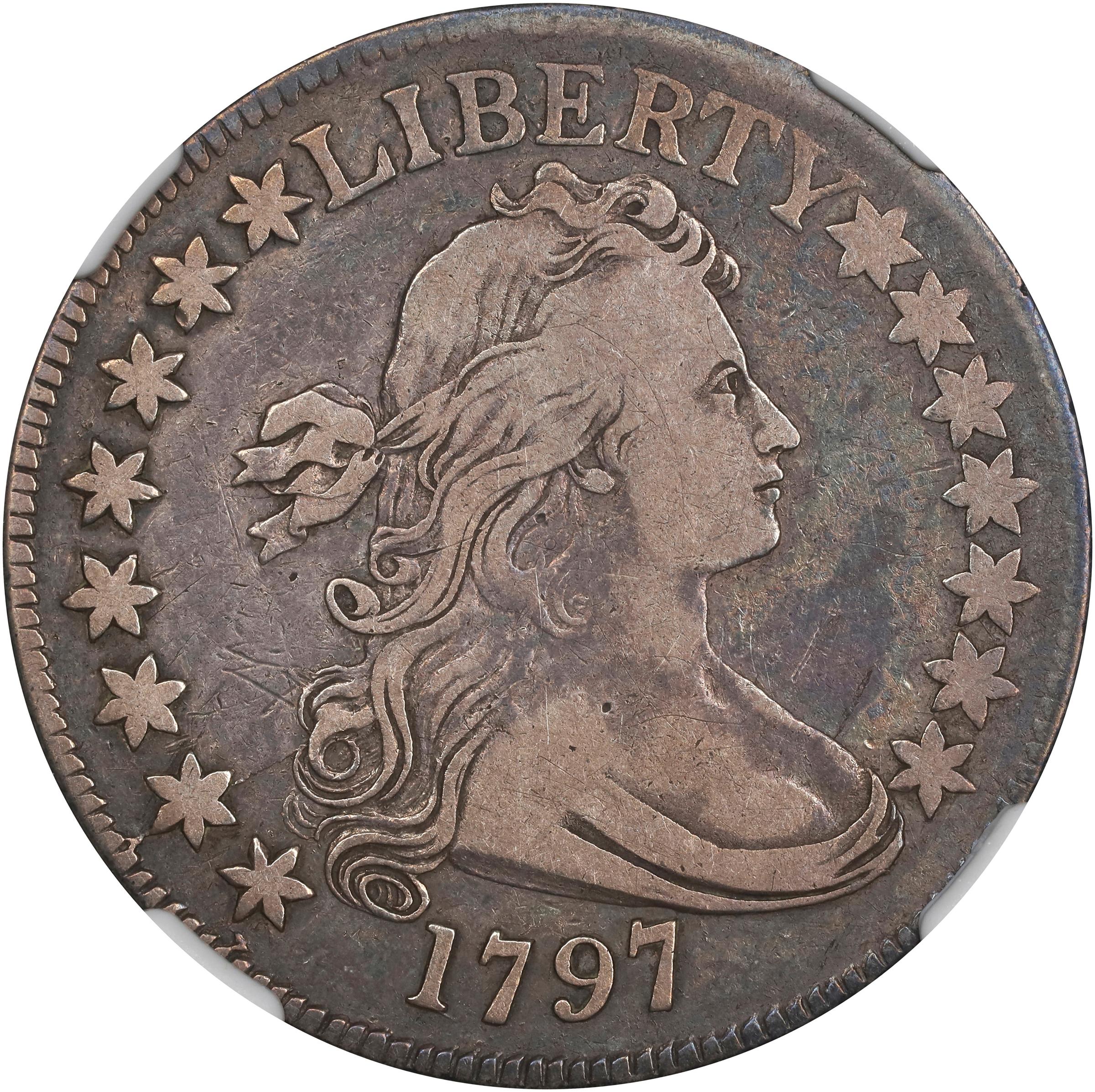
1797 50C MS (PCGS#6060)
November 2025 Showcase Auction U.S. Coins
- Commissaire-priseur
- Stack's Bowers
- Numéro du lot
- 2074
- Grade
- VF30
- Prix
- 50 400
- Description du lot
- Amato 433. Tompkins Die Stage 2/4. The Brookfield Collection is pleased to present a rare second offering for the challenging Draped Bust, Small Eagle half dollar design type. This mid grade 1797 Overton-101a example retains bolder definition on the obverse, which side is also pleasingly toned with somewhat of a circulated cameo appearance that contrasts steel gay fields and lighter mauve and golden-gray motifs. The reverse, a bit more softly defined, especially toward the lower right border, is also more deeply and evenly toned in charcoal gray. There is evidence of an old cleaning here, and a few dull marks in the lower left and right obverse field areas are also mentioned for accuracy. While not a perfect example, this piece offers above average detail in a Draped Bust, Small Eagle half dollar and, of course, the brevity and scarcity of this design type assures that all survivors are eagerly sought by type collectors as well as early half dollar specialists.<p>The 1797 half dollar is a profoundly enigmatic issue whose intrigue is only overshadowed by its scarcity. Echoing the symbolism portrayed by the flag of the United States, the earliest coins of the United States Mint depicted a star count that tried at best to mirror the number of states belonging to the Union at the time of striking. Fittingly so, the half dollars of 1794 and 1795 display 15 stars on the obverse - a number justified by Kentucky's admission on June 1st 1792. In anticipation of 1796's half dollar mintage, officials prepared a 1796-dated 15-star die for use, though no half dollars were struck in said year. However, by the time mintage resumed in the beginning of 1797, Tennessee had already joined the Union on June 1st of 1796 and a 16-stars motif was appropriate. Never to be wasteful, the Mint employed this wrongly dated and wrongly starred obverse, eventually transitioning to a 1796-dated 16-star obverse by some other combination of misguidance. Then, most curiously, a third die was created to finish out the 1797 half dollar production year; properly dated 1797, though ornamented with just 15 stars on the obverse. Several theories and conjectures have emerged to explain how this blundered regression might have occurred, though whether terribly complex or astoundingly simple, the error in star count for the 1797 Draped Bust half dollar has left numismatic scholars scratching their heads for the past two centuries.