1797 $10 BD-3, Large Eagle MS(PCGS#45718)
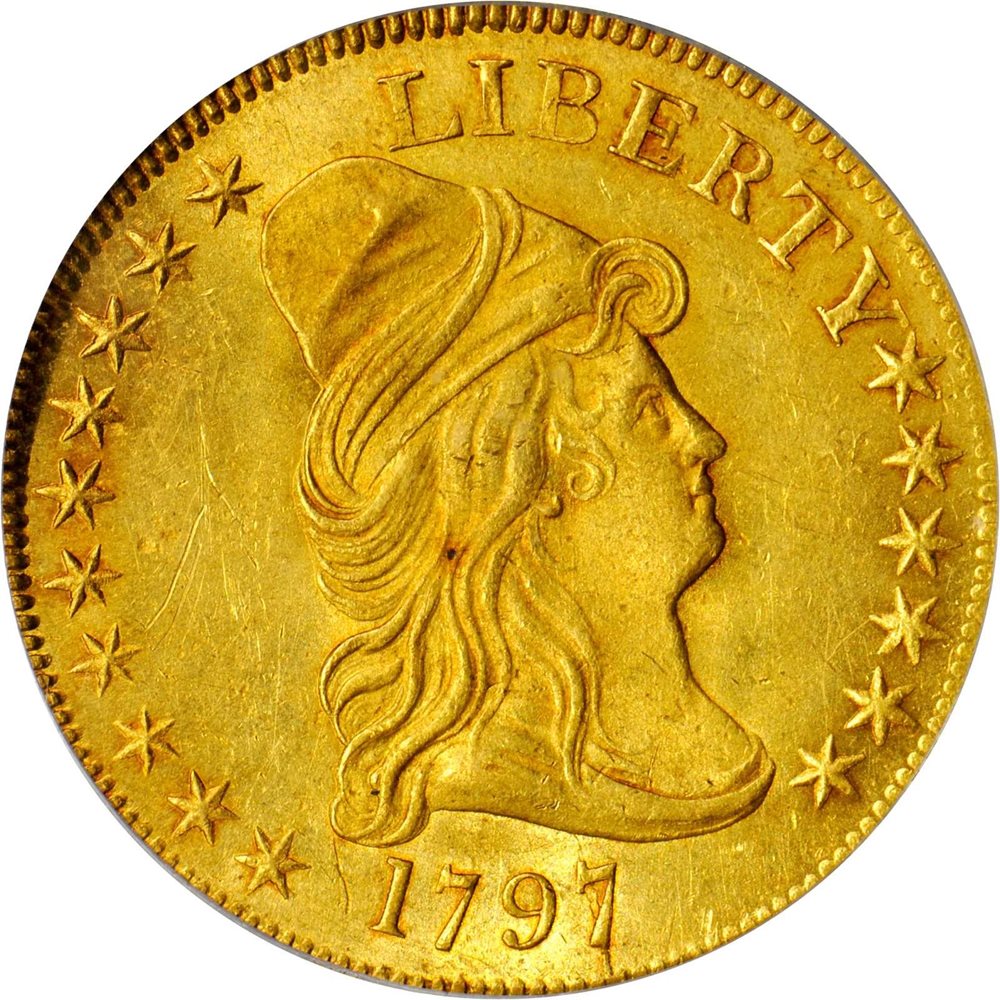
1797 $10 BD-3, Large Eagle MS (PCGS#45718)
August 2019 ANA U.S. Coins Auction Rosemont, IL
- Commissaire-priseur
- Stack's Bowers
- Numéro du lot
- 4011
- Grade
- MS63
- Prix
- 132 000
- Description du lot
- Beautiful Choice Mint State 1797 BD-3 Eagle Struck After Both 1798/7 Die Varieties 1797 Capped Bust Right Eagle. Heraldic Eagle. BD-3, Taraszka-11. Rarity-5. MS-63 (PCGS). Type and Style: Type II: Capped Bust Right, Heraldic Eagle. Style III: Head of 1795 with 16 stars arranged 10 left, six right; Reverse of 1797B with 13 stars in the field below the clouds and a short, thin neck on the eagle. The head punch is attributed to a hub prepared by Robert Scot, while the eagle punch is often attributed to a hub prepared by John Smith Gardner. Die Variety: BD-3, Taraszka-11, Breen 2-D, HBCC-3178. Only one obverse die was used to strike all three die marriages of the 1797 Heraldic Eagle ten, and it is easily distinguished from the obverse die of the 1797 Small Eagle issue by the 10x6 star arrangement (as opposed to 12x4). The short, thin neck eagle is definitive for this reverse die when paired with the 1797-dated obverse, although this reverse was also used to strike both varieties of the 1798/7 eagle (Stars 9x4 and 7x6). Die State: BD Die State d/c. This is the second known obverse die state of this variety, and the latest known for this workhorse die that was also used to strike the 1797 BD-2 and BD-4 eagles. In this die state, there are prominent die cracks through the second digit 7 in the date. The base of that digit is joined to the border by a single prominent crack, which has now developed into a small cud. There are two cracks within that digit, the left crack continuing only to the lower serif while the right crack, with die crumble evident, continues through the top of the 7 to the base of Liberty's bust. An additional die crack is present from the border through star 8, and the die has been lapped with the innermost points of several stars on the left noticeably truncated, especially star 10. The reverse die state, the only one known for this variety, is particularly significant for it confirms that the 1797 BD-2 was struck after both die marriages of the 1798/7 issue (see below). The die has been lapped with several of the letters in the legend UNITED STATES OF AMERICA and many of the dentils weakened. There are light cracks through the tops of the letters UN and TED in UNITED, as inherited from Die State b (1798/7 BD-1 and BD-2), as well as a new crack from the eagle's beak down through the shield to one of the vertical stripes. Estimated Mintage for the Issue: The mintage for the 1797 Heraldic Eagle provided in most numismatic references is 10,940 coins, based on Walter Breen's assumption that production from the new Heraldic Eagle reverse dies began on June 7, 1797 with coins bearing that date continuing to be delivered through January 30, 1798. According to Mint records, 10,940 eagles were delivered during that period. Based on a more exhaustive study of die states and emission sequences, as well as modern estimates on the number of coins extant, Dannreuther provides a broader range of 8,750 to 12,500 coins struck for the 1797 Heraldic Eagle. Estimated Mintage for the Variety: Dannreuther estimates that 1,750 to 2,500 examples were coined from the 1797 BD-3 dies. Estimated Surviving Population for the Variety: Only 40 to 50 coins are believed extant in all grades (per Dannreuther). Strike: This is an overall sharply struck example with Liberty's hair curls and the eagle's wing feathers particularly well defined. Most other features are also sharp, although we do note a touch of softness to the eagle's breast in the center of the reverse, as well as along the right obverse border. Surfaces: This vividly and originally toned beauty exhibits dominant olive-gold patina with splashes of reddish-rose iridescence around the peripheries and devices, especially on the reverse. Luster is full with a satin to modestly semi-reflective finish. A concentration of wispy handling marks in the left obverse field and a tiny carbon spot within Liberty's hair curls behind the earlobe are mentioned as identifying features. Commentary: BD-3 is the rarest of the three known die marriages of the 1797 Heraldic Eagle ten, and is approximately twice as scarce as both BD-2 and BD-4. Taraszka was the first numismatic scholar to conclude that this variety was struck after both die marriages of the 1798/7 issue, an assessment with which Dannreuther concurs. Taraszka's finding was based on the fact that the reverse die state of all known 1797 BD-3 eagles is later than those of both the 1798/7 BD-1 and BD-2 varieties (all three were struck from the same reverse die). Most significantly, the 1797 BD-3 is the only one of these three varieties that displays reverse die lapping and the crack from the eagle's beak into the shield. Scarce in an absolute sense and rare from a condition standpoint, this lovely early eagle would be an excellent choice for an advanced type or variety set. It ranks high among the survivors of the issue certified by PCGS, and is one of the most desirable Heraldic Eagle tens of any date or die pairing that we have brought to auction. Outstanding! This coin is included in the list of "Significant Specimens" for the variety in the Taraszka early eagle reference. Provenance: From the Anthony J. Taraszka Collection. Earlier from our (Stack's) Fixed Price List of 1994, lot 114. The plate coin for the die variety in the book United States Ten Dollar Gold Eagles: 1795-1804by Anthony J. Taraszka. PCGS Population (all die marriages of the issue): 4; 1 finer (MS-63+). PCGS# 45718. NGC ID: 25ZY. Click here for certification details from PCGS.