1859 $20, DCAM PR(PCGS#99071)
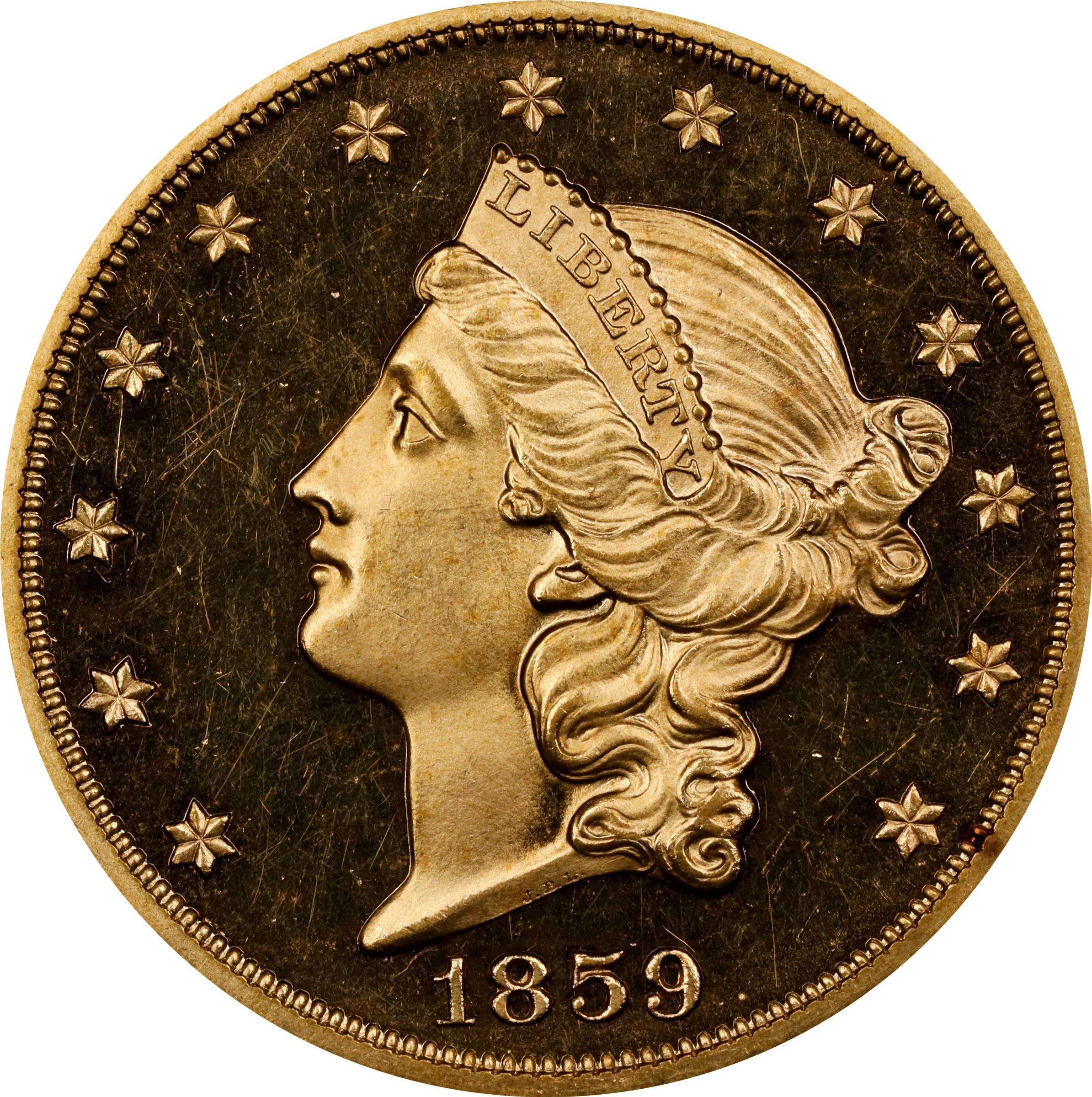
1859 $20, DCAM PR (PCGS#99071)
December 2025 Showcase Auction - The James A. Stack, Sr. Collection Part I
- Auctioneer
- Stack's Bowers
- Lot Number
- 20028
- Grade
- PR64DCAM
- Price
- 900,000
- Lot Description
- A landmark rarity from this historic issue in the Proof Liberty Head double eagle series, and an amazing beauty that really needs to be seen to be fully appreciated. Lovely and vivid rose-gold color is seen on both sides. The strike was delivered with pinpoint accuracy and imparted sharp, crisp detail throughout the design. The fields are deeply mirrored, although it is interesting to note that the polishing of the reverse die was not complete as evidenced by traces of mint frost nestled within the protected areas of some of the design elements. Close inspection with a loupe identifies these areas: the spaces between the rays above the eagle; the areas around the arrows and olive branch in its talons; the spaces within the bottoms of the letters E in UNITED and A, ER and A in AMERICA; and the bottoms of the recessed areas of the vertical stripes in the shield. Once identified, however, these same areas of incomplete polish are also discernible in images of most other Proofs of the issue that we have examined, including the specimen in the National Numismatic Collection at the Smithsonian Institution that serves as the plate coin in the 2018 reference <em>United States Proof Coins</em> by John W. Dannreuther (p.873). <p>Returning to the James A. Stack, Sr. specimen offered here, its design elements are universally frosted; the interplay between these features and the mirrored fields provides strong contrast that lives up to the DCAM designation from PCGS. The Proof-64 grade is also spot on, as this is a solid Choice specimen with only a few wispy hairlines from ancient numismatic handling that hardly interfere with the generally smooth appearance. So well composed are the surfaces, in fact, that identifiers for provenance purposes are difficult to come by. The extreme rarity of this issue and the significance of each individual specimen, however, makes the recording of such identifiers mandatory. With that in mind, we call attention to a tiny obverse carbon spot that is out of the way within the denticles at star 13 and, on the reverse, two tiny reeding marks (one of two reeds, the other of three) in the field just after the final letter A in AMERICA.<p>Proof double eagle coinage increased dramatically in 1859, when 80 coins were prepared as opposed to only five or so the preceding year. Numismatics as a hobby was experiencing its first great surge in popularity in the United States during the late 1850s, and the Mint was eager to share in the profits. So eager, in fact, that it widely overshot the mark when it came to anticipated demand for Proof double eagles in 1859. With only 10 coins known today, most of the 80 Proofs struck were either melted or released into commerce, the latter either by the Mint or after purchase, in both cases at face value. Saul Teichman has provided complete and up to date provenance information on the 10 known specimens at the <em>Newman Numismatic Portal</em>, specifically at https://nnp.wustl.edu/library/book/649995. Two of these coins are in the National Numismatic Collection at the Smithsonian, one direct from the Mint Cabinet, the other the gift of Josiah K. Lilly. A third was gifted to the American Numismatic Society by J.P. Morgan, as part of a complete 1859 Proof set. Thus three are permanently impounded and not available for private ownership, leaving just seven coins in private hands, one of which is an impaired specimen certified Proof-58 by NGC. It is the sign of the extreme rarity of early Proof double eagles that the 1859, despite its tiny surviving population, is the earliest collectible Proof for this denomination.<p>The James A. Stack, Sr. specimen is within the upper half of the census for Proof 1859 double eagles in private hands. Interestingly, the two Choice Deep Cameo Proofs among these seven coins were both once part of the famed Louis E. Eliasberg, Sr. Collection. The primary Eliasberg coin was sold in our (Bowers and Ruddy's) October 1982 sale of "The United States Gold Coin Collection" and was later part of the Ed Trompeter Collection. Since Eliasberg had acquired that coin from B. Max Mehl's May 1922 sale of the James Ten Eyck Collection, it is unknown why he purchased a second Proof 1859 double eagle from our (Stack's) December 1944 sale of the J.F. Bell Collection. Perhaps he momentarily forgot about his earlier acquisition, or perhaps he found this second piece too attractive and/or too significant to pass up. The exact reason is irrelevant, and the ex J.F. Bell specimen was sold a few years later in our (Stack's) October 1947 sale of the "H.R. Lee" Collection, which was comprised mostly of Eliasberg duplicates. Lest the word "duplicate" conjure thoughts of second-line or otherwise inferior status, we stress that very few collectors have reached or will ever be able to count two beautiful Choice Deep Cameo Proof 1859 double eagles among their holdings. The ex J.F. Bell specimen has served as a centerpiece of the august James A. Stack, Sr. Collection for nearly 80 years, and it will serve with similar distinction in the next world-class cabinet in which it is included.