1851 "887" $50 RE Augustus Humbert MS(PCGS#10214)
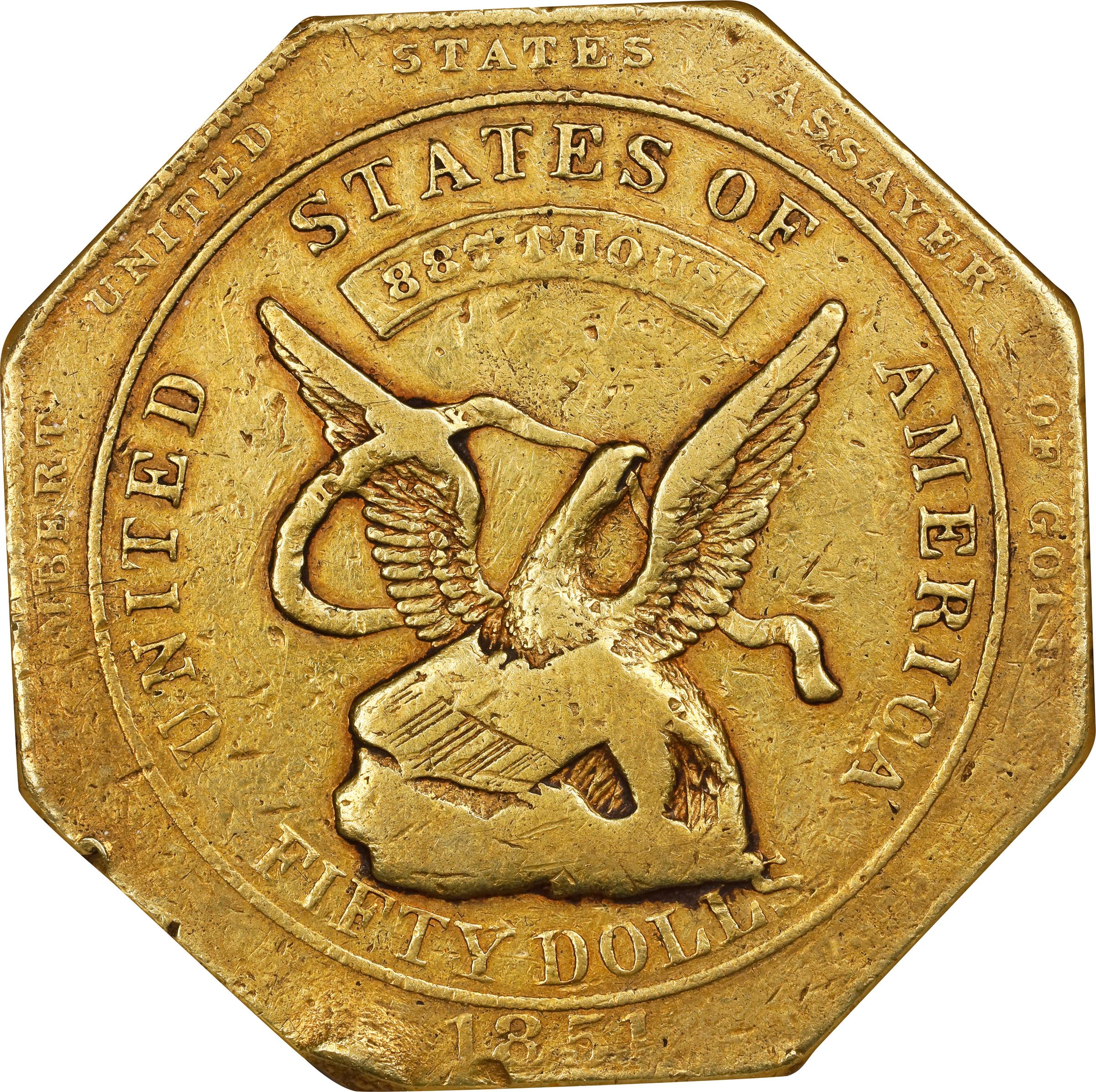
1851 "887" $50 RE Augustus Humbert MS (PCGS#10214)
November 2025 Showcase Auction U.S. Coins
- Commissaire-priseur
- Stack's Bowers
- Numéro du lot
- 2135
- Grade
- VF30
- Prix
- 28 800
- Description du lot
- This is a handsome, pleasingly original example with glints of pale pinkish-rose iridescence to dominant deep honey-olive color. A few light bumps are noted here and there, but all in all the edges are quite smooth for a mid grade survivor of this hefty type. As well, the surfaces are uncommonly free of sizeable marks for having seen such extensive commercial use. Indeed, the only marks seen are small in size and well scattered over the surfaces so that they do not individually distract. Peripheral devices are incomplete, typical for a well circulated Augustus Humbert $50, although the date is legible - if faint - and the words UNITED STATES ASSAYER OF GOLD are bold. The central devices are suitably bold for the grade, allowing ready appreciation of this classic design type from the California Gold Rush era. In sum, this piece offers more than acceptable equality for a scarce and eagerly sought territorial gold issue, and it is sure to find many willing buyers in today's market.<p>James Wilson Marshall's discovery of gold in California's American River on January 24, 1848 kicked off one of the largest, and certainly the most romanticized gold rush in United States history. As news of this discovery spread, 300,000 people from both the Eastern United States and abroad would eventually make their way to California seeking wealth and prosperity. Some did strike it rich, although the majority bettered themselves little, either financially or otherwise. A small settlement of 200 souls in 1846, San Francisco had grown exponentially into a city of 36,000 people by 1852.<p>Such a tremendous surge in population in a short period of time resulted in an acute shortage of circulating currency. Gold dust, which was quickly adopted as a medium of exchange, proved difficult to work with and was little more than a stopgap measure. Then there was the additional problem of what to do with all of the gold that was being mined. Clearly it needed to be converted into a form that was universally acceptable so that it could not only be used in commerce in California, but could also be transported to major economic centers so as to contribute to the nation's larger economy.<p>As early as 1849 proposals were introduced both in the California Legislature and United States Congress calling for the establishment of an assay office or branch mint in California. Competing political interests delayed action on the federal government's part, and most Californians wanted more than simply a state-run assay office. To meet the immediate economic needs of Gold Rush California while final action on the part of the state and/or federal government was awaited, various private minting firms sprang up in and around San Francisco. The firm of Moffat & Co., however, became the most important private minter serving the California Gold Rush; its successors Curtis, Perry and Ward eventually sold their facility to the United States government, which reopened it as the San Francisco Mint in March 1854.<p>While still under the auspices of Moffat & Co., the firm's reputation caught the eye of the federal government when the latter was finally able to take action in the establishment of a local coinage facility to service the Gold Rush. Unfortunately, however, Californians did not initially get the branch mint they desired, due to competing political interests. Rather, a compromise bill passed through Congress on September 30, 1850, and established the United States Assay Office, to be located in San Francisco. Moffat & Co. received the contract to operate as the United States Assay Office, with New York watchmaker Augustus Humbert appointed as United States Assayer. Humbert arrived in San Francisco on January 30, 1851, bringing with him the first dies for coinage that had been prepared by Charles C. Wright. The first coins - $50 gold pieces - were issued under Humbert's authority the following day, with ingots following on February 14. The United States Assay Office continued to operate with these principals until the dissolution of Moffat & Co. in early 1852, after which the federal contract was assumed by Curtis, Perry & Ward under the name of the United States Assay Office of Gold. Humbert remained as assayer under the successor firm until it ceased operations on December 14, 1853.<p>Nearly a branch mint in its own right, the operations of the United States Assay Office in 1851 and 1852 represent an important and defining chapter in the coinage history of the California Gold Rush and, indeed, the nation as a whole. One of Humbert's $50 gold pieces from his first year as assayer in California, this handsome Choice VF coin presents the advanced collector with an important opportunity to own one of the most impressive mementos of this widely studied and avidly collected era in United States frontier history.