1872-S $1 MS(PCGS#6970)
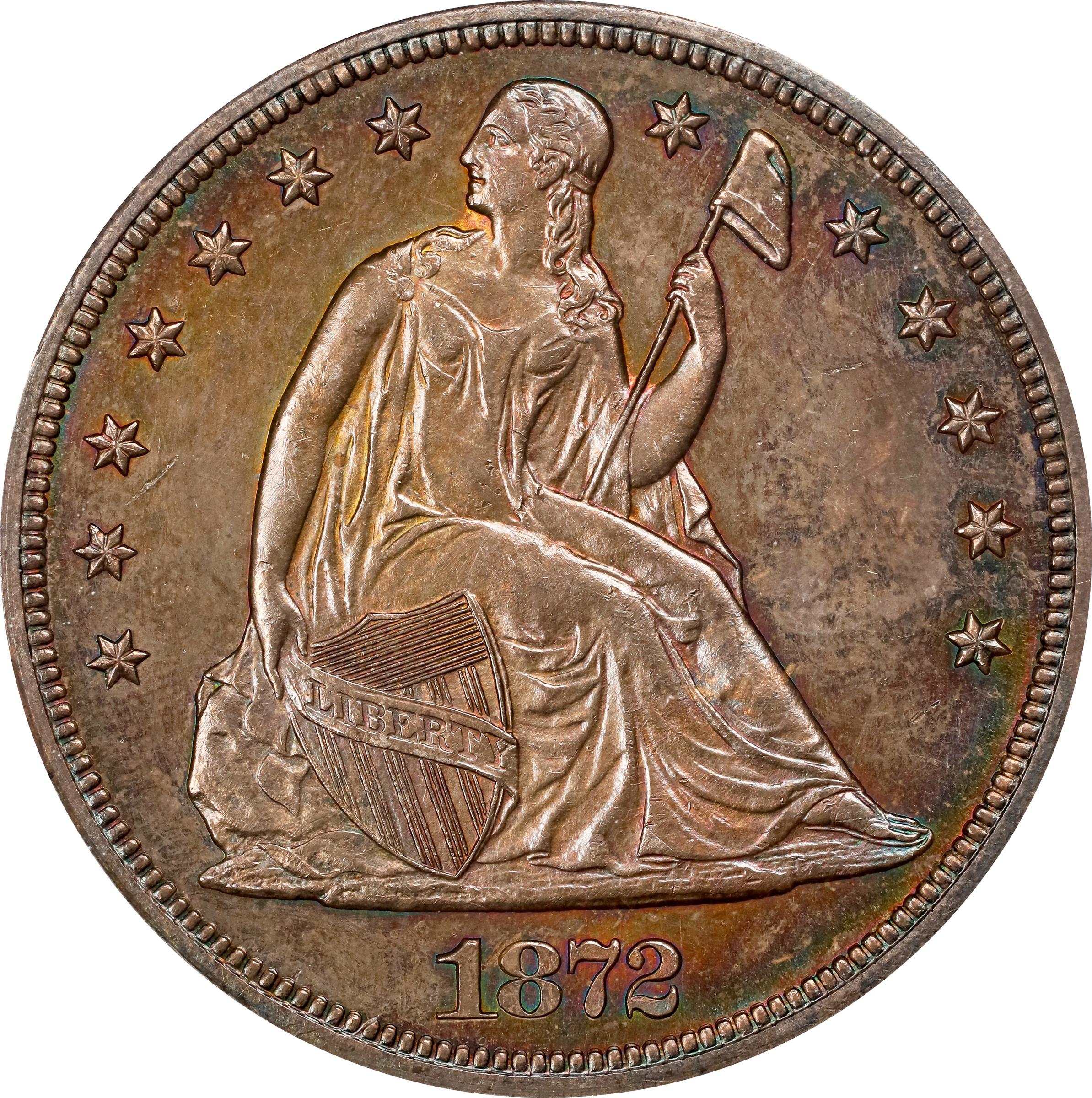
1872-S $1 MS (PCGS#6970)
Summer 2025 Global Showcase Auction U.S. Coins
- Auktionator
- Stack's Bowers
- Losnummer
- 3113
- Erhaltungsgrad
- MS63
- Preis
- 33.600
- Losbeschreibung
- OC Die State a/a. Offered is a landmark condition rarity for this key date Liberty Seated dollar issue. Pleasantly toned over lustrous satin surfaces, we note warm olive and mauve-gray patina dominating the in-hand appearance. Direct lighting, however, calls forth vivid undertones of champagne-pink, reddish-rose and cobalt blue iridescence, the colors boldest and most varied around the obverse border. Very sharply struck, indeed virtually full by circulation strike Liberty Seated dollar standards. A hint of glossiness to the texture is noted for accuracy, but the surfaces are remarkably free of sizeable marks for both the type and the assigned grade.<p>After paltry mintages during the Civil War and early Reconstruction eras, Liberty Seated dollar coinage at the request of bullion depositors increased markedly beginning in 1868 and remained strong through the series' end in 1873. Increasing production at the Comstock and other mines in the American West explain this increased demand for circulation strike silver dollars, but the oft-repeated claim in the numismatic literature that these coins were used in the export trade to China needs to be qualified. It is true that the issues of 1868 to 1873 were intended solely for export, and as an outlet for domestic production, but with the lion's share of the mintages of this era attributed to the Philadelphia Mint the primary route to Asian markets remained through the London market, and continuing the practice for Liberty Seated dollars that began in earnest in 1850. If the path was direct to China and/or other destinations in the Far East, most Liberty Seated dollars of 1868 to 1873 would have been struck at the San Francisco or Carson City mints, especially since the sources of domestic silver were in the West. Instead, the San Francisco Mint struck a mere 9,000 silver dollars in 1872 to meets requests for this denomination from bullion depositors, while equally (if not more) limited totals were achieved at the Carson City facility, 1870 to 1873. These are the only mintmarked issues of the era struck at the request of bullion depositors; the few 1870-S silver dollars produced were never intended for commercial use; the 1873-S is unknown in any collection with all 700 coins reportedly struck in February 1873 probably representing a final delivery of 1872-S dollars to help fill orders for these coins received from January 10 through March 6, 1873, ahead of the effective date of April 1 for the Act of February 12, 1873. If true, the actual mintage for the 1872-S Liberty Seated dollar is 9,700 coins.<p>Also repeated frequently in the numismatic literature is the claim that the mintage of the 1872-S was largely withheld by the San Francisco Mint at first, and then released into domestic circulation in the West after the resumption of silver specie payments in 1876. For one thing, the resumption of specie payments in April 1876 concerned the situation in the East and Midwest, where silver had disappeared from circulation early in the Civil War; in the West silver (and gold) coins continued to circulate throughout the Civil War and Reconstruction eras. Additionally, Rusty Goe (2020) observes in connection with the 1870 to 1873 Carson City Mint issues, which comment is equally appropriate for the 1872-S:<p><em>At the time, the silver value in a dollar-piece was worth more than the silver value in two half dollars. Many people out West questioned if it made sense for depositors to request coins (silver dollars) whose face value would have been less than their bullion value.</em><p>Writing in his 2016 <em>Guide Book of Liberty Seated Silver Coins</em>, Q. David Bowers states conclusively:<p><em>From </em>Banker's Magazine<em>, November 1872: "U.S. Coin in China. The new silver dollar recently struck in the San Francisco Mint is said to be adapted for general circulation in China, where the want of silver coin has been much felt. It is worth six percent more than the old dollar, and will be received in China on the same terms as the old Mexican dollar, which has hitherto been at a premium of five to eight percent." The [1872-S] dollars were sold at a premium for this purpose and were not placed into circulation.</em><p>Bowers' conclusion is correct, although the contemporary account is incorrect and the U.S. Liberty Seated dollar continued to be a poor competitor in the markets of the Far East, which explains why bullion depositors requested so few from the San Francisco and Carson City mints, as above. The rise of San Francisco as the primary port for the export of U.S. silver directly to China and other destinations in Asia began only with the introduction of the trade dollar in 1873.<p>Nevertheless, most 1872-S dollars were used in the export trade and were eventually melted overseas. The scarce circulated survivors generally represent examples repatriated later in the 19th century and which subsequently managed to avoid being melted by the Treasury Department. A few also represent coins that, for one odd reason or another, were acquired by or otherwise found their way into the hands of individuals in the United States around the time of issue. Mint State examples of the 1872-S, of which Bowers accounts for a mere 10 to 15 in all grades, survived purely as a matter of a chance in an era when there was no numismatic activity in the American West, and no interest yet in mintmarked coinage among collectors in the East. This is an interesting, yet challenging issue, as are all of those that make the Liberty Seated dollar series such a rewarding pursuit for advanced numismatic researchers and collectors.<p>