(1796) AE Medal Castorland Restrike, Original Dies, BN MS(PCGS#657)
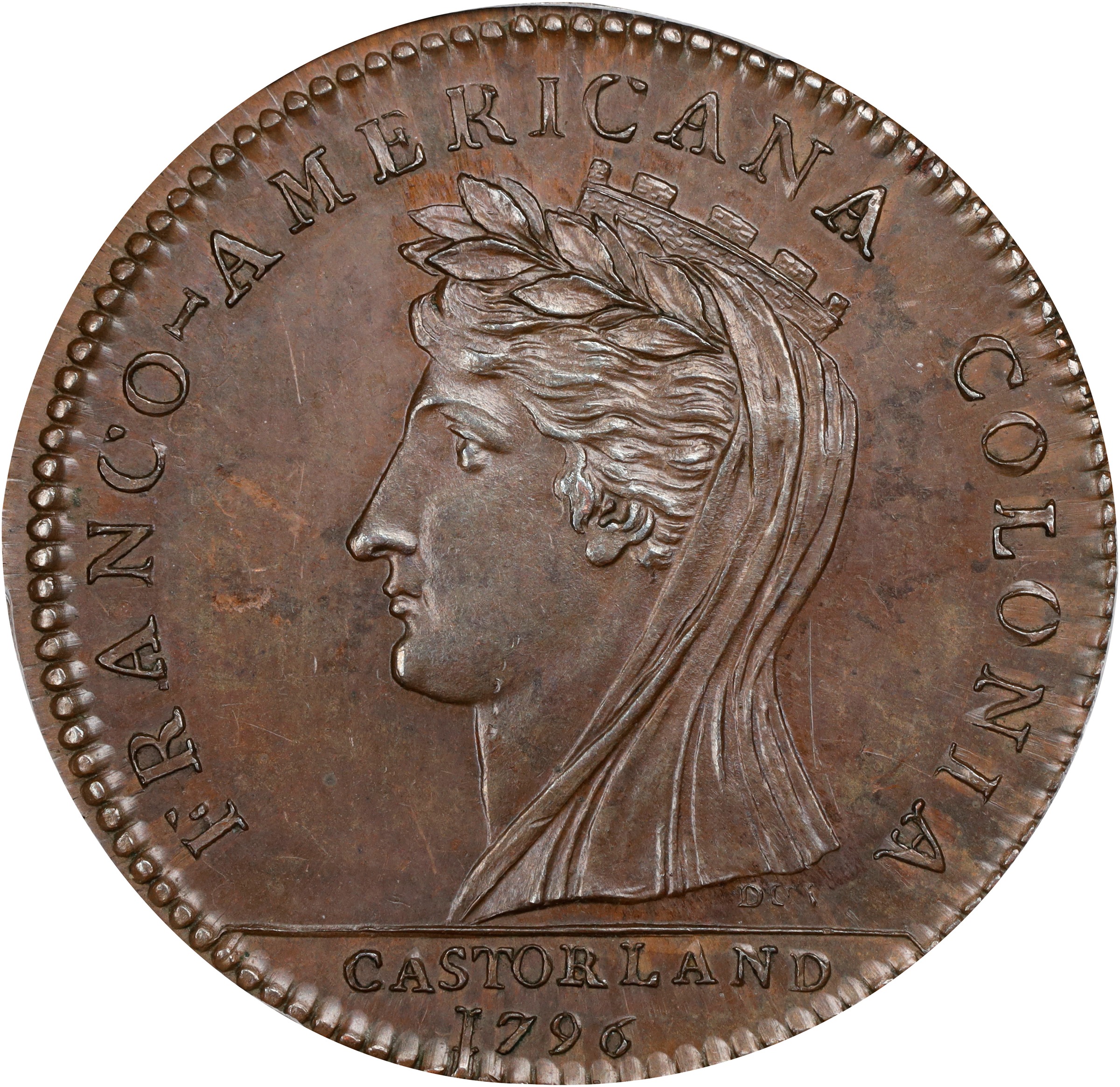
(1796) AE Medal Castorland Restrike, Original Dies, BN MS (PCGS#657)
November 2025 Showcase Auction U.S. Coins
- Auktionator
- Stack's Bowers
- Losnummer
- 1461
- Erhaltungsgrad
- MS63BN
- Preis
- 2.160
- Losbeschreibung
- 196.5 grains. 350 degrees, or 10 degrees counterclockwise of medal turn. An elegant example of this beautifully executed type. Both sides exhibit razor sharp to full strike detail through the design. The impression is slightly off center, to 3 o'clock on the obverse, 9 o'clock on the reverse, but while the border is into the beading in both areas, all of the peripheral lettering is on the flan. We note gentle mottling to original toning that blends shades of autumn-brown and golden-olive with a splash of more vivid deep rose color on the reverse, within and around the leaves of the tree. The finish is noticeably prooflike and very attractive. Original dies, no evidence of die crack on the reverse, but extensive spalling is present near the jug handle. A concentration of lint marks (also as made) is seen in the right reverse field, above the area of spalling, with a few additional lint marks present in the left obverse field, close in to some of the letters in FRANCO. No post-production blemishes come readily to the fore during in-hand viewing, and close inspection with the aid of magnification is required to discern a couple of extremely faint pin scratches in the lower right obverse field. The die state and planchet finish of this piece clearly place it later in the striking order than the earliest originals, analogous to lot 4250 in our November 2020 E Pluribus Unum offering, as well as lot 1134 in our March 2023 sale of the Sydney F. Martin Collection, Part III. It is one of the later originals struck, but still an original, and is misattributed by PCGS as a "Restrike, Original Dies" in its current holder.<p>The Castorland medals are among the most fascinating American reference medals of the 18th century, with much in common with the 1796 Myddelton tokens. Though the Castorlands were struck at the Paris Mint and the Myddleton tokens were English productions from Boulton and Watt, both were struck to promote American settlement projects in what were then considered hinterlands. The Castorland settlement, just 50 miles from the Canadian border in upstate New York, was largely abandoned by 1814, but the medal lived on. As was common at the Paris Mint at the time, the original dies were preserved, producing restrikes best dated along a continuum from the earliest perfect die state to the last broken one. After 1842, the Paris Mint began dating restrikes using edge privy marks. For popular medals, which included most of American interest, copy dies supplanted broken original dies. The Paris Mint continued to strike Castorland pieces from copy dies well into the 20th century. While later strikes served just one purpose - interesting collectibles for a numismatist's cabinet - the earliest strikes in silver and copper, as here, clearly served another function. Whether they were intended as gifts for early investors, marketing tools to lure new settlers, or something else, the record remains fairly silent thus far.