1860 AE $10 Clark, Gruber & Co., BN MS(PCGS#10145)
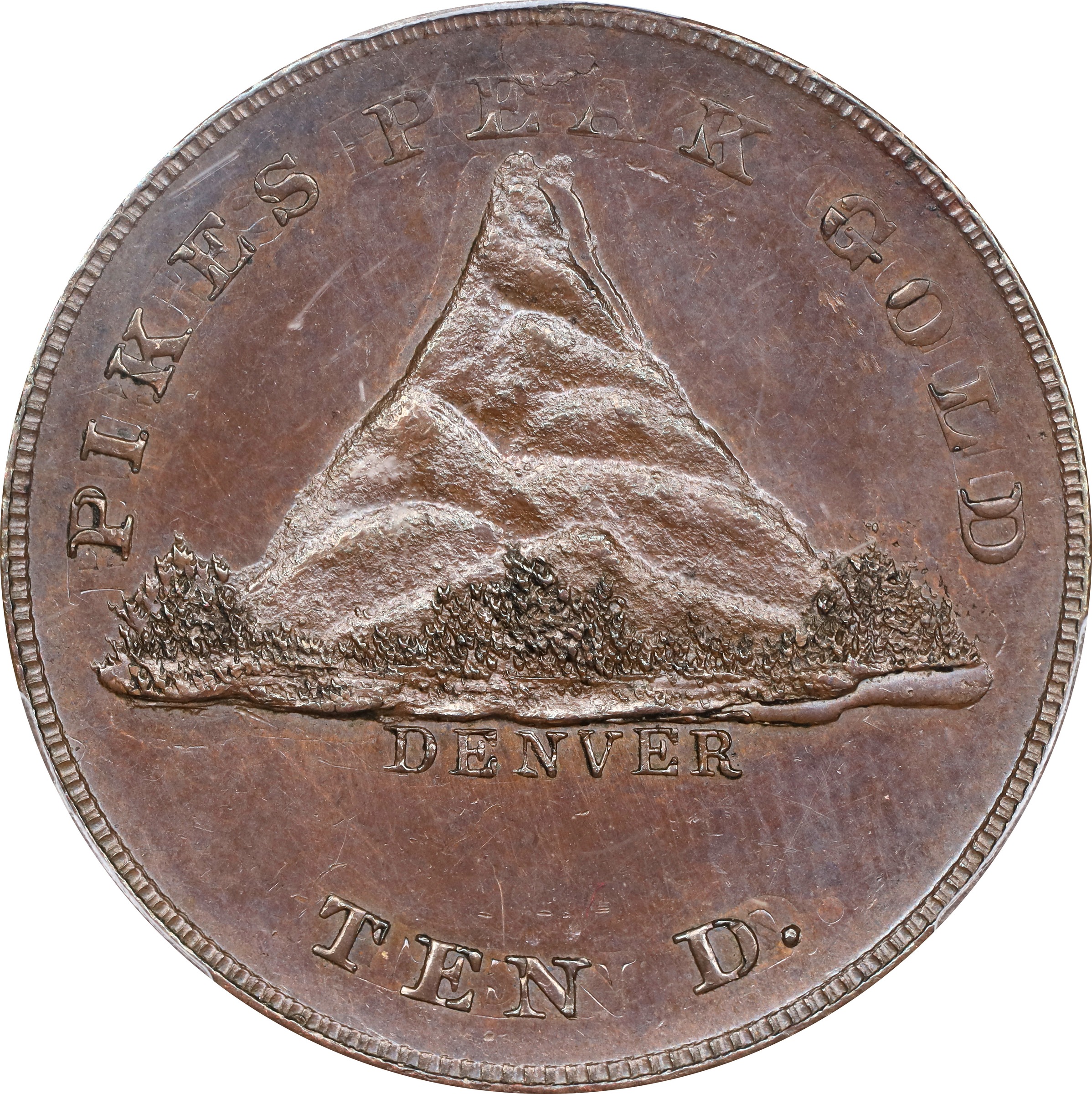
1860 AE $10 Clark, Gruber & Co., BN MS (PCGS#10145)
Spring 2026 Showcase Auction U.S. Coins
- Commissaire-priseur
- Stack's Bowers
- Numéro du lot
- 3187
- Grade
- MS63BN
- Prix
- 45 600
- Description du lot
- In the late 1850s, while the nation was still reeling from the effects of the disastrous Panic of 1857, gold was discovered in the Territory of Jefferson, attracting fortune seekers from all over. Many prospectors from the East Coast undertook the dangerous journey westward, passing through Leavenworth, Kansas where Austin and Milton Clark and merchant Emmanuel Gruber had set up a provisioning business. Reading about the gold finds and hearing the tales told by the prospective settlers, all three partners decided to establish a private banking and assay firm in what would soon be renamed Colorado. In 1860, the partners reached Denver and quickly set up the office of Clark, Gruber & Company, which was ready in July that same year to begin producing their gold coinage. The precious metal used to make Clark, Gruber & Co.'s $2.50, $5, and $10 gold pieces did not meet federal purity standards, so in order to compensate the firm deliberately made their coins overweight, to the point that the coins' intrinsic value exceeded stated face value by about 1%. The coins were eagerly accepted and soon Clark, Gruber & Co. became by far the largest and most important of the Colorado private coiners.<p>While the two smaller denominations resembled their federal counterparts, the obverses of both the 1860 $10 and 1860 $20 bore a distinctive if completely fanciful representation of Pike's Peak (which in no way resembles the actual mountain), the legend PIKE'S PEAK GOLD, and with DENVER below the base of the mountain, and finally beneath that the value TEN D. or TWENTY D. The $10 pieces were the first coins to be produced at the new private mint, an occasion that was recorded by the <em>Rocky Mountain News</em> on July 25, 1860, who were invited to watch the first coins come off the press. The issues proved successful and by October of 1860, some $120,000 worth in all had been struck. While short lived - the subsequent 1861 $10 and 1861 $20 bear designs that closely resemble contemporary U.S. Mint coinage to facilitate use - the Mountain design has since become synonymous with Colorado territorial coinage of all types. Writing in the outstanding 2023 reference <em>America's Golden Age: Private & Pioneer Gold Coins of the United States 1786-1862</em>, Don Kagin and David McCarthy account for only 100 to 150 survivors of the 1860 "Mountain Ten" in gold.<p>Clark, Gruber & Co. also produced a limited number of die trials, the copper "Mountain Ten" offered here likely made shortly before coinage began in gold on July 25, 1860. As a group, the patterns and die trials from Clark, Gruber & Co. are the most frequently seen within this specialized segment of private and territorial gold and related coinage. In an absolute sense, however, all off-metal strikings from this firm are rare, the present example one of perhaps only a dozen or so copper impressions of the 1860 $10. It is a handsome and inviting Mint State example, the surfaces hard and frosty with a hint of reflectivity in the fields. Warm chestnut-brown patina and crisp strike detail provide further visual appeal. The obverse is double struck, as clearly seen on the peak of the mountain and at the peripheral letters.