(1849) $10 Miners' Bank MS(PCGS#10236)
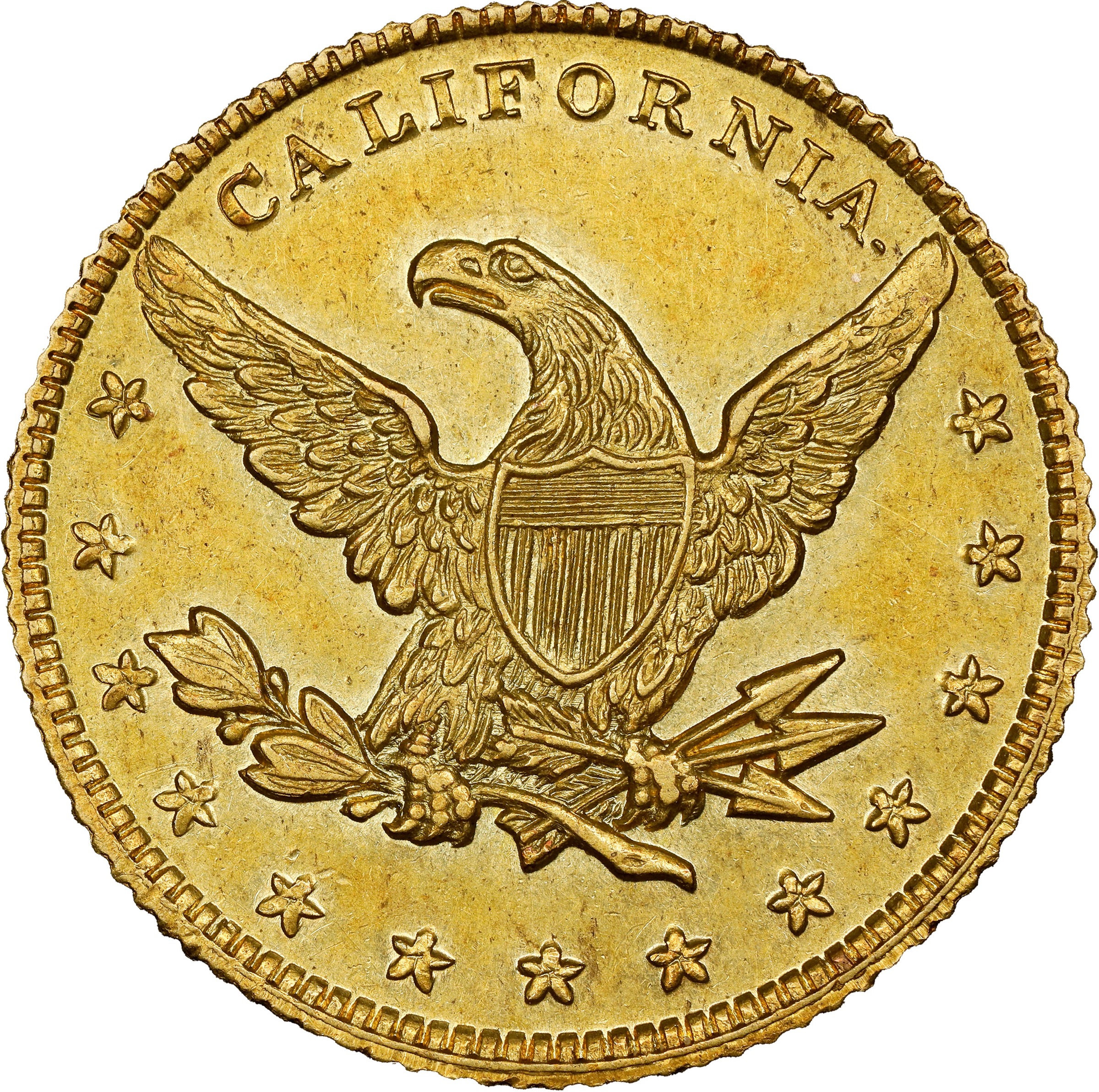
(1849) $10 Miners' Bank MS (PCGS#10236)
February 2026 Showcase Auction - The James A. Stack, Sr. Collection Part II
- Auktionator
- Stack's Bowers
- Losnummer
- 23061
- Erhaltungsgrad
- MS62
- Preis
- 432.000
- Losbeschreibung
- A singularly remarkable example of this notable historic rarity. Both sides are supremely frosty, with green-hued gold showing some rosy highlights under outstanding flashy luster. The strike is excellent for the issue, with the sometimes soft central reverse perfectly detailed and the raised border of denticles likewise fully realized. The obverse is aligned trivially to 12 o'clock, with the die edge visible at the bottom of that side, while the reverse is aligned in the opposite direction, with broader denticles at top than at bottom. The crisp obverse is immaculate, showing no contact marks of any size, just trivial and scattered hairlines. The reverse is nearly as pristine, even though the wide expanse of its fields tends to attract marks on most known specimens. Only a few tiny marks are seen on that side, along with an area of planchet granularity a bit closer to the top of R in FRANCISCO than the base of N in TEN. The visual appeal is simply superb, and it's easy to see why our firm cataloged this coin in 1945 as "an Uncirculated Gem."<p><p>This coin is a golden example of no good deed going unpunished. When the Miners' Bank was first a going concern in downtown San Francisco in early 1849, they were cashing checks "in gold dust turned out of a bottle with a spoon into a bit of brown paper," according to a contemporary observation reprinted in the 2023 Kagin and McCarthy book. Thinking that coins of standard value might be a bit easier to handle than hand-rolled twists of gold dust, the Miners' Bank moved forward with a plan to create coins from their gold dust deposits. In August 1849, the bank gave a coining contract to the partnership of Kohler and Company, composed of the future state and United States Assay Office assayer Frederick Kohler and fellow New Yorker David Broderick. An attempt to have the Federal authorities at the port accept their coins for duty failed, and the Kohler firm's lack of assaying experience became evident as their productions were first panned by the assayers of the Philadelphia Mint and then by the commercial community at large. The coins did not last long in circulation, and most were melted in short order. Today, most of the known coins show little wear. Two-thirds of the pieces PCGS has certified are graded between AU-53 and MS-60.<p><p>While circulated examples are hard to find, gems are unheard of. This is the single finest example PCGS has ever certified and the finest ever approved by CAC. Every example we've sold since 2006 has been graded in the AU range, and digging deeper into our history finds just a single example graded higher than this one: the Archangel Collection coin, an NGC MS-63, that sold for $230,000 in our November 2006 sale. This piece, off the market for 80 years, sets a new standard that today's connoisseurs can reach for.