1773 'Penny' Virginia, BN PR(PCGS#246)
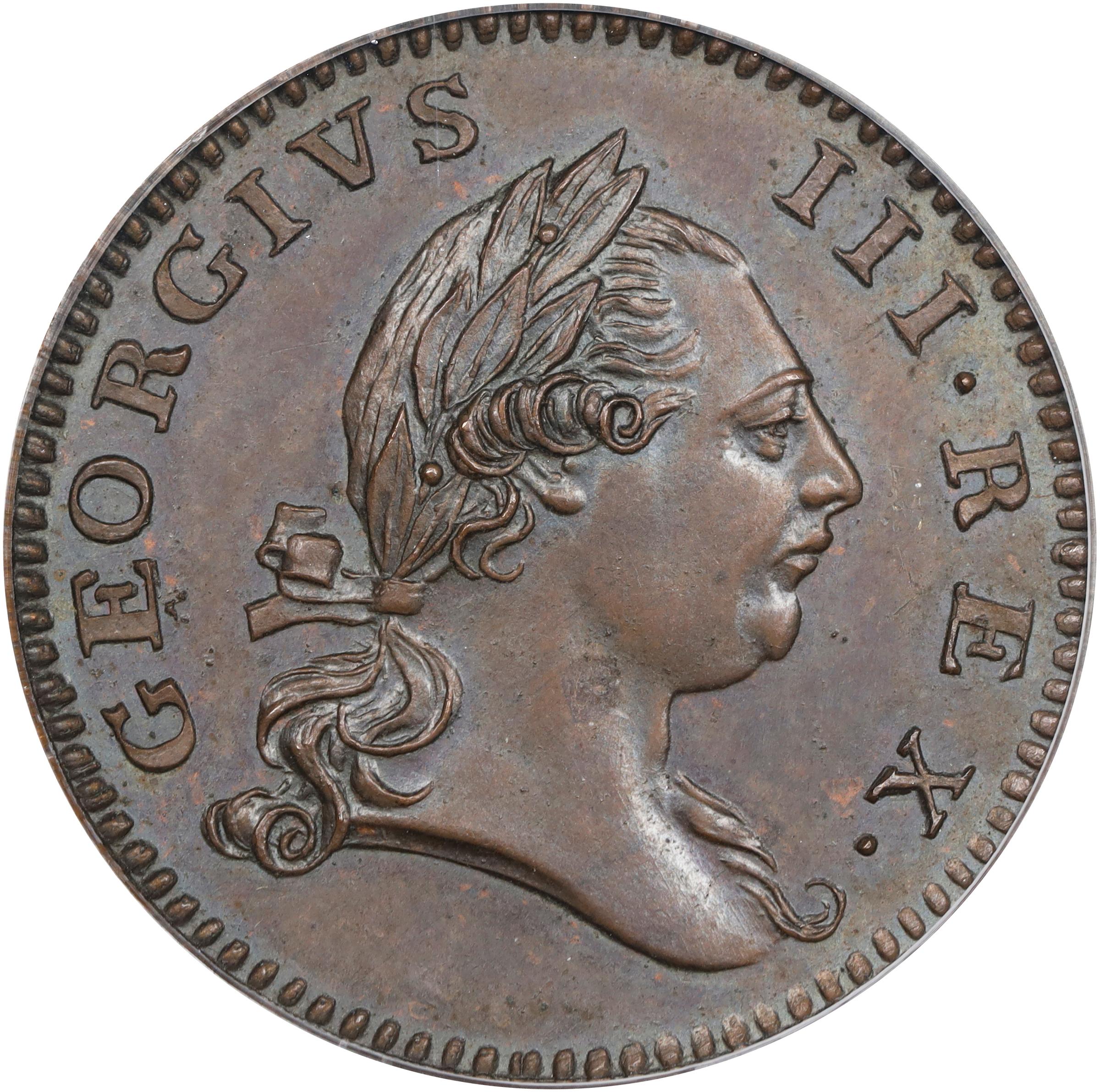
1773 'Penny' Virginia, BN PR (PCGS#246)
Summer 2025 Global Showcase Auction U.S. Coins
- Auctioneer
- Stack's Bowers
- Lot Number
- 1260
- Grade
- PR64BN
- Price
- 20,400
- Lot Description
- A very appealing specimen of an avidly sought type, the most august form of the only issue in the early American series that can be truly called a "colonial" coin. As Eric Newman stated in the opening salvo of his <em>Coinage for Colonial Virginia</em> (1956), "Virginia halfpence of 1773 have the unique distinction of being the only fully authorized coins with legal tender status which were specifically minted for all or any part of the English colonies which became the United States of America." The coins were authorized by Royal Warrant in May 1773. By July 1773, Virginia's agent in London, the merchant John Norton, reported that coinage had begun: "I have a large Quantity of Copper d[elivere]d at the Mint, which is getting ready for Coinage, but the Engraver is so dilatory that he has not furnished all the Tools. I still hope to get the Money coined in about a Month or six weeks. I gave Cap. Barron one of the p[iece]s which is the size of a Guinea, & thickness of a half Penny." While Newman posited that this description had to be one of the pieces we now call a Virginia penny, his Newman 1-A die marriage, a guinea is 25 mm in diameter, a standard Virginia halfpenny is 24.8 mm, and these impressively large "penny" pieces were struck on 27 mm planchets of the sort used on the Irish halfpence of the era.<p>By the time the coins were shipped to Virginia in February 1774, the Boston Tea Party had already happened three months earlier and the American political situation had begun to get dicey. The Virginia halfpence sat in their kegs in Williamsburg until February 1775, when thousands began to enter commerce. Thousands of others never saw the light of day until the Civil War era, when a keg (or most of one) was discovered in Richmond, which followed Williamsburg as Virginia's state capital.<p>These specially struck broad planchet Virginia halfpence or Virginia "pennies" may have been struck before the general issues, at the same time, or just slightly later; since neither the obverse nor reverse were used on regular circulation strikes, the hard data is silent on the issue. At the time, the Royal Mint did a good business striking presentation pieces, off metal productions, and patterns, and these pennies clearly found cherished places in contemporary cabinets. They are clearly products of the era, as this planchet style went out of use in 1782. Most remain high grade and attractive with a few exceptions (a worn pocket piece example is in the collection of the American Numismatic Association Money Museum, and Syd Martin owned a lovely one that was damaged in modern times). PCGS has never graded an example lower than Proof-62 BN.<p>This example shows nice medium brown surfaces with olive highlights and some reflective surface visible. The appearance is highly original, more glossy than prooflike from decades of benign neglect, an ideal situation that has left this coin well preserved. A darker area of toning is present on the king's neck, some traces of old buildup seen here and there, but no marks or hairlines are apparent. The visual appeal is superb for the grade, assigned when this PCGS Generation 3.1 holder was in use between 1993 and 1998. We've sold only two examples of the rare Virginia penny in the last five years, the Unc Details--Damaged piece, ex Martin, and a PCGS Proof-64 BN that brought $18,000 in March 2023.