1787 1/2C Massachusetts, Ryder 1-D, BN MS(PCGS#688339)
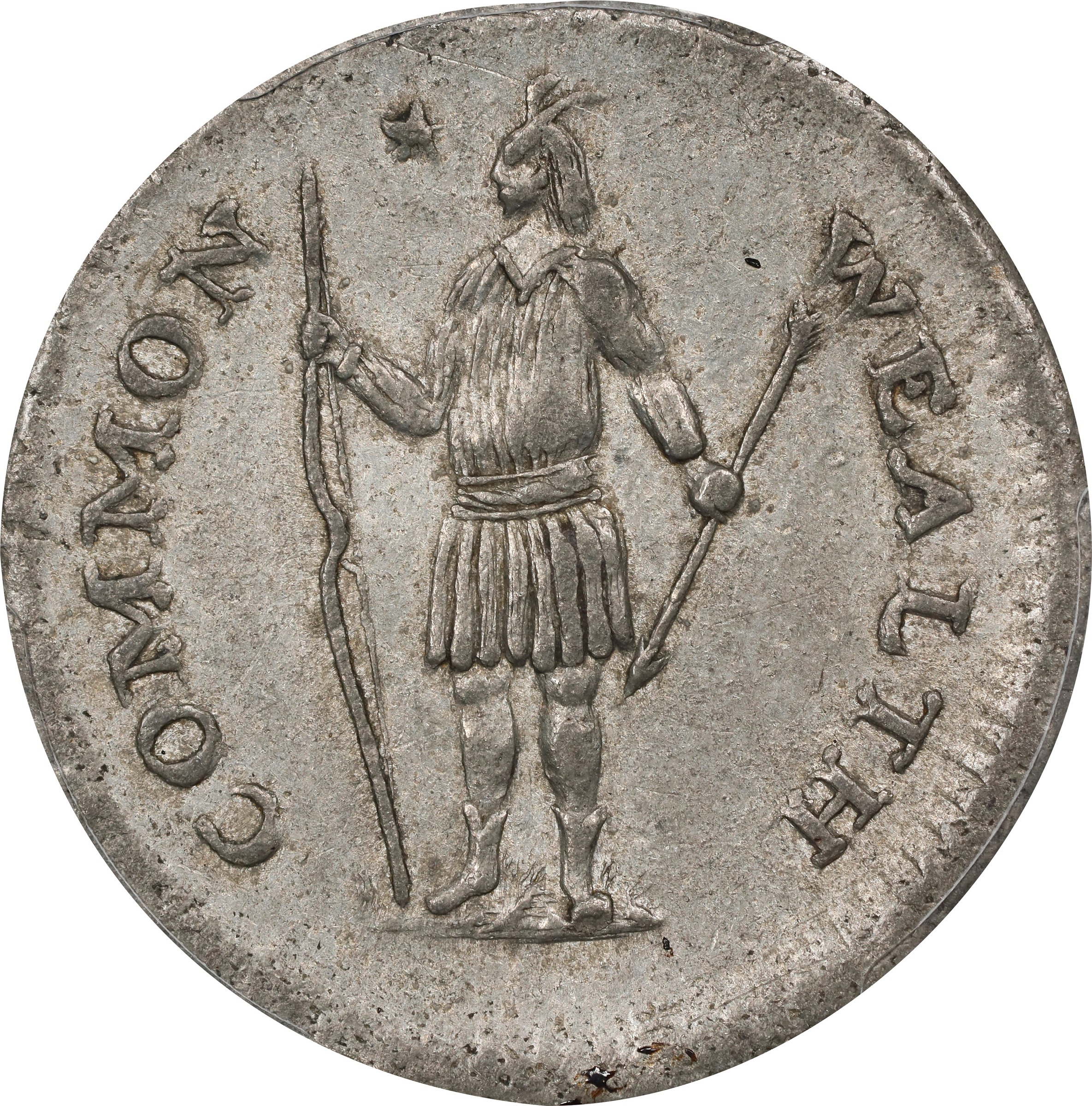
1787 1/2C Massachusetts, Ryder 1-D, BN MS (PCGS#688339)
November 2025 Showcase Auction U.S. Coins
- Commissaire-priseur
- Stack's Bowers
- Numéro du lot
- 1196
- Grade
- AU58BN
- Prix
- 78 000
- Description du lot
- 70.2 grains. The singular highlight of the Richard August Collection of Massachusetts Half Cent, the first American half cent. Struck in tin at the Massachusetts Mint from dies by Jacob Perkins, this piece is struck from an early and unlapped state of the dies. On all other specimens seen from this obverse die, the tufts of grass extending skyward from the ground have been polished away, a process that also makes the Indian's boots look separate from his ankles. Lapping or die polishing also affects the reverse in later states, creating blank spots in the wings and rendering the leaves in the olive branch appear distant from each other, but this piece was struck before that polishing was accomplished. This piece was, minimally, struck from the very earliest known die state, but we find no other examples struck from this state of the dies.<p>The surfaces remain lustrous and uncorroded, mellowed from brightness to a fine light silver gray. The devices are sharp and the surfaces are smooth, though a bit of inherent planchet roughness is noted around the reverse periphery. A single thin hairline is noted to the upper left of the feather atop of the Indian's head, some other very minor marks, nothing serious. A few specks of dark detritus cling to the surface at the very bottom of the obverse, and traces of the same substance are seen around the edge. The bifurcation, or splitting, at the bottom of the letters of the obverse legend is a often-encountered characteristic of tin struck on a screw press; it may sometimes be seen on Continental dollars and other familiar issues in this composition. The overall visual appeal of this piece is excellent, but if it was ugly it would be no less historic. Still, the fact that's it's appealing is an added bonus.<p>In his 1988 <em>Encyclopedia</em>, Walter Breen listed this coin as Breen-965, describing it as "1787 half cent. Same. 'White metal' (tin?) trial piece. Unique. 'Ryder 7-D.' Discovered by Richard August." Michael Packard seems to have made the first reference to this piece in print in the May 15, 1986 issue of <em>Penny-Wise</em>. Mr. August was a big cagey about displaying this piece (most of his coins, even), and for many years rumors swirled about its authenticity. Upon seeing this coin in hand for the first time, your cataloger had absolutely no doubts, and it has since been confirmed by PCGS and others. As Breen noted, this is struck in what appears to be pure tin. This soft metal has long been used by coiners for proofs, trials, splashers, cliches, and all the other sorts of ephemeral trial strikes meant to serve a singular and temporary function in the die sinking process: to show the die sinker how a positive impression of the dies looks before full scale coinage (at usual striking pressure) begins.<p>The half cent denomination was first made manifest by the Commonwealth of Massachusetts. The authorizing legislation for the Massachusetts Mint, passed on October 17, 1786, stated the mint would coin cents and half cents. This legislation was passed one day after the Continental Congress passed an ordinance authorizing a Federal mint and the half cent denomination. The half cent was first authorized by the Continental Congress in July 1785, but the October 16, 1786 resolution confirmed that there would be "two copper coins ...as follows: One equal to the one hundredth part of the federal dollar, to be called a cent: And one equal to the two-hundredth part of the federal dollar to be called a half cent." Massachusetts took the hint, and they quickly hired the local genius Jacob Perkins to engrave the dies.<p>It is reasonable to assume that Joseph Callender, who engraved and sunk these dies, struck this piece. We wish Mr. August had left the story of how he acquired this coin, but we can only imagine that his boundless energy for hunting down unusual early American coins all over New England beginning in the early 1960s was the beginning of its story of discovery. Dick always knew this coin was important, and he always knew it was real. We wonder if he considered just how special this piece really is. As the earliest trial strike known from an official American mint, it takes on immense importance. But as the very earliest half cent struck anywhere, this piece becomes the Big Bang for an entire enthusiastic fraternity of American collectors. As the urtext of an entire denomination, this piece must be considered one of the most important Massachusetts coins extant and a magnificent highlight of this unforgettable collection.