1933 $10 MS(PCGS#8885)
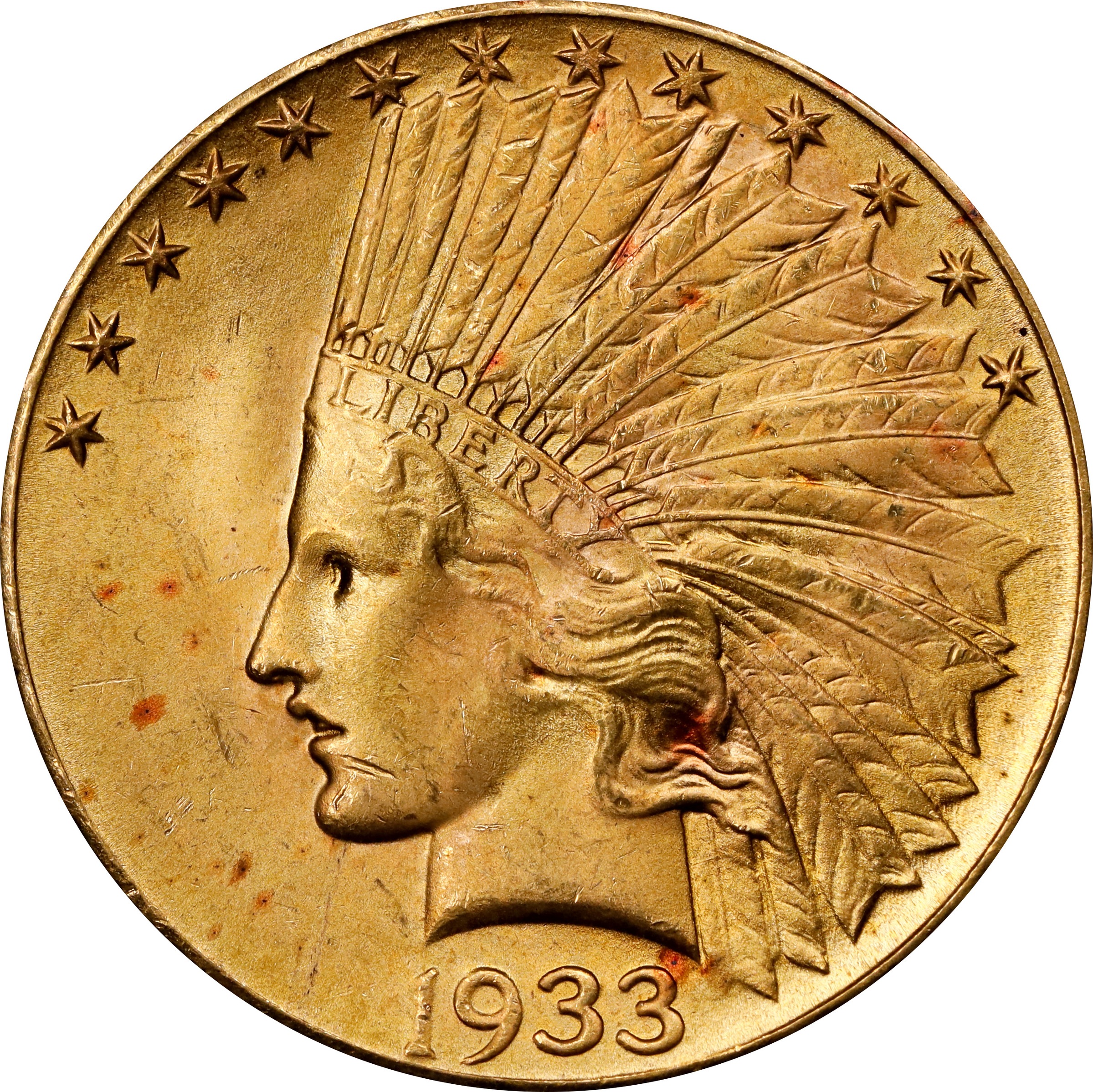
1933 $10 MS (PCGS#8885)
February 2026 Showcase Auction - The James A. Stack, Sr. Collection Part II
- Auktionator
- Stack's Bowers
- Losnummer
- 23041
- Erhaltungsgrad
- MS66
- Preis
- 960.000
- Losbeschreibung
- Our first offering for this landmark issue in the Indian eagle series in more than a decade, this is a numismatic treasure of the utmost significance that combines absolute and condition rarity into an irresistible package for advanced 20th century gold collectors. Undeniably original surfaces boast full, billowy, satin-textured luster and dominant golden-apricot color. The strike detail is impressively sharp throughout - virtually complete, in fact - and allows full appreciation of this classic 20th century gold design. Both sides show light, scattered alloy spots, as well as a few handling marks, one of the latter on Liberty's chin serving as the most useful identifier for provenance purposes.<p>Trailing only the 1907 Rounded Rim, the 1933 is the second rarest issue in the challenging Indian eagle series. It is also one of the most famous and eagerly sought issues in all of U.S. numismatics, linked by date to, and sharing much of its history with, the legendary 1933 Saint-Gaudens double eagle. David E. Tripp, author of <em>Illegal Tender: Gold, Greed, and the Mystery of the Lost 1933 Double Eagle </em>(2004) has done in-depth research and written extensively on both issues. He contributed a detailed history of the 1933 eagle to the catalog description for our (Stack's) October 2004 sale of what was then the finest certified example (NGC MS-66, lot 2190). Tripp breaks down the 312,500-piece mintage of the 1933 eagle into six transfers from the coiner's department in the Philadelphia Mint to the cashier: 50,000 coins on January 19, 1933; four additional deliveries of 50,000 coins each between February 3, 1933 and March 3, 1933; and a final delivery of 62,500 coins between the same February and March dates. 312,000 of these coins were sealed in the Mint's Vault F, 12 were destroyed through "special assays", nine were destroyed during the 1934 Annual Assay, 304 examples previously set aside for assay were not destroyed and subsequently returned to the cashier and, from the first 50,000-coin delivery on January 19, 100 were sent to the treasurer for sale to the public. Since those 100 examples were considered as having been issued for circulation, the 1933 eagle thereby gained the important status denied to the 1933 double eagle; the 1933 eagle as an issue became legal to own whereas, much later, the federal government deemed only one example of the 1933 double eagle legal to own. <p>When Franklin Delano Roosevelt issued Presidential Proclamation 2039 on March 6, 1933, banning both the paying out of gold by official institutions and hoarding of gold, and beginning the recall of privately owned gold, only four of the 100 1933 eagles from the January 19 delivery sent to the treasurer had been sold. A fifth example was released just five days prior to the Presidential Proclamation, as reported in a letter by David Tripp printed in the November 15, 2004 issue of <em>Coin World</em>:<p><em>On March 1 [1933], the last (not the first) known authorized release of a 1933 eagle was made, not from the treasurer, but from the cashier's window in the Philadelphia Mint. Thus, the records indicate a total of five 1933 eagles found circulation through official channels.</em><p>The rest of the outstanding mintage, including the 312,000 coins sealed in the Mint's Vault F - 99.84% of the mintage - is presumed to have been destroyed through melting and, in David Tripp's words, "rendered into ingots, and shipped to Fort Knox." Yet how, then, do we explain the existence of more than five 1933 eagles today? Survivors are rare, to be sure, with Q. David Bowers providing an estimate of 45 to 60 in his 2017 reference <em>A Guide Book of Gold Eagle Coins</em>, and <em>PCGS CoinFacts</em> taking an even more conservative approach with just 30 to 40 believed extant. The answer is the same as for the 1931 and 1932 double eagles offered in our December 2025 sale of the James A. Stack, Sr. Collection, as well as the 1933 double eagle that Mr. Stack acquired at the same time but which was seized by the Secret Service on June 20, 1945. In fact, the Secret Service investigation into the 1933 double eagle during the 1940s also focused on the 1931 and 1932 double eagles and 1933 eagles in the hopes of discovering the channels through which examples of all these issues found their way into the hands of contemporary numismatists. The investigators eventually identified Philadelphia jeweler Israel Switt as the primary conduit. As the owner of a shop on "Jewelers Row" in Philadelphia and a depositor of scrap gold, Switt had developed close ties to a number of employees at the United States Mint, especially Mint Cashier George A. McCann, from whom he obtained 1931, 1932, 1933 double eagles and 1933 eagles for the coin trade.<p>Dave Bowers, however, suggests that Switt may not have been the only source for these coins, as related in his 2017 <em>Guide Book of Gold Eagle Coins</em> authored for Whitman:<p><em>Most [1933 eagles] were probably taken from Mint or Treasury holdings by government employees. Or, perhaps most were exchanged for common coins by Mint employees, who then sold them to coin dealers, as was done with 1933-dated double eagles.</em><p><em></em><em>Among numismatists with a supply was F.C.C. Boyd, the New York City coin dealer, collector and business executive. Abe Kosoff recalled that in the late 1930s there was a steady stream of Treasury employees coming to New York City with scarce and rare gold coins that they had exchanged for common issues - a win-win situation for all concerned. Otherwise the 1933 eagle would be a formidable rarity.</em><p>On the other hand, the two 1933 eagles that Boyd purchased from Philadelphia coin dealer James G. Macallister originated with Switt, so at least some of these other avenues also led back to the man with the shop on "Jewelers Row." Interestingly, Boyd and Macallister donated one of these two coins to the Smithsonian Institution to correct an oversight when Mint Director Nellie Tayloe Ross' order of late 1934 for the Mint to forward examples of both the 1933 double eagle and 1933 eagle to the National Coin Collection were not carried out with regard to the eagle.<p>Mr. Stack almost certainly acquired his 1933 eagle around the same time he obtained his 1931, 1932 and 1933 double eagles in 1943, with either the McCann-Switt or a similar relationship the original source from the Mint. Making its first appearance in the modern numismatic market, the Stack coin was certified MS-66 by PCGS ahead of this landmark offering. It is tied for CC#2 coin for the issue behind the PCGS MS-66+ that last appeared in Ira & Larry Goldberg's June 2016 auction (certified PCGS MS-66 at that time). The only other MS-66 certified, at NGC, was the front cover coin - and lot 2190 - in our (Stack's) 69th Anniversary Sale of October 2004, for which David Tripp contributed his excellent research and writing to the description. With strong eye appeal and the equally strong aura that surrounds all key date gold issues in the classic U.S. Mint series, this leading highlight of the James A. Stack, Sr. Collection will also serve as a centerpiece in the next world-class numismatic cabinet in which it is included.