1795 $10 13 Leaves MS(PCGS#8551)
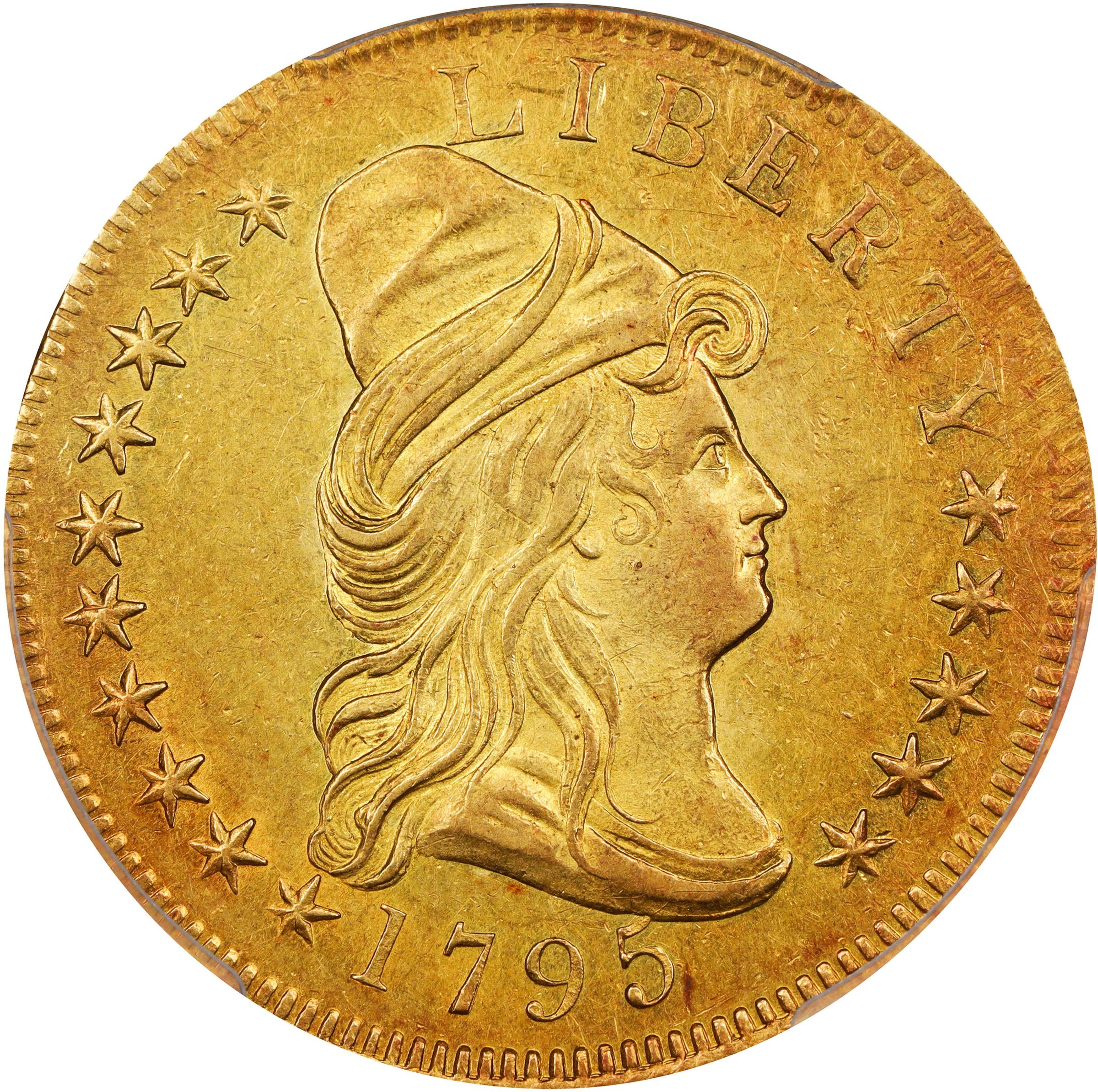
1795 $10 13 Leaves MS (PCGS#8551)
Summer 2025 Global Showcase Auction U.S. Coins
- Auktionator
- Stack's Bowers
- Losnummer
- 3199
- Erhaltungsgrad
- AU58
- Preis
- 120.000
- Losbeschreibung
- This is a handsome Choice AU quality 1795 eagle, a perennially popular early gold issue. Otherwise deep honey-gold surfaces are accented with vivid rose and deeper olive highlights, the former most pronounced around the peripheries. Overall detail is uncommonly sharp with all major design elements bold and the denticulation mostly complete, although it is broken by light adjustment marks (as made) at the upper right obverse and lower right reverse. The eagle's head, breast, legs and talons are particularly noteworthy for the crispness of detail they possess, as many coins of this type are soft in one or more of these areas. Attenuated outer star points are due to lapping of the obverse die - a diagnostic of this BD number. A few wispy hairlines are noted for accuracy, but there are no sizable handling marks, and the appearance is impressively smooth overall. Aesthetically pleasing and of profound historical significance, this coin is highly recommended for an advanced numismatic cabinet. BD Die State e/c.<p>As the first eagle struck in the United States Mint, the popularity of the 1795 with collectors knows no bounds. The Act of April 2, 1792, which established our nation's monetary system, named the ten-dollar gold eagle as the highest denomination. As specified in that Act, the weight of these early eagles is 17.50 grams (270.0 grains) standard and 247-4/8 grains pure (i.e., unalloyed metal). These specifications made the first eagles 11/12 fine, with 11 parts pure gold to one part alloy, the latter mixed with the precious metal to improve the coin's wearing qualities when used in commerce.<p>The design of the Capped Bust Right eagle is credited to Robert Scot, first chief engraver of the United States Mint. Initially the $10 gold eagle featured a small eagle with outstretched wings perched on a branch on the reverse, although this was replaced in 1797 by a heraldic eagle motif. Small Eagle Capped Bust Right tens were produced for only two years, from September 1795 to June 1797, although three dates are represented (1795, 1796, 1797). More than half of the mintage of this type was from 1795-dated dies, most examples of which were probably struck from the variety now known as BD-1. In the 2006 reference <em>Early U.S. Gold Coin Varieties: A Study of Die States, 1795-1834</em>, John W. Dannreuther confirms that the BD-5, offered here, is the scarcest attributions for the 13 Leaves <em>Guide Book</em> variety of this issue with only 35 to 45 survivors in all grades. Given the ever-increasing number of advanced type collectors and early gold enthusiasts and the significance of this first year ten-dollar issue, the 1795 eagle as an issue is very scarce in an absolute sense. Examples are rare from a market availability standpoint, given that most spend years, if not decades, in tightly held collections. This important bidding opportunity is sure to result in strong competition.