1796 1/2C With Pole, BN MS(PCGS#1027)
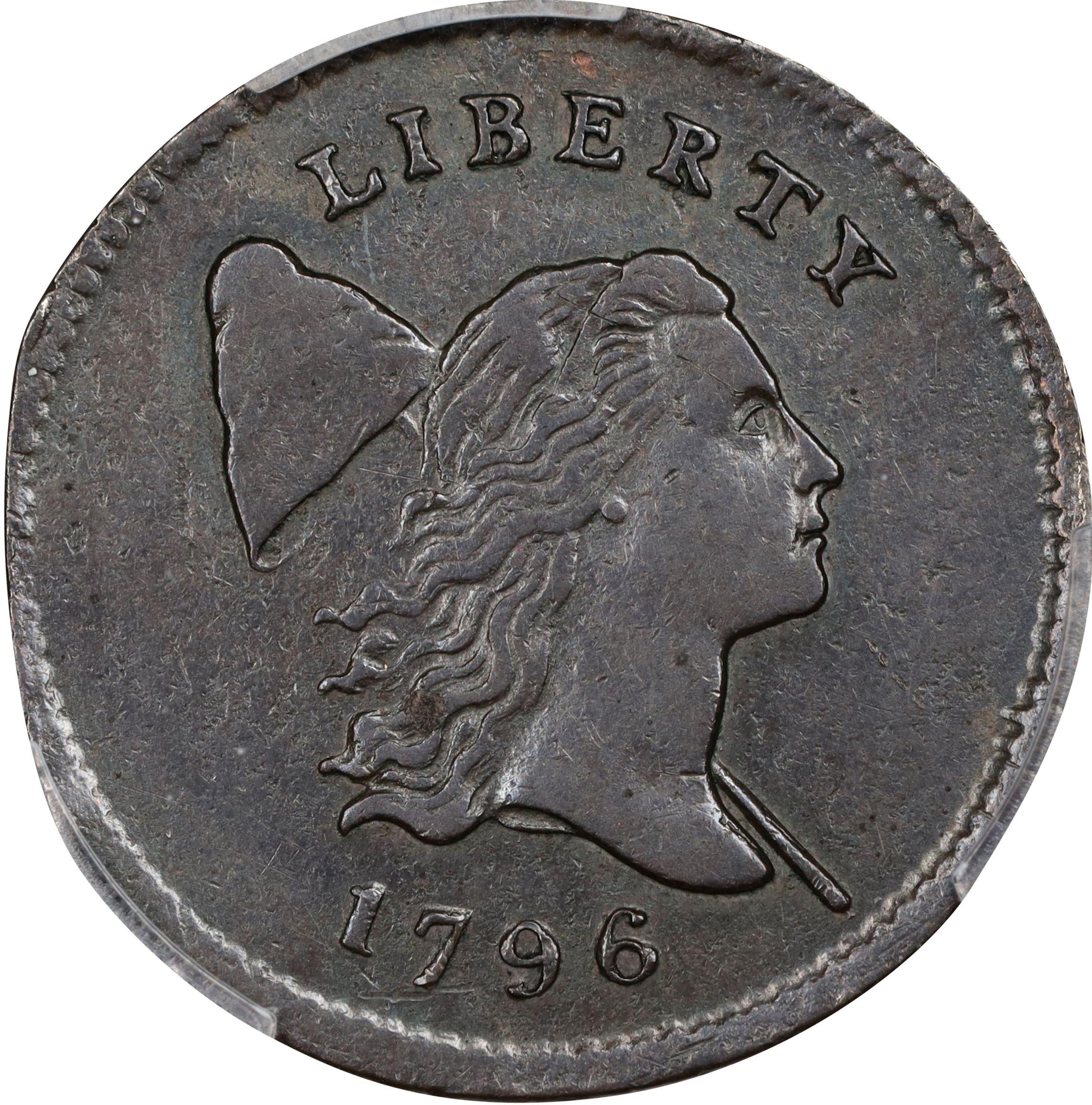
1796 1/2C With Pole, BN MS (PCGS#1027)
Summer 2025 Global Showcase Auction U.S. Coins
- Auctioneer
- Stack's Bowers
- Lot Number
- 3002
- Grade
- AU55BN
- Price
- 78,000
- Lot Description
- Any 1796 half cent is a coin of importance. The issue holds a place of legendary esteem among rare early American coins, and a specimen in any grade is cherished.<p>But not all 1796 half cents look like this one.<p>Not all 1796 half cents show a portrait of Liberty that is fully realized and expressive, fully struck up within a perfectly centered frame of denticles on an appealing planchet. Few show this kind of sharpness, preservation, and eye appeal. Only a small proportion, in this grade or any other, can claim rich color and problem-free surfaces. And only a precious handful can approach this high grade. This is a very special half cent indeed.<p>Both sides are toned a rich chocolate brown, enlivened by complimentary tones of sedate olive around design elements, a shade that emerged as the last mint color gently faded. Both sides are appealingly smooth and glossy, a triumph at a time the Mint's copper acquisition and processing was touch and go at best. The surfaces are even in texture and color, indicating a professionally rolled planchet and proper preservation since striking. Despite the against-all-odds excellence demonstrated by the employees of the First United States Mint, their technology and processes still had their limitations, and the coins they created were still ultimately handcrafted one at a time. The planchet upon which this coin is struck shows a straight clip at its left, more accurately called an incomplete planchet, a relic of a Mint worker sending sheet copper through a blanking press by hand. In an effort to conserve scarce resources and reduce waste, the planchets were cut as closely as possible to each other. This planchet came from the end of one of those strips, a relic of the people-powered efforts each of these coins represents. From an aesthetic perspective, it harms nothing and interrupts only the peripheral denticles, which otherwise brilliantly frame the designs on both sides with ideal centering and a perfect impact from the dies.<p>The surfaces are nearly smooth, with magnified scrutiny showing just trivial scattered imperfections and a few subtle fissures beneath the letters LIB and R in LIBERTY, leftovers from microscopic bubbles in a copper ingot being rolled into striations when a cast copper ingot became planchet stock in a rolling mill. Both sides are free of granularity, either the sort that is inherently in a planchet at the time of coining or the kind that comes from environmental exposure in the days since. Of course, the latter is often called the former, but this coin, blessedly, has neither. Nor does it have significant marks or injuries from its brief stay in circulation, or from mishandling during the nearly 175 years when this has been a valuable, collectible object. Spenders sometimes damage coins quite accidentally, and collectors, even those with the best of intentions, sometimes damage coins intentionally. This has seen neither. We note a short diagonal nick at the base of the digit 7 in the date and a single nearly invisible hairline scratch on Liberty's forehead that extends into the hair.<p>The visual appeal of this coin is superb, essentially unimprovable at this grade level. This is precisely why it was depicted on the cover, front and center, of one of our firm's most legendary offerings of a famously high-quality cabinet. The James A. Stack, Sr. name has long been associated by savvy collectors with a high level of connoisseurship, an exacting taste for the best coins. In the first of several auctions over the years in which Stack's offered sets from the James A. Stack, Sr. collection, the 1975 sale of his quarter and half dollars, the introduction noted "when Mr. Stack began his collecting activities almost forty years ago...he took full advantage of opportunities presented by the dispersal of such outstanding collections as those formed by Neil, Atwater, Dunham, Hall, and Colonel Green, to name only a few. As a result all the great rarities are here, in addition to many of the 'finest knowns.'" Stack was a perfectionist and a quality fanatic when few collectors approached their acquisition process that way. He was buoyed by fortuitous timing. During the era of Stack's principal acquisitions, many of the best United States coins flooded into the market, as rarities from cabinets like Newcomer, Brand, and Green found new homes via both public auction and private treaty. And while we don't know precisely where Stack acquired this coin, a famous earlier appearance gives us a very likely scenario.<p>When William Baldwin Guy of Middletown, Connecticut was born, half cents were not only still circulating, they were still being made. He became a successful druggist and an advanced numismatist, turning his attention to detail and practiced scientific precision to his avocation just as he did his vocation. "The late W.B. Guy has been favorably known to American collectors and dealers for many years," wrote Henry Chapman in 1911, just a few months after Guy's death, noting he was a "close student of the die varieties of the American colonial coins, United States cents and half cents." His collection of coppers from his native Connecticut numbered 178 pieces, and his collection of large cents included over 560 individually offered pieces, mostly different varieties, both stunning achievements in their era. And despite all of the superb large cents he had, none of them - including not one of the 17 1793 cents he amassed - sold for even half as much as his single best half cent, which brought an impressive $105. His best half cent was this coin.<p>When Henry Chapman had his chance to catalog this piece in 1911, he described it as follows:<p><em>Sharp, even impression, with broad surface outside milling; this is slightly straightened behind head, probably owing to its being the last example cut out by the planchet die. Olive color. Excessively rare.</em><p>The coin sold for $105 to Elmer Sears, a Massachusetts dealer who decided one year later to become the financial backer of a young man named Wayte Raymond as he founded a new firm, United States Coin Company. Sears was a major supplier of coins to "Col." E.H.R. Green, who was also living in Massachusetts, but many of his coins ended up trading hands via his young protege Raymond as well. Where this coin resided between 1911 and its acquisition by James A. Stack, likely in the late 1930s or early 1940s, is unknown, but the timing of its absence generally lines up with the years Green collected. The Green material was dispersed during the years of Stack's most vigorous acquisitions.<p>When we offered this coin in 2020, more than five years ago, the PCGS population in this grade was the same: five certification events at AU-55. Since that time, the population data in higher grades reflects two additional certification events, though the verifiable population of actual coins in high grades seems to be the same. The last high grade discovery known to us is a Mint State example offered by the auction house Woolley and Wallis in Salisbury, England in 2013. Many of the highest grade 1796 half cents have little provenance history, being discovered rather anonymously in the United Kingdom after these small coins became hugely valuable. This one, in addition to its history as a half cent made for circulation, wears the added laurel of a history in American collections spanning back over a century. It was cherished then just as it's cherished now, and we're fortunate to again be a part of this coin's still-growing legacy today.